
Iguazú National Park
25.6834° S · 54.4548° W · National Park
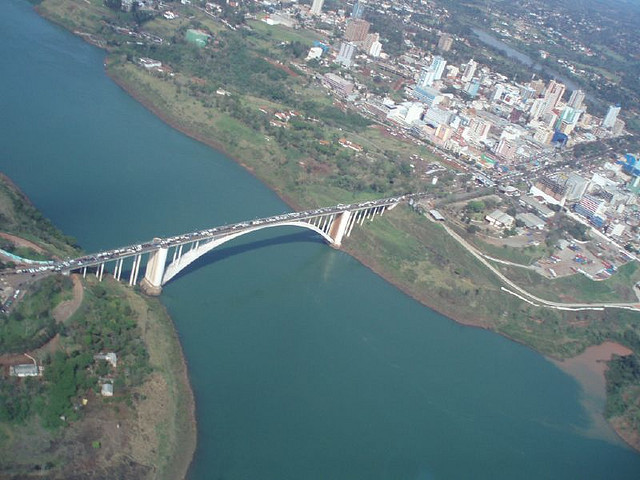
Photo: Martin St-Amant (S23678) · CC BY-SA 3.0 · Wikimedia Commons
Iguazú National Park is a national park in Misiones Province, Argentina. Argentina created the national park in 1934. The free Lokali audio guide runs 8 minutes.
✓ Published October 2026 · how we write these guides
Visitor facts
| Lokali audio guide | 8 min · free |
|---|---|
| Type | National Park |
| Location | Puerto Iguazú, Argentina |
| Coordinates | -25.6834, -54.4548 |
| Official website | iguazuargentina.com |
| Languages | 50+, in the Lokali app |
The story
Listen first. Before you see anything, there is a low roar under the trees. It is steady and deep, like distant traffic that never stops. The air feels heavy and warm on your skin, and it smells of wet leaves and red earth. Butterflies drift across the path, some of them yellow, some bright orange. Somewhere ahead, water is falling in enormous amounts. You are on the edge of the subtropical forest in Argentina's far northeast, and every step brings that sound closer.
This is Iguazú National Park, in the province of Misiones. Argentina created the park in 1934 to protect both the falls and the forest around them. In 1984, UNESCO listed it as a World Heritage Site. Across the river lies Brazil, with its own protected park on the other bank. The Iguazú River forms the border here. Not far downstream, it joins the Paraná River near the point where Argentina, Brazil, and Paraguay meet.
The name comes from Guaraní, the language of the Indigenous people of this region. It is usually translated as "big water." Once you reach the first viewpoint, that name feels like an understatement. The falls are not one single curtain of water. They are a long, broken chain of cascades, spread along a curving cliff for nearly three kilometres. The count changes with the seasons, but people commonly cite around 275 individual falls. In the rainy months they merge together. In a dry spell, gaps of rock and green appear between them.
Why does the river drop here at all? The answer is under your feet. This land sits on thick layers of dark basalt, a volcanic rock formed by ancient lava flows. Over a very long time, the river cut back into these layers and left a series of steps and ledges. Look at the cliff faces between the cascades. You can see the horizontal bands of rock, stacked like the pages of a closed book. The water is still slowly wearing them away.
The Guaraní tell a different story. Legend has it that a giant serpent god, called M'boy, lived in the river. A young woman named Naipí was promised to him. But she fled in a canoe with a young warrior, Tarobá. In his anger, the serpent split the riverbed and created the falls to trap them. According to the tale, Naipí became a rock at the foot of the falls. Tarobá became a palm tree on the edge above. Rainbows in the mist, locals say, are the two lovers reaching for each other.
The first European to describe the falls in writing was the Spanish explorer Álvar Núñez Cabeza de Vaca, in the sixteenth century. He crossed this region on foot on his way toward Asunción. For the Guaraní, of course, the falls were already very old news. Later, Jesuit missions spread across this part of South America. Their ruins still stand elsewhere in Misiones province, and they are one reason the province carries its name.
Most visitors explore the park on a network of metal walkways and forest trails. The Upper Circuit runs along the top of the cliff. Here you walk right above the edge, and the water slides under the grating beneath your shoes. The Lower Circuit drops down through the forest. It gives you wide views of the falls from below, with spray drifting across the path. The two routes feel very different, so it is worth doing both.
And then there is the Devil's Throat, or Garganta del Diablo in Spanish. A small narrow-gauge train carries visitors through the forest toward it. From the last station, a long walkway crosses the wide, calm upper river. For a while, it feels almost peaceful. Then the sound grows, and a cloud of white mist rises ahead. At the end, you look down into a horseshoe-shaped chasm. Much of the river pours into it at once. You will probably not hear the person beside you.
Here is a detail many visitors miss. Watch the air above the Devil's Throat. Small dark birds flash through the spray and dive straight into the falling water. These are great dusky swifts. They nest on the wet rock behind the cascades, in places no predator can reach. They fly through the curtain of water to get home. Once you notice them, you see dozens of them, moving in and out of the mist like dark sparks.
The forest itself deserves your attention too. This is part of the Atlantic Forest, a type of rainforest that once covered huge areas of Brazil, Paraguay, and Argentina. Much of it has been cleared, and this park protects one of its largest surviving pieces. Look for toucans with their heavy orange bills, and for lizards on warm railings. The animal you will definitely meet is the coati. It has a long ringed tail and a pointed nose, and it has learned that tourists carry food.
A second surprise is easy to overlook. Some of the most beautiful moments here are not at the big viewpoints. They happen between them, on quiet stretches of trail. Stop for a moment. You will hear frogs, insects, and birds over the steady roar. Notice the plants growing on other plants, such as orchids and bromeliads clinging to the branches. The mist from the falls keeps this whole edge of the forest damp, so moss and ferns cover almost every surface.
A story often told about this place involves Eleanor Roosevelt, the wife of the American president. When she saw the falls, she is said to have exclaimed, "Poor Niagara!" Nobody can say for certain whether she really said it. But the comparison is understandable. Niagara is one strong, single drop. Iguazú is something else: a wide horizon of water, broken into hundreds of pieces, with forest growing between them. It does not fit easily into one photograph, or even ten.
On a sunny afternoon, rainbows appear almost everywhere the mist rises. They shift as you walk, so each viewpoint shows a new one. Your clothes will probably be damp by now. Your shoes may be wet too. That is part of the experience. The falls do not let you stay a distant observer for very long. Sooner or later, the water reaches you.
Before you leave, pause at the railing one more time. Look at a single cascade, and follow one stream of water from the edge down into the white foam. It has travelled a long way to get here, and it will keep moving long after you go. As you walk back along the trail, the roar will slowly fade behind the trees. Listen for the moment it disappears. Then notice the butterflies, the red earth, and the warm air again.
Key facts
What to look for
Practical tips
Common questions
Is there a free audio guide to Iguazú National Park?
Yes — the Lokali app narrates Iguazú National Park free of charge in 50+ languages. The guide runs about 8 minutes, covers the history, what to look for on site and practical tips, and works offline once downloaded.
Where is Iguazú National Park?
Iguazú National Park is near Puerto Iguazú, Argentina, at -25.6834, -54.4548. Tap the map link on this page for directions from where you are.
What is Iguazú National Park known for?
Argentina created the national park in 1934. UNESCO listed the park as World Heritage in 1984.
What should you look for at Iguazú National Park?
Dusky swifts diving straight through the falling water. Horizontal bands of dark basalt in the cliff faces. Rainbows shifting in the mist on sunny afternoons.
What should you know before visiting Iguazú National Park?
Do both the Upper and Lower Circuits for contrast. Bring a rain poncho for the Devil's Throat walkway.
When is the best time to visit Iguazú National Park?
Arrive early to reach the Devil's Throat before crowds.
On the map
Opens directions to Iguazú National Park from your location.
More to see near Iguazú National Park
Hear Iguazú National Park in your language
The full story, narrated, in 50+ languages. Download it before you go and it plays offline, at your own pace, with no ticket and no tour group.