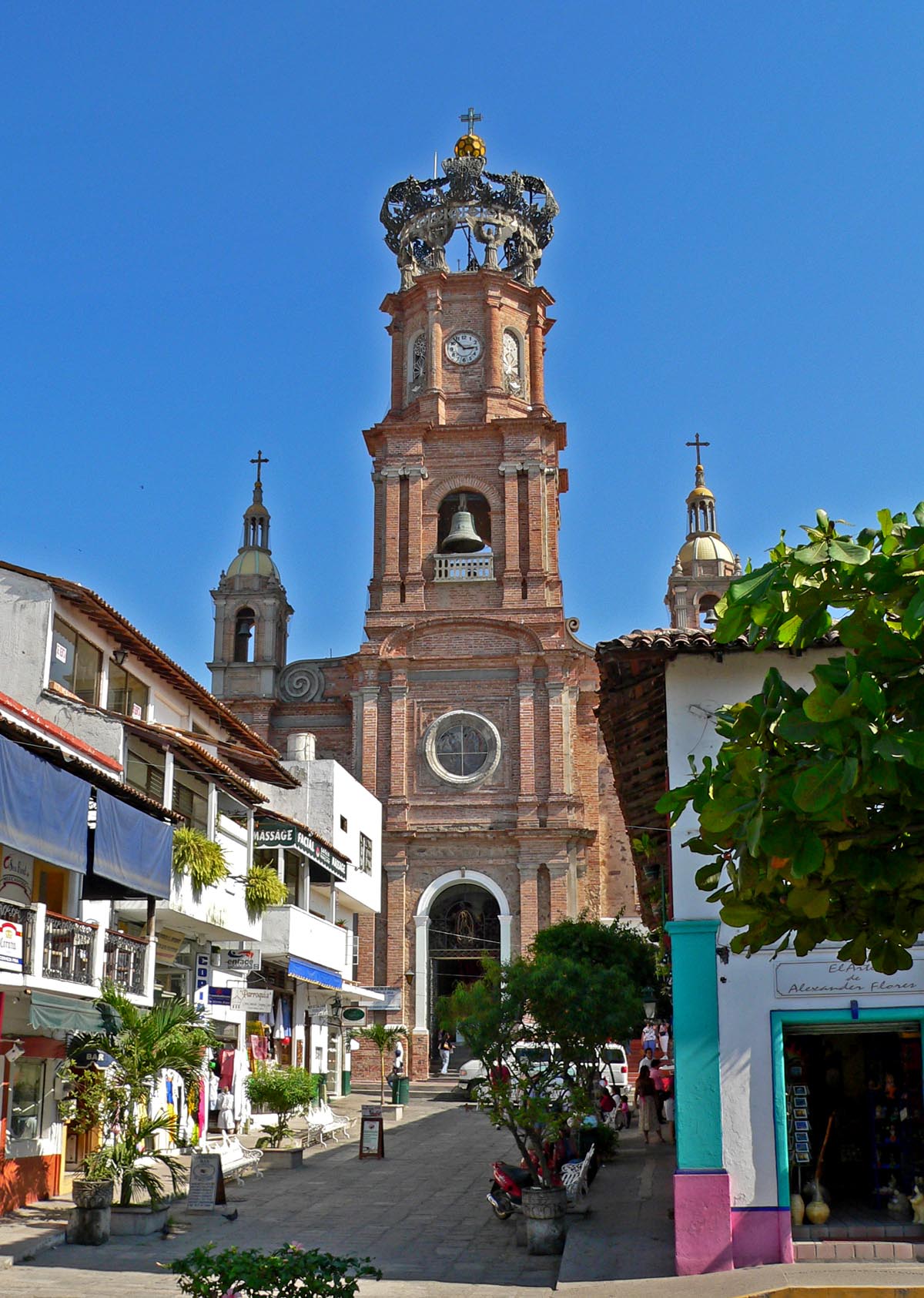
Iglesia de Guadalupe
20.6245° N · 105.2717° W · Cathedral
Iglesia de Guadalupe is a 19th-century parish church with an unmistakable crown-shaped spire that dominates the Old Town skyline. It is in Puerto Vallarta, Mexico. Most visitors spend 20–30 min here. The free Lokali audio guide runs 5 minutes.
✓ Verified August 2026 · how we write these guides
Visitor facts
| Time needed | 20–30 min |
|---|---|
| Lokali audio guide | 5 min · free |
| Type | Cathedral |
| Best for | History |
| Location | Puerto Vallarta, Mexico |
| Coordinates | 20.6245, -105.2717 |
| Languages | 45, in the Lokali app |
The story
Step in from the bright street and the air turns cool. Light falls through tall windows onto pale stone. Candles flicker near the altar. Somewhere a few quiet voices pray. Above the doors of this church rises a great crown of stone and metal, the best-known shape in all of Puerto Vallarta.
This is the Parish of Our Lady of Guadalupe. It stands a few blocks back from the sea, in the old heart of the town. Its tower and crown rise high above the low roofs around it. Narrow streets lead toward it from every side. From many points in the city, and even from boats on the bay, you can find the church by looking for that crown.
The church is named for Our Lady of Guadalupe, who holds deep meaning across Mexico. The first place of worship on this spot was small and plain. It was a simple chapel set up on April 15, 1883, by a priest named Sabino Virute. For years it served the families of what was then a small settlement.
As the town grew, the people wanted a larger church. New foundations were laid in 1903. Then, on October 12, 1921, work began in earnest on the building you see today. It would not be quick or easy. The church rose slowly, over many decades, through hard times.
The work was soon interrupted. In 1926 a conflict known as the Cristero War broke out across Mexico. It set the government against the Catholic Church, and building stopped. The war ended in 1929. Only in 1930 could work on the church begin again.
Through the following years the building slowly took shape. The dome was raised and completed. By 1940 the main body of the church was finished, though the towers were not yet done. The tall main tower above the bell area was not completed until 1955. Stone by stone, across more than thirty years, the church was patiently made whole.
Then came its crown. The great crown above the tower was built in 1963 and set in place in 1965. It was drawn by a priest named Rafael Parra Castillo, who also shaped the tower beneath it. The sculptor Jose Esteban Ramirez Guareno gave the design its final form. Some in the town say the crown recalls the crown of a European empress who once ruled Mexico, though this is more a local story than a settled fact.
The crown has not always stood unchanged. In 1995 an earthquake shook the region and damaged the original. The crown that rises over the church today is a newer one. It was made by the artist Carlos Terres and put in place in 2009. From the street below, the join of old and new is hard to see. The shape feels timeless.
Step inside and let your eyes adjust to the dim light. The interior is calm and high, and the air is cool. Rows of wooden benches lead in straight lines toward the altar. Above and around the altar, gold and warm color catch the light from the windows. Statues and paintings line the walls. People come not only to look but to pray, and it is good to move softly here.
Near the altar you will find the image of Our Lady of Guadalupe. For believers, this image is the center of the whole building. Candles burn before it. Flowers are often laid nearby. Even visitors who do not share the faith can feel the weight of devotion that fills this corner of the church.
The church is busiest each December. In the days before the twelfth of that month, the streets around it fill with processions. Groups from across the town walk to the church in honor of Our Lady of Guadalupe. Workers, schools, and whole families take their turn over many days. There is music, there are candles, and the doors stay open late into the night.
Outside again, cross the street and look up. The crown sits against the sky, held above the town as it has been for decades. It survived a long, broken construction. It survived war and earthquake. And still it rises, plain and strong, over the rooftops and the bay beyond.
Stand here a moment before you move on. This church was built slowly, by many hands, across a hard century. It carries the patience of all those years. Look once more at the crown, then carry its quiet shape with you into the bright streets outside.
Key facts
What to look for
Practical tips
Common questions
How long do you need at Iglesia de Guadalupe?
Plan 20–30 min. That is the time most visitors spend at Iglesia de Guadalupe. The free Lokali audio guide adds about 5 minutes of narration you can listen to as you walk, so it fits inside your visit rather than adding to it.
Is there a free audio guide to Iglesia de Guadalupe?
Yes — the Lokali app narrates Iglesia de Guadalupe free of charge in 50+ languages. It covers the history, what to look for on site and practical tips, and it works offline once downloaded.
Where is Iglesia de Guadalupe?
Iglesia de Guadalupe is in Puerto Vallarta, Mexico, at 20.6245, -105.2717. Tap the map link on this page for directions from where you are.
What should you know before visiting Iglesia de Guadalupe?
Dress modestly and enter quietly during prayer.
What is Iglesia de Guadalupe known for?
The first chapel here was founded on April 15, 1883.
What is the best time to visit Iglesia de Guadalupe?
The crown was inspired by a vision of the Virgin Mary.
On the map
Opens directions to Iglesia de Guadalupe from your location.
More to see in Puerto Vallarta




Hear Iglesia de Guadalupe in your language
The full story, narrated, in 50+ languages. Download it before you go and it plays offline, at your own pace, with no ticket and no tour group.