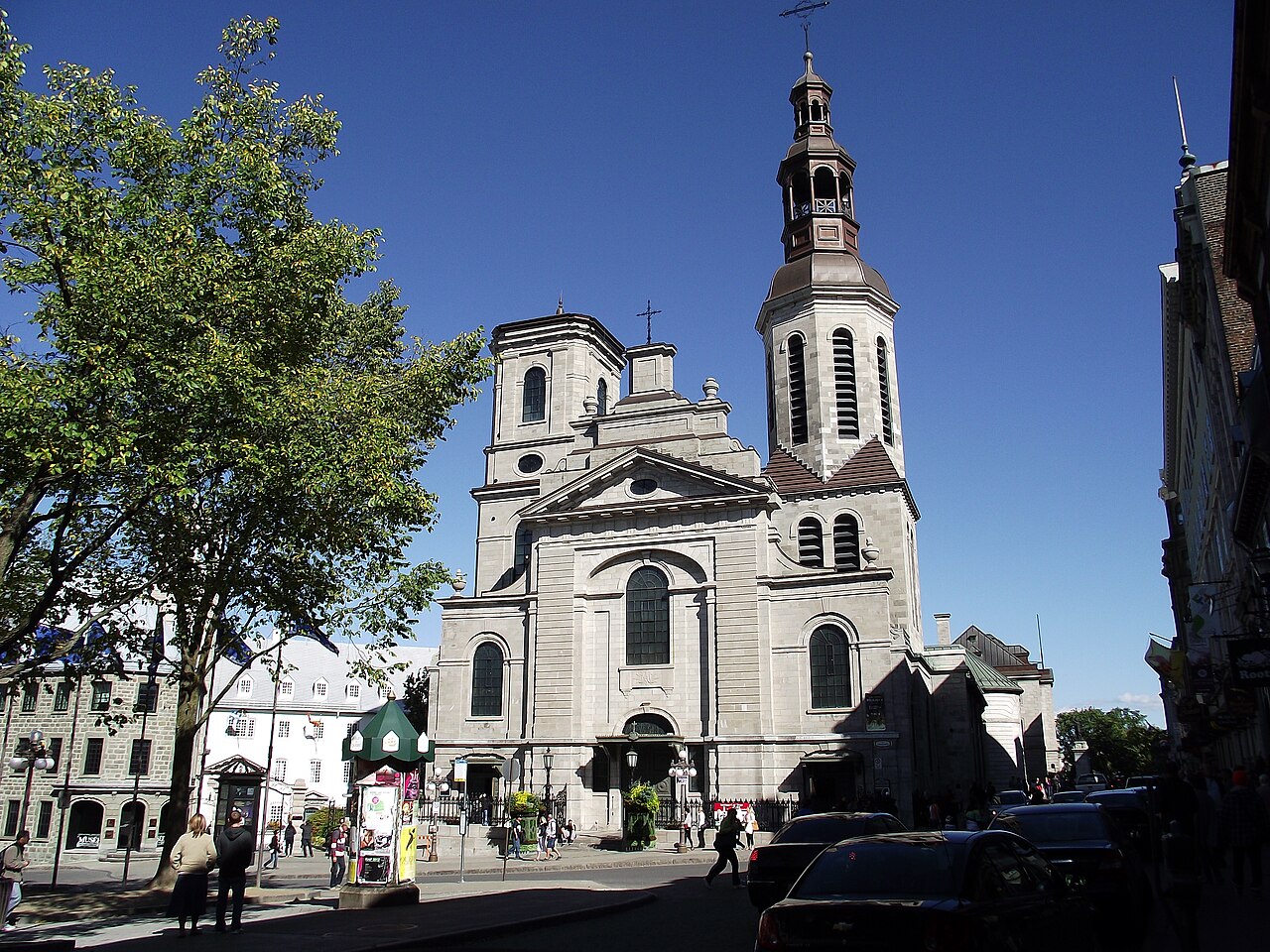
Basilica-Cathedral of Notre-Dame de Québec
46.8130° N · 71.2057° W · Cathedral
Basilica-Cathedral of Notre-Dame de Québec is a cathedral in Quebec, Canada. Seat of the Roman Catholic archdiocese since 1674, this neoclassical cathedral anchors the old city's spiritual and architectural identity. Most visitors spend 45–60 min here. The free Lokali audio guide runs 5 minutes.
✓ Verified August 2026 · how we write these guides
Visitor facts
| Time needed | 45–60 min |
|---|---|
| Lokali audio guide | 5 min · free |
| Type | Cathedral |
| Best for | History |
| Location | Quebec, Canada |
| Coordinates | 46.8130, -71.2057 |
| Languages | 45, in the Lokali app |
The story
You step in from the busy street, and the noise falls away. The air is cool and still. Light comes down through the tall windows. Above you, a golden canopy shines over the altar. Your eyes need a moment to adjust to the soft light. You are inside the Basilica-Cathedral of Notre-Dame de Québec.
This is one of the oldest churches in North America. An early stone church on this ground was completed in 1647. For a long time, this was the main Catholic church for a vast area. That area stretched far across the continent, well beyond the city walls. Generations of families have been baptised and married within these walls.
Today the building is the seat of the Catholic Archbishop of Quebec. It holds the rank of both basilica and cathedral. From here, the Catholic faith spread to many other parts of Canada and the United States over the centuries. The church has stayed at the centre of religious life in the city for a very long time.
The church you see is not the first one. The building has been damaged and rebuilt more than once. Cannon fire struck it during the siege of the city in 1759. Fire destroyed much of it again in 1922. Each time, builders raised it once more, following the older plans. So the church holds the memory of many earlier versions inside it. What looks old here is often a careful copy of something older still.
Many important people are buried below the floor. In the crypt rest the bishops of Quebec across the centuries. Among them lies François de Laval, the first bishop of the city. He arrived in the seventeenth century and shaped the early church here. The Catholic Church later named him a saint. Several governors of New France are also buried beneath the building.
Look up at the canopy above the main altar. It rests on tall columns and is covered in gold colour. This kind of canopy is called a baldachin. It marks the most sacred part of the church. The light catches the gold and draws your eyes forward. Even on a grey day, this corner of the church seems to glow.
On one side stands a special door. It is called a Holy Door. Only a small number of churches in the world have one. This was the first Holy Door made outside Europe. It is opened only during certain holy years set by the Church. In other years it stays closed, but you can still walk up and look at it closely.
Take time to look upward at the ceiling and the windows. Coloured glass softens the daylight and spreads it across the stone. The decoration is detailed and calm rather than loud. Painters and craftworkers spent years on the surfaces you see. The longer you look, the more small details appear.
The church stands in the old part of Quebec City. This whole district is protected as a World Heritage Site. The narrow streets, stone houses, and walls around it are among the oldest in the country. The church is the spiritual centre of this old town. When you leave, the streets outside feel like part of the same long story.
If you visit during a service, you may hear the organ. Its sound fills the high space and seems to come from every side at once. Even when the church is quiet, sounds carry far. A single set of footsteps can echo across the stone floor. The quiet here has a weight to it.
This is a working church, not only a monument. People come here to pray as well as to visit. When you walk through, move slowly and speak softly. Photography is often allowed, but it is kind to lower your voice near people at prayer. Take a moment to simply be still.
Step outside for a moment as you leave. The front of the church faces a small square in the old town. From here you can see the tall stone facade and the bell towers above it. Street musicians sometimes play nearby in the warm months. This square has been a meeting place for the city for a very long time.
Before you leave, sit for a moment in one of the wooden pews. Think of all the people who have sat in this same place across nearly four centuries. They came in good times and in hard times. The quiet here has held them all. Then rise, and step back out into the light of the street.
Key facts
What to look for
Practical tips
Common questions
How long do you need at Basilica-Cathedral of Notre-Dame de Québec?
Plan 45–60 min. That is the time most visitors spend at Basilica-Cathedral of Notre-Dame de Québec. The free Lokali audio guide adds about 5 minutes of narration you can listen to as you walk, so it fits inside your visit rather than adding to it.
Is there a free audio guide to Basilica-Cathedral of Notre-Dame de Québec?
Yes — the Lokali app narrates Basilica-Cathedral of Notre-Dame de Québec free of charge in 50+ languages. It covers the history, what to look for on site and practical tips, and it works offline once downloaded.
Where is Basilica-Cathedral of Notre-Dame de Québec?
Basilica-Cathedral of Notre-Dame de Québec is in Quebec, Canada, at 46.8130, -71.2057. Tap the map link on this page for directions from where you are.
What should you know before visiting Basilica-Cathedral of Notre-Dame de Québec?
Lower your voice; people come here to pray.
What is Basilica-Cathedral of Notre-Dame de Québec known for?
An early stone church here was completed in 1647.
What is the best time to visit Basilica-Cathedral of Notre-Dame de Québec?
The treasury displays vestments and silver chalices from the 1600s.
On the map
Opens directions to Basilica-Cathedral of Notre-Dame de Québec from your location.
More to see in Quebec


Hear Basilica-Cathedral of Notre-Dame de Québec in your language
The full story, narrated, in 50+ languages. Download it before you go and it plays offline, at your own pace, with no ticket and no tour group.