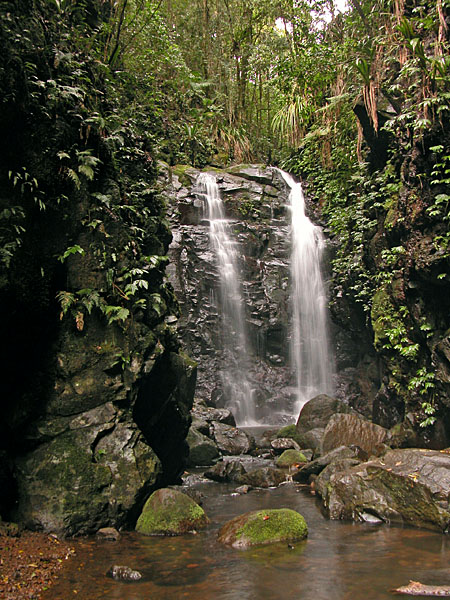
Lamington National Park
28.1422° S · 153.1150° E · National Park
Photo: Malcolm Jacobson · CC BY-SA 2.0 · Wikimedia Commons
Lamington National Park is a national park in Queensland, Australia. Declared a national park in 1915. The free Lokali audio guide runs 8 minutes.
✓ Published October 2026 · how we write these guides
Visitor facts
| Lokali audio guide | 8 min · free |
|---|---|
| Type | National Park |
| Location | Queensland, Australia |
| Coordinates | -28.1422, 153.1150 |
| Official website | parks.qld.gov.au |
| Languages | 50+, in the Lokali app |
The story
Listen for a moment. Somewhere above you, water drips from a fern frond onto a fallen leaf. A whipbird calls, a long rising note that ends in a sharp crack, and a second bird answers almost at once. The air is cool and damp. It smells of wet soil, moss, and slow decay. Under your boots, the track is soft with old leaves. Light comes down through the canopy in thin green shafts. This is Lamington National Park, high on the ranges of South East Queensland. It is one of the oldest rainforest landscapes on the planet.
The park runs along the McPherson Range, the high ridge that marks the border between Queensland and New South Wales. On a clear day, from the lookouts on the southern edge, you can see straight across into New South Wales. Below the cliffs lies a wide green valley, with a sharp peak rising from its centre. That peak is Wollumbin, also called Mount Warning. The view tells you something important about the ground you are standing on... it was once part of a volcano.
Around twenty million years ago, a huge shield volcano stood in this region. Geologists call it the Tweed Volcano. Over millions of years, rain and rivers wore away its centre and left a vast hollow, called a caldera. The cliffs of Lamington are the northern rim of that hollow. The rich basalt soils that the lava left behind are a big reason the forest here grows so thick. So the plants around you are growing on the remains of an ancient eruption.
The forest itself is even older in its lineage. Lamington is part of the Gondwana Rainforests of Australia, a group of reserves listed as a World Heritage Area. Gondwana was a supercontinent. It once joined Australia, Antarctica, South America, Africa and India. Some of the plant families growing here have close relatives in places that drifted apart long ago. When you walk this track, you are walking through a living record of a forest type that once covered much of that supercontinent.
The clearest example is the Antarctic beech. On the higher, colder ridges of the park, you can find these trees with thick, mossy trunks and twisting roots. Many stand in clusters, growing up from a single old base. Their relatives grow today in New Zealand, New Guinea and South America. Some of the beech stands at Lamington are thought to be extremely old, because the trees keep sending up new trunks from the same root system. It can feel like a forest from a fairytale... cold mist, green moss, and silence.
The name of the park comes from a person, not a place. Lord Lamington was Governor of Queensland around the turn of the twentieth century. The park was declared in 1915 and named in his honour. There is a popular story here that many Australians enjoy. The lamington cake, a square of sponge rolled in chocolate and coconut, is also said to carry his name. According to one well-known tale, the governor himself did not care for the cake at all. That part is folklore, not documented history.
The real force behind the park was a local man named Romeo Lahey. He grew up in the region and saw the timber industry moving into these mountains. Lahey campaigned hard to protect the plateau before the loggers reached it. He wrote letters, spoke to officials, and pushed the government for years. His work helped secure the park in 1915. It is worth remembering him as you walk. Without that early campaign, much of what you see here might be cleared farmland or a logged slope.
The park has two main areas that most visitors reach by road. One is Green Mountains, where the O'Reilly family settled in the early twentieth century and later built a guesthouse. The other is Binna Burra, on the eastern side, where another mountain lodge has welcomed walkers for generations. In 2019, bushfires burned through parts of the Binna Burra area and destroyed the historic lodge buildings. This shocked many people, because rainforest does not usually burn. The fires showed how dry the region had become.
Green Mountains is also linked to one of Queensland's most famous rescue stories. In 1937, a passenger plane went missing over these ranges during a storm. Search teams looked for days without success. Then Bernard O'Reilly, a member of the local family, set out alone into the rugged forest. He followed his own reasoning about where the plane might be. He found the wreck and the survivors. The story is still told at Green Mountains, and the crash site can be reached by a long, demanding walk.
Now look around at the life of the forest. On the lawns and track edges near the visitor areas, you may see small wallabies called pademelons grazing quietly. Crimson rosellas, bright red and blue parrots, are very common here and often come close. Keep watch for the regent bowerbird. The male is black with a brilliant golden yellow head and wings. In the deeper forest, listen for Albert's lyrebird. This shy bird can copy the calls of many other species with remarkable accuracy.
Water shapes almost everything here. The plateau catches heavy rain, and that water pours off the cliffs in hundreds of waterfalls and cascades. Some fall in long white ribbons down rock faces. Others slide over smooth basalt into clear, cold pools. After rain, the sound of running water seems to come from every direction. Many walking tracks lead to these falls, and some trails cross creeks on stepping stones. At night, in certain damp, sheltered spots, tiny glow worms shine like blue-green stars on the banks.
The walking network is one of the great pleasures of Lamington. There are short strolls near the visitor areas and long day hikes across the plateau. One famous route, the Border Track, follows the ridge and links Green Mountains with Binna Burra. Along the way, you pass through changing forest types, from warm subtropical rainforest to cool beech groves. At Green Mountains, a tree top walk lets you climb into the canopy. From up there, you see the forest from a bird's point of view.
Before you move on, take one more quiet moment. Look at the tree closest to you. Notice the ferns and orchids growing on its trunk, and the moss filling every crack in the bark. Listen again for the whipbird's call, or the steady drip of water from the leaves. This forest has survived volcanoes, drifting continents, and the axe. As you walk back along the track, you carry a little of that long story with you... and the mountain stays here, green and wet and patient.
Key facts
What to look for
Practical tips
Common questions
Is there a free audio guide to Lamington National Park?
Yes — the Lokali app narrates Lamington National Park free of charge in 50+ languages. The guide runs about 8 minutes, covers the history, what to look for on site and practical tips, and works offline once downloaded.
Where is Lamington National Park?
Lamington National Park is in Queensland, Australia, at -28.1422, 153.1150. Tap the map link on this page for directions from where you are.
What is Lamington National Park known for?
Declared a national park in 1915. Named after Lord Lamington, a Queensland governor.
What should you look for at Lamington National Park?
Golden head and wings of the male regent bowerbird. Mossy, multi-trunked Antarctic beech trees on high ridges. Small pademelons grazing at the forest edges.
What should you know before visiting Lamington National Park?
Bring a waterproof jacket, even on sunny mornings. Wear sturdy shoes for muddy and slippery tracks.
When is the best time to visit Lamington National Park?
Arrive early for the best birdwatching near visitor areas.
On the map
Opens directions to Lamington National Park from your location.
More to see in Queensland


Hear Lamington National Park in your language
The full story, narrated, in 50+ languages. Download it before you go and it plays offline, at your own pace, with no ticket and no tour group.