
Springbrook National Park
28.1400° S · 153.2742° E · National Park
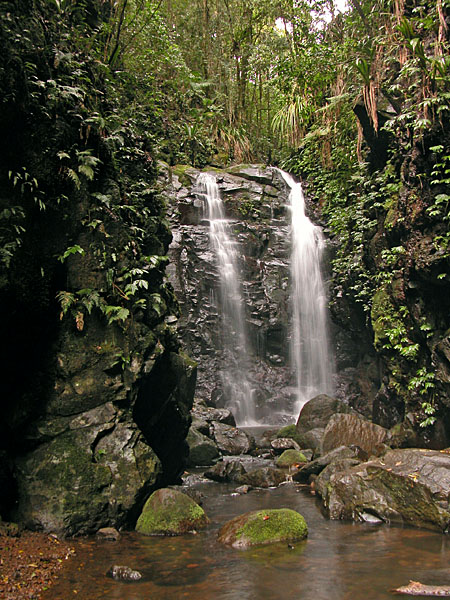
Photo: Knödelbaum · CC BY-SA 3.0 · Wikimedia Commons
Springbrook National Park is a national park in Queensland, Australia. Plateau formed from lava of the ancient Tweed Volcano. The free Lokali audio guide runs 7 minutes.
✓ Published October 2026 · how we write these guides
Visitor facts
| Lokali audio guide | 7 min · free |
|---|---|
| Type | National Park |
| Location | Queensland, Australia |
| Coordinates | -28.1400, 153.2742 |
| Official website | parks.qld.gov.au |
| Languages | 50+, in the Lokali app |
The story
Listen for a moment. Somewhere above you, water is dripping from leaf to leaf, a slow and uneven rhythm that never quite stops. The air here is cool and damp, even on a warm Queensland day. It smells of wet soil, moss and rotting wood. Underfoot, the path is soft with fallen leaves. Welcome to Springbrook National Park, high in the hinterland behind the Gold Coast, where the beaches and towers of the coast feel very far away.
This park sits on the rim of something enormous, though you cannot see all of it from any single point. Around twenty-three million years ago, a great shield volcano stood in this region. Geologists call it the Tweed Volcano. Over millions of years, rain and rivers wore away its centre. That left a vast eroded basin, a caldera, ringed by high cliffs. Springbrook is part of that northern rim. The plateau you are standing on is old lava, slowly shaped by water.
The heart of that ancient volcano still stands to the south. It is the peak known as Wollumbin, also called Mount Warning, just across the border in New South Wales. On a clear day, you can see it from the lookouts here, a sharp point rising out of the green valley. The Tweed Valley spreads below it like the floor of a giant bowl. When you look across that space, you are looking into the eroded crater of the volcano itself.
This land has a much longer human story than the park signs alone can tell. The Yugambeh people are the traditional owners of this country, and their connection to these mountains and waterways reaches back over a very long time. Many places here carry meaning in their culture. As you walk, it is worth remembering that these forests were known, named and cared for long before any road climbed the escarpment.
Springbrook belongs to something much larger. It is part of the Gondwana Rainforests of Australia, a World Heritage Area that stretches across south-east Queensland and north-east New South Wales. The name points to Gondwana, the ancient supercontinent that once joined Australia, Antarctica, South America and other lands. Some of the plant families growing here have ancestors that go back to that time. In a sense, this forest is a living record of a world that broke apart long ago.
Here is one of the surprises most visitors miss. At the Best of All Lookout, a short walk leads you through a grove of Antarctic beech trees. Their trunks are twisted and knotted, often covered in thick green moss. These trees belong to a plant group that once grew across Gondwana, and relatives still grow in South America today. Some of the clumps here are thought to be extremely old, regrowing again and again from the same base over a very long time.
The lookout at the end of that path deserves its name. The ground falls away almost straight down, and the whole Tweed Valley opens out below you. Farms, small towns and rivers sit in the caldera floor. Wollumbin rises in the distance. Clouds often move through at eye level, or even below you, so the view can change in minutes. If mist hides everything, wait a little. It may lift as quickly as it arrived.
Water shapes almost everything you see in this park. Springbrook is one of the wettest places in Queensland, and that rain feeds a chain of waterfalls along the plateau edge. Purling Brook Falls drops over a cliff into a deep gorge. The Twin Falls circuit takes walkers behind falling water, along ledges under the rock. After heavy rain, the falls roar. In dry spells, they thin to silver threads. Each visit sounds different.
Look closely at the cliffs beside the waterfalls. You will often see layers in the rock, bands of different colour and texture stacked one above another. These are separate lava flows from the old volcano, laid down at different times. The softer layers wear away faster, which creates the overhangs and caves that walkers pass beneath. The water has been cutting into this stone patiently, layer by layer, for an unimaginably long time.
In the western part of the park lies the Natural Bridge section, and it holds one of Springbrook's strangest sights. Here, a creek has carved a hole through the roof of a basalt cave. The waterfall now plunges straight through that opening into a pool inside the cave. You stand in the shadow and watch a column of water falling through a circle of daylight. It is a short walk, and many people find it the most memorable stop in the whole park.
After dark, the Natural Bridge cave shows a second surprise. Tiny blue-green lights appear across the rock ceiling. These are glow worms, but they are not worms at all. They are the larvae of a small fly. Each one produces light to attract insects, which become trapped in sticky threads hanging below. The colony here is protected, so visitors are asked to turn off torches near the cave, avoid flash photography, and stay quiet.
The forest has its own sounds, if you stay still long enough. Listen for a loud whip-crack call, often from a pair of birds answering each other. Listen too for complex songs that seem to copy other birds. That may be a lyrebird, a ground bird known for imitating the sounds around it. You might also notice the hum of insects, the drip of water and, in the evenings, frogs calling from the creeks.
Before you leave, take one more slow breath of this cool, wet air. Look at the moss on the nearest stone, the ferns unrolling at the path's edge, the light filtering green through the canopy. Everything around you grew from rain falling on old volcanic rock. As you walk back toward the car park, notice how the sounds of water follow you for a while... and then, slowly, fade behind the trees.
Key facts
What to look for
Practical tips
Common questions
Is there a free audio guide to Springbrook National Park?
Yes — the Lokali app narrates Springbrook National Park free of charge in 50+ languages. The guide runs about 7 minutes, covers the history, what to look for on site and practical tips, and works offline once downloaded.
Where is Springbrook National Park?
Springbrook National Park is in Queensland, Australia, at -28.1400, 153.2742. Tap the map link on this page for directions from where you are.
What is Springbrook National Park known for?
Plateau formed from lava of the ancient Tweed Volcano. Part of the Gondwana Rainforests World Heritage Area.
What should you look for at Springbrook National Park?
Mossy, twisted trunks in the Antarctic beech grove. Wollumbin's sharp peak rising from the Tweed Valley. Stacked bands of old lava flows in cliff faces.
What should you know before visiting Springbrook National Park?
Bring a rain jacket, even on sunny coastal days. Wear shoes with good grip for wet rocky paths.
On the map
Opens directions to Springbrook National Park from your location.
More to see in Queensland

Hear Springbrook National Park in your language
The full story, narrated, in 50+ languages. Download it before you go and it plays offline, at your own pace, with no ticket and no tour group.