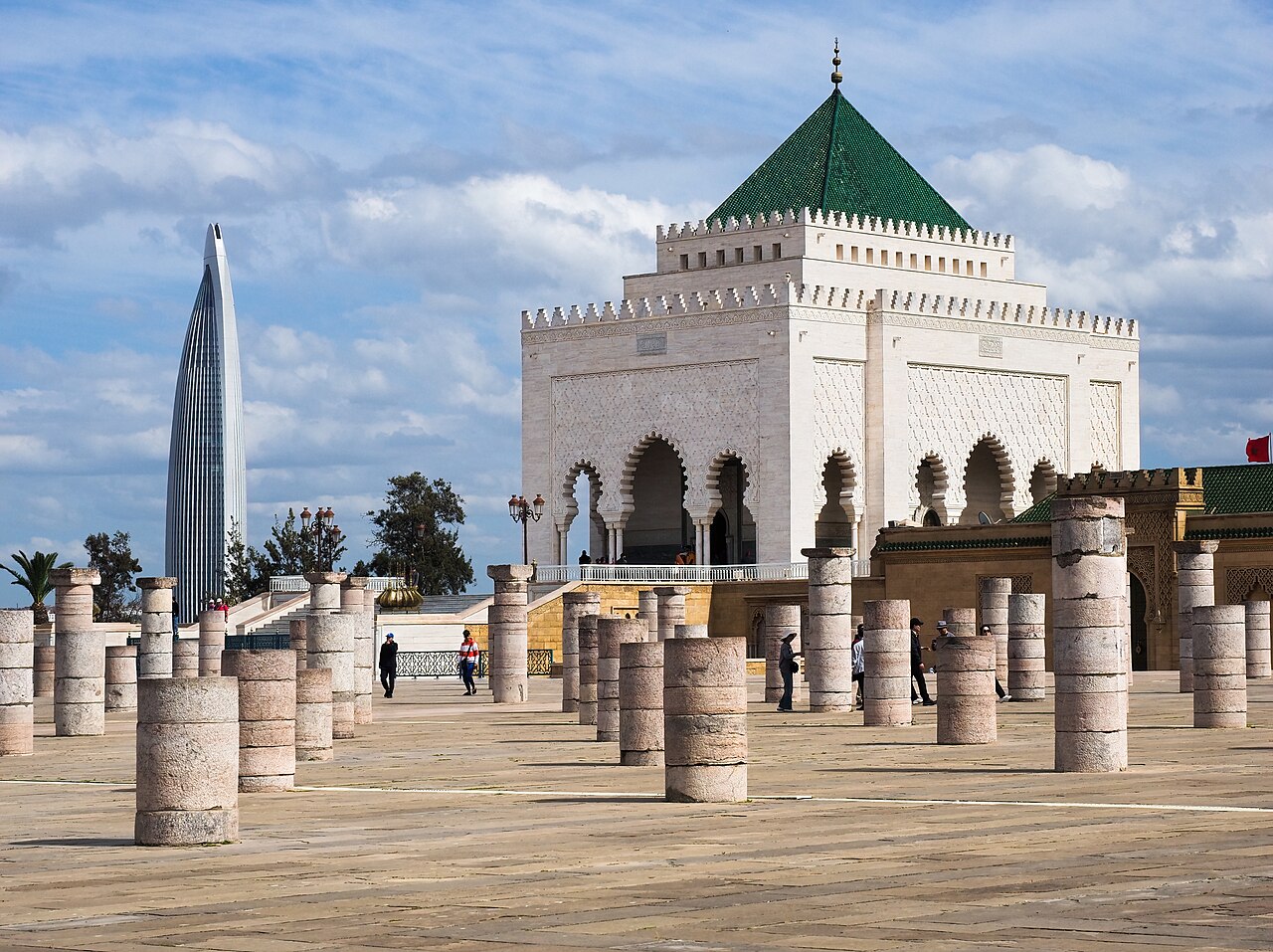
Mausoleum of Mohammed V
34.0289° N · 6.8131° W · Mausoleum
Mausoleum of Mohammed V is a stunning modernist-Islamic monument completed in 1975, housing the tomb of Morocco's independence leader. It is in Rabat, Morocco. Most visitors spend 30–45 min here. The free Lokali audio guide runs 5 minutes.
✓ Verified August 2026 · how we write these guides
Visitor facts
| Time needed | 30–45 min |
|---|---|
| Lokali audio guide | 5 min · free |
| Type | Mausoleum |
| Best for | History |
| Location | Rabat, Morocco |
| Coordinates | 34.0289, -6.8131 |
| Languages | 45, in the Lokali app |
The story
Climb the few steps and pause at the doorway. Inside, the room is cool and hushed. White marble walls rise around you. Light falls from a high stained-glass ceiling. A reader sits quietly with the Quran. Below, three white tombs rest in a sunken chamber. People look down in silence. The cool of the marble settles over you as you enter.
This is the Mausoleum of Mohammed V. It stands on the same wide esplanade as the Hassan Tower, at the heart of historic Rabat. Where the tower is bare red stone left unfinished, this building is finished with great care. The two face each other across the open platform, eight centuries apart. One was meant to gather the living. The other was made to honor the dead.
Mohammed V was the king who led Morocco to independence. He was a central figure as the country moved out from under French control. He died in 1961. The nation mourned him deeply. His son and successor, King Hassan II, decided to build him a resting place worthy of his memory. For many Moroccans, his name is tied to the birth of the modern nation.
Work on the mausoleum began in 1961, the year of the king's death. It took about ten years to complete. The building was finished in 1971. Behind it lies a careful idea. The tomb would honor not only one man, but the dignity of the modern Moroccan state itself. It was to be a gift from a son and from a whole country.
The design was given to a Vietnamese architect named Cong Vo Toan. His task was delicate. He used traditional Moroccan forms and decoration, but built them with modern materials and methods. The result looks deeply rooted in local style, while standing as a building of the twentieth century. The match between old form and new method is the quiet achievement of the design.
Look first at the outside. The mausoleum is built of white marble. The roof is covered in green tiles, a color long linked with Islam and with Morocco's kings. The walls carry carved patterns. The whole form is square and balanced, raised above the surrounding platform on a low base. White below, green above, the building catches the eye from across the whole esplanade.
At the entrances stand the royal guards. They wear bright uniforms and sit very still, some of them on horseback. They are there every day, in the heat and in the cold. Visitors come close to look and to photograph them. It is polite to be quiet and respectful as you pass. Their stillness sets the tone for everything inside.
Step inside and look up. The ceiling is the heart of the room. It is carved and painted wood, worked in fine geometric patterns, and rich with color and gold. Light comes through the stained glass. The craft is extraordinary. Artisans spent years on the carving and the decoration by hand. Let your eyes travel slowly across the patterns. No two sections repeat exactly.
Now look down into the central chamber. The main tomb is carved from white onyx. It holds Mohammed V. Beside him rest his two sons. One of them is King Hassan II, who built this place and was later buried here himself, in 1999. Three kings of one family lie together. Their tombs are simple in shape, set in a calm circle of marble below.
Notice the reader near the tomb. Very often a person sits and recites verses from the Quran aloud. The soft sound fills the marble room. This is not a performance for visitors. It is a continuing act of prayer and respect for the dead, carried on through the day. The words rise and fall, and the room seems to hold them.
There are rules for visitors, and they are simple. Dress modestly, covering shoulders and legs. Speak softly, or do not speak at all. This is an active place of remembrance and a royal tomb, not only a monument. Entry is free, but quiet is expected of everyone who comes inside.
Step back out onto the esplanade when you are ready. The bright sky and the red tower meet you again. The contrast is the whole point. One ruler's mosque was never finished. Another ruler's tomb was finished with great love. Together they tell how Morocco holds its past and its present in one place. Old and new, bare and adorned, stand within a few steps of each other.
Stand a moment between the two. Listen to the soft recitation behind you and the wind across the columns ahead. A building can be a way of remembering. Here, a son built for his father something that the whole country could share, and shares to this day.
Key facts
What to look for
Practical tips
Common questions
How long do you need at Mausoleum of Mohammed V?
Plan 30–45 min. That is the time most visitors spend at Mausoleum of Mohammed V. The free Lokali audio guide adds about 5 minutes of narration you can listen to as you walk, so it fits inside your visit rather than adding to it.
Is there a free audio guide to Mausoleum of Mohammed V?
Yes — the Lokali app narrates Mausoleum of Mohammed V free of charge in 50+ languages. It covers the history, what to look for on site and practical tips, and it works offline once downloaded.
Where is Mausoleum of Mohammed V?
Mausoleum of Mohammed V is in Rabat, Morocco, at 34.0289, -6.8131. Tap the map link on this page for directions from where you are.
What should you know before visiting Mausoleum of Mohammed V?
Dress modestly, covering your shoulders and legs.
What is Mausoleum of Mohammed V known for?
King Mohammed V died in 1961.
What is the best time to visit Mausoleum of Mohammed V?
The interior is cool and hushed.
On the map
Opens directions to Mausoleum of Mohammed V from your location.
More to see in Rabat


Hear Mausoleum of Mohammed V in your language
The full story, narrated, in 50+ languages. Download it before you go and it plays offline, at your own pace, with no ticket and no tour group.