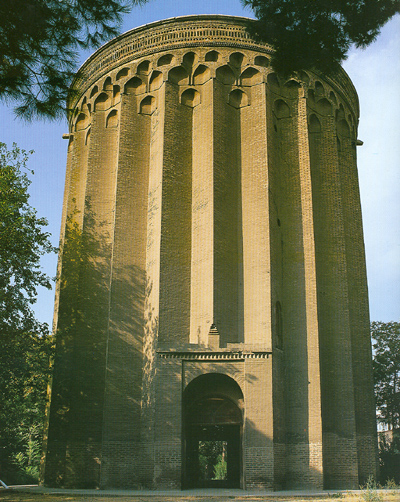
Photo: User Zereshk on en.wikipedia · Public domain · Wikimedia Commons
Toghrol Tower is a mausoleum tower in Ray, Iranian national heritage site. Seljuk-era brick tomb tower, usually dated to the twelfth century. The free Lokali audio guide runs 7 minutes.
✓ Published October 2026 · how we write these guides
Visitor facts
| Lokali audio guide | 7 min · free |
|---|---|
| Type | Tower |
| Location | Ray, Iran |
| Coordinates | 35.6007, 51.4456 |
| Languages | 50+, in the Lokali app |
The story
Start with your hand, if you can reach the base. Feel the brick. It is warm when the sun has been on it, rough at the edges, and slightly dusty to the touch. Every single brick was shaped by hand, fired in a kiln, and set in place by a mason who never saw this tower finished as you see it now. Listen, too. The traffic of southern Tehran hums somewhere behind you. But close to these walls, the air feels quieter, as if the tower keeps a small pocket of stillness around itself.
You are standing in Ray, one of the oldest continuously inhabited places on the Iranian plateau. Today it feels like a district on the southern edge of the capital. For most of history, though, it was the other way around. Ray was the great city, and Tehran was a village on the road to it. Under its ancient name, Rhages, this place appears in very old texts. For centuries it was a crossroads where caravans, scholars, and armies passed between east and west.
The tower in front of you belongs to the Seljuk period. The Seljuks were a Turkic dynasty that swept into Iran in the eleventh century and built an empire that stretched across much of western Asia. They adopted Persian culture, the Persian language at court, and Persian building traditions. Brick towers like this one are among their most recognisable legacies. Most scholars place this monument in the twelfth century, the high point of Seljuk architecture in Iran.
Now, about the name. The tower is traditionally linked to Tughril Beg, the founder of the Seljuk empire. He died in Ray in the eleventh century, and he made this city one of his capitals. So the story goes that this is his tomb. But here is the first surprise — historians are not certain. The style and the dating suggest it may be later than his lifetime. It may honour another ruler of the same name, or someone else entirely. The name has stayed, but the identity of the person it honours is still an open question.
Walk slowly around the base and count the edges. The tower is not round, and it is not a simple polygon. Its outer wall folds in and out in a series of sharp, triangular ribs, like a star seen from above. Most accounts describe twenty-four of these points. Run your eye up one rib to the top. The pattern creates long vertical shadows, and those shadows change through the day. In the morning light the tower looks soft. In the late afternoon it looks deeply carved.
Why build it this way? A plain cylinder of brick this tall would be heavy and rather blank to look at. The folded wall does two jobs at once. It stiffens the structure, the same way a folded sheet of paper stands up better than a flat one. And it turns a simple tower into something that catches light and moves as you move. Seljuk builders understood that brick, used well, could be decoration and structure at the same time.
Look up toward the top edge. The tower once carried a roof, most likely a pointed or conical cap, as many Seljuk tomb towers did. That roof is gone. What remains is an open crown of brick against the sky. Standing inside, if you are able to, you look straight up into daylight. It is a strange feeling. A building made to enclose a grave now frames a circle of open air above your head.
The city around this tower did not survive as well as the tower did. In the early thirteenth century, the Mongol invasions reached Ray, and the old city was devastated. Much of medieval Ray never recovered. Its markets, mosques, and houses fell into ruin, and the population moved elsewhere over time. That is the second surprise — this lone brick tower is one of the few large structures from that great medieval city still standing above the ground.
You may notice that some of the brickwork looks cleaner and more even than the rest. The tower has been repaired more than once. In the nineteenth century, under the Qajar dynasty, which ruled Iran from nearby Tehran, the monument was restored. More conservation work followed in the modern era. Look closely at the lower walls and the upper walls. You can sometimes see where older, weathered bricks meet newer ones. The tower carries the work of many generations, not just the first builders.
Locals also tell a story about sound. According to a popular belief, the interior of the tower has unusual acoustics, and a voice or a clap inside it seems to return or linger. Treat this as local lore rather than documented science. But if the space is open and quiet when you visit, it costs nothing to test it gently. Brick and a tall hollow shape often do strange things to sound, and many visitors enjoy the experiment.
Think for a moment about what a tomb tower meant to the people who built it. On the flat plain around Ray, a tall shape could be seen from far away. It marked the memory of a powerful person in the landscape itself. Travellers approaching the city would see it before they reached the gates. It was a monument for the living as much as a grave for the dead — a clear statement of who had ruled here.
Today the setting is very different. Apartment blocks, roads, and small shops surround the site. Not far away are other traces of old Ray, including the spring and rocky slopes that have drawn people here since ancient times. The contrast is part of the experience. You stand beside twelfth-century brick while motorbikes pass and neighbours go about their day. The old city and the modern district share the same ground.
Before you leave, step back far enough to see the whole tower at once. Notice the star-shaped ribs rising from the ground to the open top. Notice the colour of the brick, which shifts from pale sand to warm brown as the light changes. And notice how few people may be here with you. This is a quiet place, and it rewards slow looking.
As you walk away, glance back once more. The ribs catch the light differently from every angle, so the tower never looks quite the same twice. Somewhere inside these walls is a story that historians have not fully settled. That uncertainty is fitting. Ray is a city of layers, and this tower is one of the few that still rises clearly above the rest.
Key facts
What to look for
Practical tips
Common questions
Is there a free audio guide to Toghrol Tower?
Yes — the Lokali app narrates Toghrol Tower free of charge in 50+ languages. The guide runs about 7 minutes, covers the history, what to look for on site and practical tips, and works offline once downloaded.
Where is Toghrol Tower?
Toghrol Tower is in Ray, Iran, at 35.6007, 51.4456. Tap the map link on this page for directions from where you are.
What is Toghrol Tower known for?
Seljuk-era brick tomb tower, usually dated to the twelfth century. Traditionally linked to Seljuk founder Tughril Beg, though disputed.
What should you look for at Toghrol Tower?
Sharp triangular ribs running from the ground to the top. The open crown where the original roof once stood. Patches where weathered old bricks meet cleaner restored ones.
What should you know before visiting Toghrol Tower?
Visit in late afternoon when shadows deepen the brick ribs. Walk the full circle around the base before going inside.
When is the best time to visit Toghrol Tower?
Bring water and sun protection on hot, open summer days.
On the map
Opens directions to Toghrol Tower from your location.
More to see near Toghrol Tower


Hear Toghrol Tower in your language
The full story, narrated, in 50+ languages. Download it before you go and it plays offline, at your own pace, with no ticket and no tour group.