
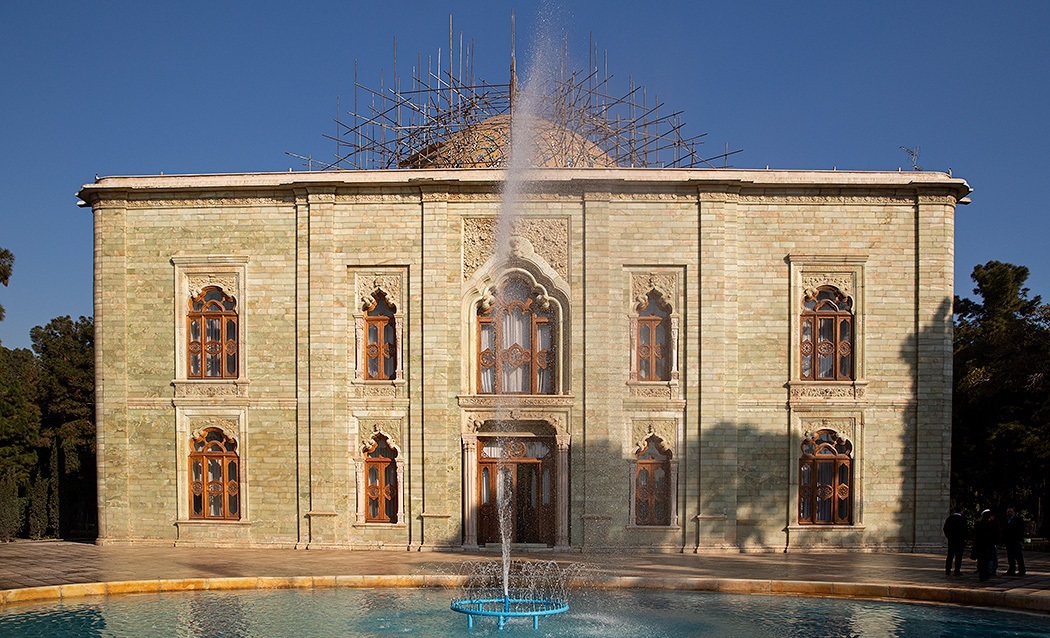
Photo: Ondřej Žváček · CC BY 2.5 · Wikimedia Commons
National Museum of Iran is a museum in Tehran, Iran. Designed by French architect André Godard with Maxime Siroux. The free Lokali audio guide runs 7 minutes.
✓ Published October 2026 · how we write these guides
Visitor facts
| Lokali audio guide | 7 min · free |
|---|---|
| Type | Museum |
| Location | Tehran, Iran |
| Coordinates | 35.6870, 51.4146 |
| Official website | nationalmuseumofiran.ir |
| Languages | 50+, in the Lokali app |
The story
Start at the entrance and look up. A tall arch of warm, honey-coloured brick rises in front of you. Its surface is not smooth. Every brick catches the light at a slightly different angle, so the whole wall seems to shift as the sun moves across it. Traffic hums somewhere behind you. In front of you, the doorway opens into one of the deepest collections of human history anywhere on Earth.
This is the National Museum of Iran, in the heart of Tehran. It is really two museums side by side. The older building holds the Museum of Ancient Iran. It covers the long story before Islam, from stone tools to the last Persian empires. A second building next door holds the Museum of the Islamic Era. Together they trace thousands of years of life on the Iranian plateau.
The arch you are looking at is not random decoration. It was designed to echo a famous ancient building — the great vaulted hall of Ctesiphon, near modern Baghdad. That hall was a palace of the Sasanians, the last Persian dynasty before the arrival of Islam. Its giant open archway, called an iwan, became a symbol of Persian royal power. So before you even step inside, the building is already pointing back to an empire.
Here is a detail many visitors miss. The architect was not Iranian. He was a Frenchman, André Godard, who worked with his colleague Maxime Siroux. Godard spent decades in Iran as an archaeologist and director of antiquities. The museum opened in 1937. In those years, Iran was building new institutions to show its own past to its own people, and this building was a central part of that effort.
Step inside, and the temperature drops a little. The halls are calm, high, and fairly plain. That plainness is useful. It keeps your eyes on the objects. The ground floor follows time roughly in order, so you can walk forward and watch human life slowly change. Early cases hold flint blades and simple tools. Then come the first pots, the first seals, the first signs of towns and trade.
Pay attention to the painted pottery from Susa, an ancient city in the southwest of Iran. Some of these vessels are very old indeed, made long before writing existed. The clay is pale, and the paint is dark and sure. Look closely and you will see long-necked birds, running dogs, and ibex — wild goats with huge curving horns. The horns are so exaggerated that they almost become circles. These potters were not copying nature. They were designing.
Now the first real surprise. Somewhere in this museum you may meet a man who died in a salt mine. He is known as the Salt Man of Chehrabad. Miners found his remains in a salt mine in the province of Zanjan, in northwest Iran. The salt preserved parts of his body, his hair, and even his leather boot. Later, more salt men were found at the same mine. Standing in front of him, the distant past suddenly has a face.
As you move on, the scale of the objects grows. You are entering the age of the Achaemenids, the Persian dynasty of Cyrus and Darius. Their empire stretched from Egypt to the edge of India. Their great ceremonial city was Persepolis, in the south of Iran. Several of the heaviest pieces here came from that site. Grey stone, polished in places, carved with remarkable confidence.
Look for a large relief from Persepolis showing a royal audience. A seated king holds a staff, and an official stands before him with his hand raised to his mouth — a gesture of respect. Behind them stand guards and attendants. Scholars still debate whether the king is Darius or his son Xerxes. Notice the beards. Each curl is cut as a neat, tight spiral, repeated again and again with almost mechanical patience.
Nearby you may find a huge column capital, the top part of a pillar, carved as the front halves of two bulls joined back to back. At Persepolis, these capitals held up the wooden beams of vast roofs. Here, at eye level, you can see how heavy and solid they really are. Imagine a forest of columns, each crowned with animals like these, all supporting a ceiling high above the crowds.
The second surprise is a statue with no head. It shows Darius the Great, and it was found at Susa. But it was not made in Iran. It was carved in Egypt, from Egyptian stone, and then brought here. The inscriptions on it appear in several languages, including Egyptian hieroglyphs. On the base, figures represent the many peoples of the empire. One king, many nations — this was the message, cut in stone.
Before you leave the ancient halls, find the bronze statue of a Parthian nobleman. The Parthians ruled Iran between the Achaemenids and the Sasanians. This man stands tall, with a moustache, a thick headband, and loose trousers. The bronze is dark, and his expression is serious. He feels very different from the stiff, formal kings of Persepolis. He looks like an individual person, a specific man who once walked these lands.
If you have energy left, cross to the Islamic-era building. The mood changes. Instead of heavy stone, you find glazed tiles, textiles, metalwork, and manuscripts. Turquoise and cobalt blues glow in the cases. Delicate Arabic and Persian script runs around bowls and panels. It is the same land and many of the same skills, now turned toward new beliefs, new patrons, and new ways of decorating a surface.
When you step back outside, look again at the brick arch. It may feel different now. Behind it you have seen painted goats from Susa, a king's beard cut in spirals, a headless statue from Egypt, and a man preserved in salt. Listen to the city around you, the engines and the voices. Tehran is young compared with the objects inside. For a few more seconds, let the old brick hold your attention before you walk on.
Key facts
What to look for
Practical tips
Common questions
Is there a free audio guide to National Museum of Iran?
Yes — the Lokali app narrates National Museum of Iran free of charge in 50+ languages. The guide runs about 7 minutes, covers the history, what to look for on site and practical tips, and works offline once downloaded.
Where is National Museum of Iran?
National Museum of Iran is in Tehran, Iran, at 35.6870, 51.4146. Tap the map link on this page for directions from where you are.
What is National Museum of Iran known for?
Designed by French architect André Godard with Maxime Siroux. The museum opened to the public in 1937.
What should you look for at National Museum of Iran?
Spiral-carved beards on the Persepolis royal audience relief. Twin bull heads joined back to back on a column capital. Ibex with oversized curving horns on Susa painted pottery.
What should you know before visiting National Museum of Iran?
Visit the ancient building first, then the Islamic-era building. Expect a separate ticket for each of the two buildings.
When is the best time to visit National Museum of Iran?
Photograph the brick facade in late afternoon light.
On the map
Opens directions to National Museum of Iran from your location.
More to see in Tehran



Hear National Museum of Iran in your language
The full story, narrated, in 50+ languages. Download it before you go and it plays offline, at your own pace, with no ticket and no tour group.