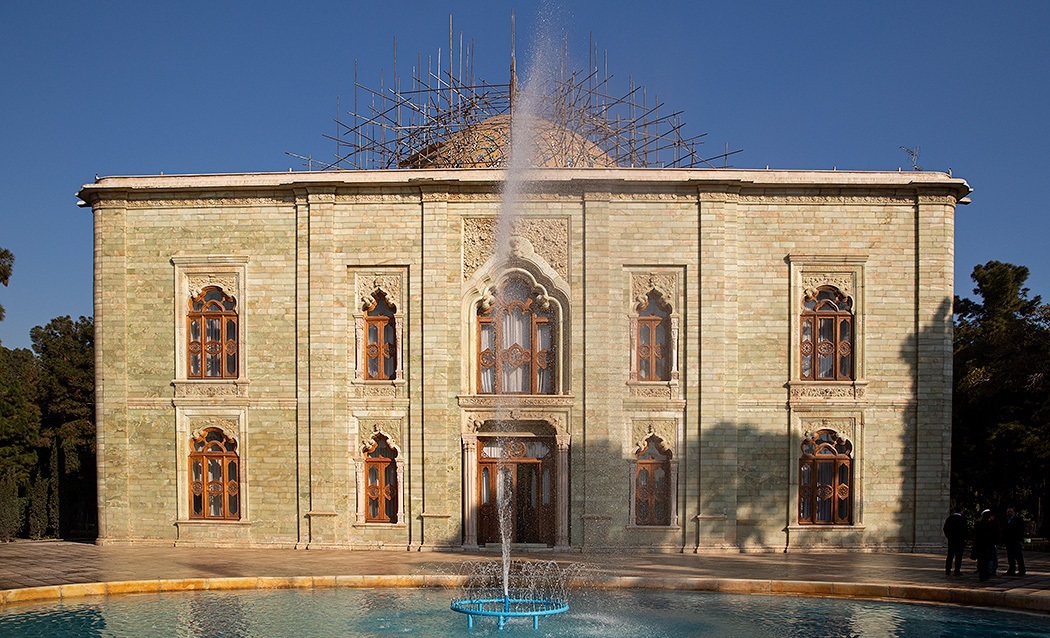
Photo: Hamid Tavakoli · CC BY 4.0 · Wikimedia Commons
Marble Palace is a palace in Tehran, Iranian national heritage site. Rey appears in ancient Persian texts as Ragha. The free Lokali audio guide runs 6 minutes.
✓ Published October 2026 · how we write these guides
Visitor facts
| Lokali audio guide | 6 min · free |
|---|---|
| Type | Palace |
| Location | Tehran, Iran |
| Coordinates | 35.6890, 51.4020 |
| Languages | 50+, in the Lokali app |
The story
Start with your hand. If there is polished stone within reach, rest your palm on it for a moment. Good marble stays cool even when the afternoon air above it is dry and warm. Around you, the sounds of Rey carry in from the streets. Engines idle, a vendor calls out, and a pigeon lands somewhere above. Take a breath before we begin, because this place deserves a slow look.
First, an honest word between us. The Marble Palace that most travellers read about stands in central Tehran, a short drive north of here. This guide will not borrow that building's story and pretend it belongs to Rey. Records on the site in front of you are thin, and dates and builders' names should not be invented. So we will use what can be trusted. That means the long history of Rey itself, and the stone and space you can see with your own eyes.
That history is very long. Rey is one of the oldest continuously inhabited places on the Iranian plateau. Ancient Persian texts call it Ragha. The Greeks knew it as Rhagae. It even appears in the Book of Tobit, an old Jewish text, as a city where money was left in safekeeping. When you stand anywhere in Rey, you stand on top of many layers of earlier towns.
The proof sits not far from here, at a spring called Cheshmeh Ali. Beside it rises a low mound. Archaeologists excavated it in the twentieth century and found painted pottery from prehistoric farming villages. Those potters worked thousands of years before any palace in this region. Water drew people here first. Everything else, including grand buildings of polished stone, came much later.
Think about what Rey became in the medieval centuries. It was one of the great cities of the Islamic world. It had markets, libraries and scholars. The physician Muhammad ibn Zakariya al-Razi was born here. Europeans later knew him as Rhazes. His medical writings were read in Europe for centuries. His name, al-Razi, simply means 'the man from Rey'. The city carried itself into the vocabulary of medicine.
Then came disaster. In the thirteenth century, the Mongol invasions swept across Iran, and Rey suffered terribly. The great city never fully recovered. A small village to the north slowly grew in its place. That village was Tehran. Over the following centuries the roles reversed completely. Today Rey sits within greater Tehran, a southern district of the capital it once overshadowed.
Now bring your eyes back to the building. A name like 'Marble Palace' makes a promise, so check whether this place keeps it. Look at the floors, the steps and the facing on the walls. Marble usually shows veins. These are thin wandering lines of grey, white, cream or rust inside the stone. Each slab is unique. When slabs are cut and laid side by side, a skilled mason can match the veins so the pattern flows across the joins.
Iran has worked fine stone for a very long time. Quarries across the country produce marble, travertine and onyx in many colours. Travertine is a pitted, honey-coloured stone formed near mineral springs. Look closely at any pale stone here. Small holes or a slightly spongy surface suggest travertine. A smooth, glassy sheen with clear veins suggests true marble. Many buildings mix the two, so you may find both.
Here is something many visitors miss. Polished stone acts like a slow mirror. Stand to one side and watch how light from a doorway or window slides across the floor. In the morning it lies long and pale. Near midday it becomes short and bright. In late afternoon it turns warmer. Wherever you stand, the room changes with the hour.
Listen to the space too. Hard stone surfaces reflect sound, so footsteps ring and voices carry. In older Iranian buildings, this quality often worked together with courtyards, pools and shaded porches. Those features helped people cope with the dry summers of the plateau. Notice whether this site has water, shade or an inner court. These are old answers to the same climate that Rey's first villagers faced.
A second surprise lies in the ground beneath you. Southern Tehran sits on the same land that drew those prehistoric farmers. Much of old Rey is still buried. Builders in this area sometimes uncover pottery or old foundations when they dig. Whatever stands here today is the newest chapter on a very old page.
If you have time after your visit, Rey rewards a short wander. Look out for the Toghrol Tower, a tall brick tomb tower from the Seljuk period, around the twelfth century. Also visit the shrine of Shah Abdol-Azim, where pilgrims gather in large numbers. Its courtyards are especially lively on Thursday evenings and on religious holidays. Together, these places show Rey's two great threads: memory of empire and living devotion.
Before you walk on, return to the stone one more time. Find a single vein in the marble and follow it with your eyes until it disappears into a join or a shadow. That line formed slowly underground, long before anyone cut it, carried it or polished it. Now it lies here, in a city older than most capitals on earth. As you step back into the street, listen for the change in sound. The echo fades, the traffic returns, and Rey goes on as it has for thousands of years.
Key facts
What to look for
Practical tips
Common questions
Is there a free audio guide to Marble Palace?
Yes — the Lokali app narrates Marble Palace free of charge in 50+ languages. The guide runs about 6 minutes, covers the history, what to look for on site and practical tips, and works offline once downloaded.
Where is Marble Palace?
Marble Palace is in Tehran, Iran, at 35.6890, 51.4020. Tap the map link on this page for directions from where you are.
What is Marble Palace known for?
Rey appears in ancient Persian texts as Ragha. Ancient Greek writers called the city Rhagae.
What should you look for at Marble Palace?
Veins in marble slabs that continue across neighbouring joins. Small pits that mark honey-coloured travertine rather than marble. Light from doorways sliding across the polished floor.
What should you know before visiting Marble Palace?
Confirm the site with locals; Tehran has a separate Marble Palace. Visit morning or late afternoon for softer light on stone.
When is the best time to visit Marble Palace?
Combine your visit with Toghrol Tower and Cheshmeh Ali spring.
On the map
Opens directions to Marble Palace from your location.
More to see in Tehran


Hear Marble Palace in your language
The full story, narrated, in 50+ languages. Download it before you go and it plays offline, at your own pace, with no ticket and no tour group.