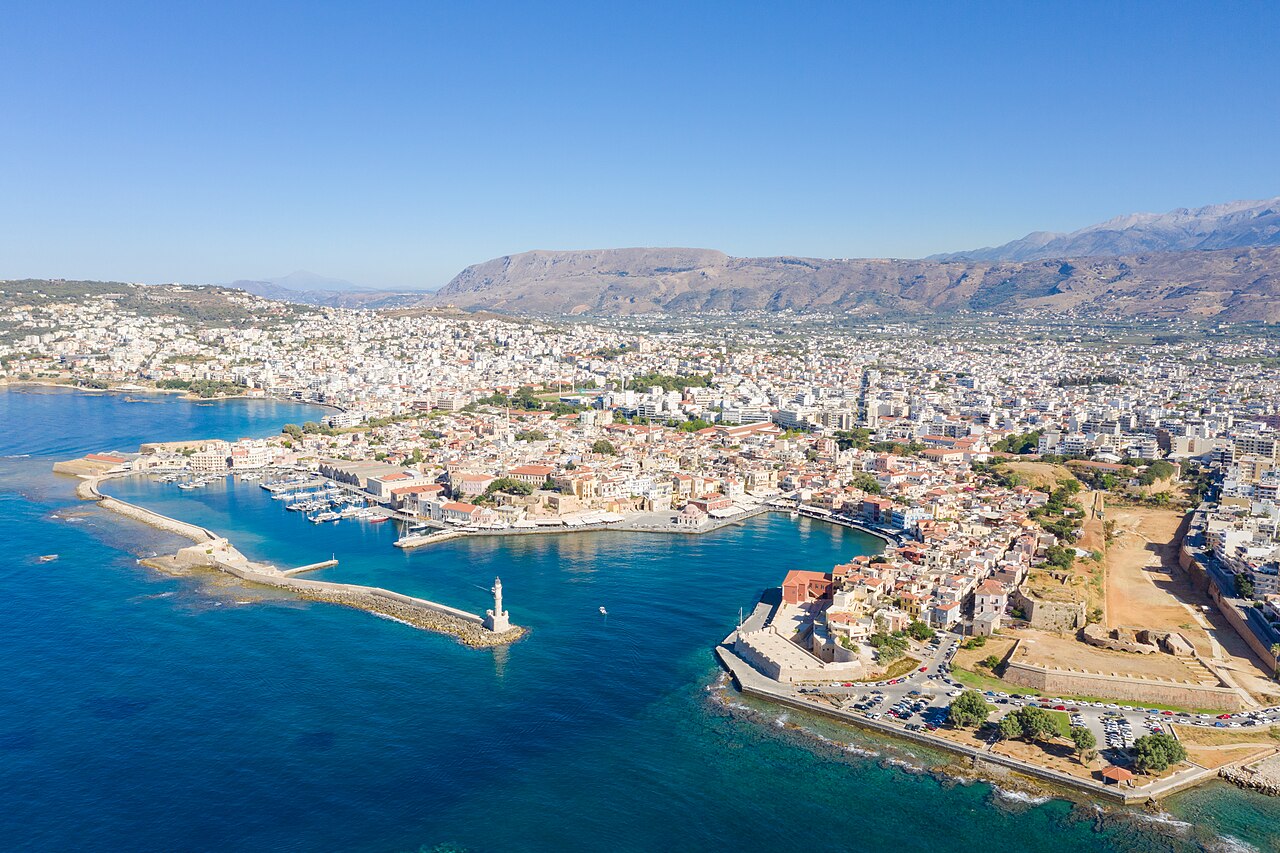
Chania Old Harbour is a waterfront in Rethymno, Greece. Venetian port lined with 17th-century townhouses, fish tavernas, and the iconic lighthouse. Most visitors spend 1–2 hours here. The free Lokali audio guide runs 9 minutes.
✓ Verified August 2026 · how we write these guides
Visitor facts
| Time needed | 1–2 hours |
|---|---|
| Lokali audio guide | 9 min · free |
| Type | Waterfront |
| Best for | Romantic |
| Location | Rethymno, Greece |
| Languages | 45, in the Lokali app |
The story
The water laps against stone that has seen Venetian galleys, Ottoman frigates, and now the painted fishing boats of modern Crete. Stand at the edge of Chania's Old Harbour and you are looking at a working port that has anchored this city for seven hundred years. The curve of the breakwater, the rhythm of the waves, the smell of salt and diesel and grilled octopus — this is a place that has never stopped being what it was built to be.
The Venetians dug this harbour in the fourteenth century, carving a safe anchorage out of the northern Cretan coast. They needed a naval base to control the eastern Mediterranean, and Chania gave them deep water and a natural shelter from the meltemi winds that rake the Aegean each summer. The stone quays you walk on today were laid by Venetian engineers, though the warehouses and arsenals that once lined them are gone now, replaced by tavernas and gelato shops.
At the harbour's eastern arm stands the lighthouse — a slender Egyptian-style tower built by the Ottomans in the eighteen-thirties on the ruins of an earlier Venetian beacon. It is one of the oldest lighthouses in the Mediterranean still standing. The pale stone glows amber at sunset, and locals will tell you it is the most photographed landmark in Crete. Walk out to it if the breakwater is open — the view back toward the town shows the whole sweep of the harbour, the Venetian arsenals low and vaulted along the waterfront, the White Mountains rising behind.
The Ottomans held Chania for two and a half centuries, and their mark is everywhere in the old town behind the harbour. Minarets became bell towers after the Greek population exchange of nineteen twenty-three. Wooden balconies overhang the lanes. The neighbourhood called Kastelli, on the low hill above the harbour, holds the oldest layers — Minoan foundations, Roman mosaics, Venetian walls, Ottoman fountains, all compressed into a few winding blocks.
The harbour itself has always been a place of arrival and departure. Cretans left from here during the upheavals of the early twentieth century, bound for Athens or Alexandria. Allied soldiers evacuated through Chania in nineteen forty-one as the Germans closed in from the east. Today the ferries run to Piraeus, and the fishing boats go out each evening and return at dawn with crates of red mullet and cuttlefish.
The Venetian arsenals — the long vaulted sheds along the eastern quay — were built to repair and shelter warships. Seven of them survive, though only a few are open to the public. They host exhibitions now, art shows and cultural events. Walk inside one if you can — the stone vaults are cool even in August, and the acoustics are extraordinary. You can hear the sea through the open arches.
The best light comes early or late. Morning brings the fishing boats back, and the quayside market sets up with the catch still flipping in plastic tubs. By mid-morning the tour groups arrive and the waterfront fills. Late afternoon the sun drops behind the town and the harbour falls into soft shadow, the lighthouse catching the last gold. Evening is when locals come — families walking the breakwater, couples at the tavernas, the smell of charcoal and lemon drifting across the water.
Chania was the capital of Crete until nineteen seventy-one, when the government moved to Heraklion. That shift left the old town quieter, less bureaucratic, more itself. The harbour never lost its working character. Fishermen still mend nets on the quay. The ferry terminal is a ten-minute walk west. This is not a museum harbour — it is a living one, and that is what makes it compelling.
The water in the harbour is startlingly clear. Look down from the quay and you can see the stone blocks of the Venetian foundation, green with weed, and sometimes a school of small fish holding station in the current. The seabed is littered with pottery shards — centuries of broken amphorae and plates, the archaeological layer of a port that has been in continuous use since the Middle Ages.
The town behind the harbour is a maze of lanes too narrow for cars, lined with stone houses painted ochre and rose and faded blue. Bougainvillea spills over walls. Cats sleep in doorways. There are more tavernas than you can count, and the quality varies wildly — the best ones are not on the waterfront but one street back, where the rent is lower and the cooking is for locals.
Walk the full circuit of the harbour if you have time. Start at the lighthouse, follow the eastern quay past the arsenals, cross the small bridge at the inner harbour where the fishing boats tie up, and continue along the western quay toward the Firkas Fortress. The fortress is Venetian, built in the fifteen-hundreds to guard the harbour entrance, and it holds a small maritime museum. The view from the ramparts shows the whole harbour spread below, the lighthouse across the water, the open sea beyond.
When you leave, notice the way the town steps up from the waterfront in terraces of stone and tile. The harbour is the anchor, the reason Chania exists. Everything else grew up around it, layer by layer, century by century. The water is still the same — salt, clear, constant — and the light on it changes every hour.
Key facts
What to look for
Practical tips
Common questions
How long do you need at Chania Old Harbour?
Plan 1–2 hours. That is the time most visitors spend at Chania Old Harbour. The free Lokali audio guide adds about 9 minutes of narration you can listen to as you walk, so it fits inside your visit rather than adding to it.
Is there a free audio guide to Chania Old Harbour?
Yes — the Lokali app narrates Chania Old Harbour free of charge in 50+ languages. It covers the history, what to look for on site and practical tips, and it works offline once downloaded.
What should you know before visiting Chania Old Harbour?
Visit early morning to see the fishing boats return.
What is Chania Old Harbour known for?
Venetians built the harbour in the fourteenth century.
What is the best time to visit Chania Old Harbour?
Sit at a waterfront café at sunset.
More to see in Rethymno


Hear Chania Old Harbour in your language
The full story, narrated, in 50+ languages. Download it before you go and it plays offline, at your own pace, with no ticket and no tour group.