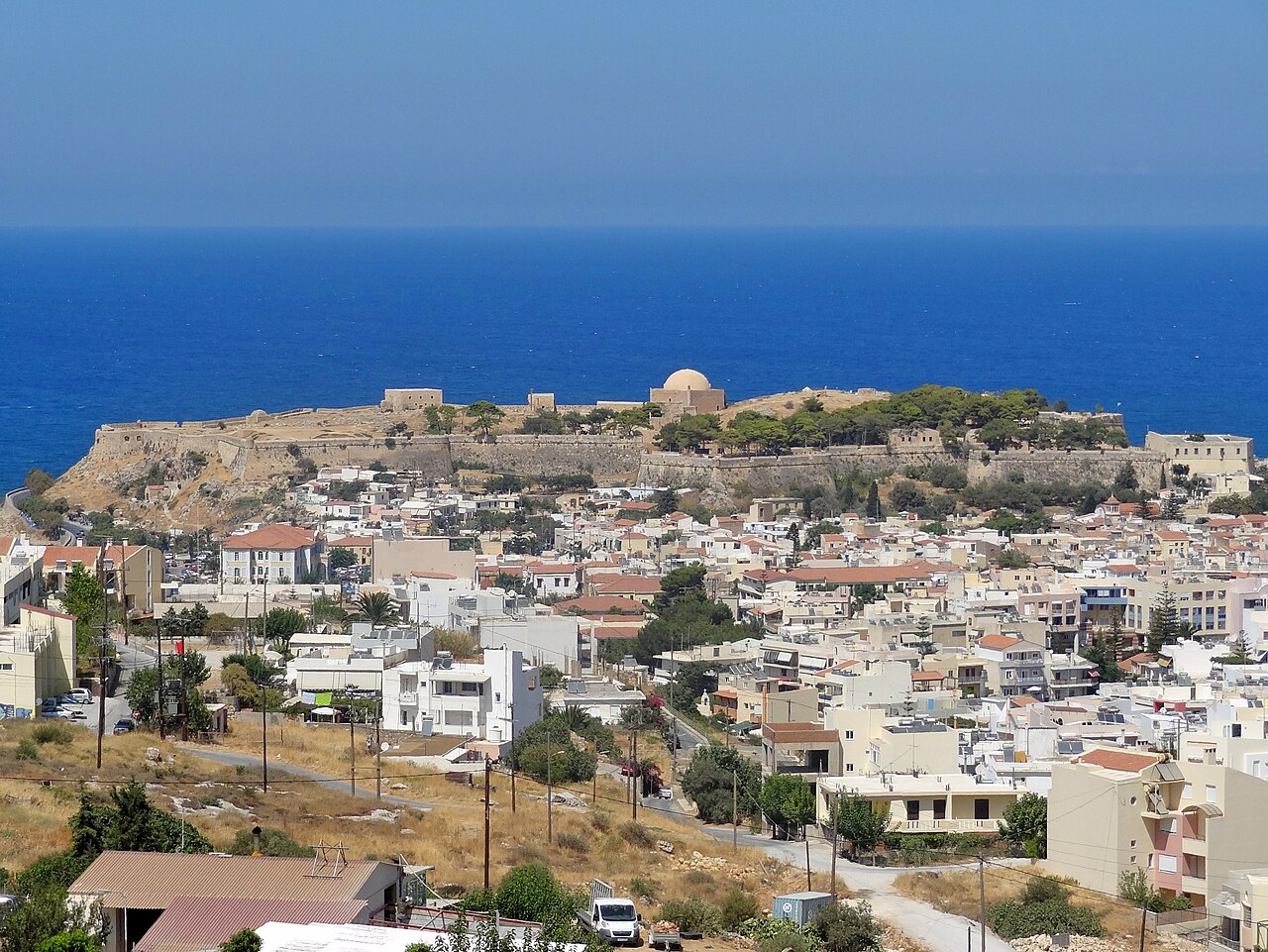
Venetian Fortress, Rethymno
35.3616° N · 24.4728° E · Fortress
Venetian Fortress, Rethymno is a 16th-century hilltop fortress overlooking Rethymno, built by Venice to defend against piracy. It is in Rethymno, Greece. Most visitors spend 1–1.5 hours here. The free Lokali audio guide runs 9 minutes.
✓ Verified August 2026 · how we write these guides
Visitor facts
| Time needed | 1–1.5 hours |
|---|---|
| Lokali audio guide | 9 min · free |
| Type | Fortress |
| Best for | Photography |
| Location | Rethymno, Greece |
| Coordinates | 35.3616, 24.4728 |
| Languages | 45, in the Lokali app |
The story
The stone beneath your feet is pale limestone, worn smooth by centuries of boots and bare soles. Wind moves freely up here — it carries salt from the Cretan Sea below and the faint smell of wild thyme growing between the cracks in the ramparts. This is the Fortezza, Rethymno's hilltop fortress, a sprawling star-shaped citadel that has watched over the harbour for more than four hundred years.
The Venetians began construction in fifteen seventy-three, after Ottoman raids devastated the undefended town. They needed a refuge large enough to shelter the entire population of Rethymno — over fifteen hundred people — during sieges. The architect Sforza Pallavicini designed massive walls that could withstand cannon fire, bastions angled to eliminate blind spots, and a self-contained water system. Building took thirteen years and required demolishing earlier Byzantine churches and Venetian homes that stood on this hill.
Walk the perimeter and you notice the walls vary in thickness — some sections reach nearly two metres wide. The Venetians built in haste, layering rubble and mortar between outer faces of dressed stone. In places the masonry shows repair work from later centuries, patches of darker rock interrupting the pale gold. The fortress was never quite finished. By fifteen eighty-six, when the last stones were laid, Venice was already overstretched across the Mediterranean and funds had dried up.
The Fortezza fell to the Ottomans in sixteen forty-six after a brief siege. The Venetians surrendered without a major battle — provisions were low and reinforcements never came. The Ottomans converted the central Church of Saint Nicholas into a mosque, adding a minaret and a mihrab that still survive inside. For nearly three centuries this was an Ottoman garrison, barracks and powder magazines filling the courtyards. The minaret remains one of the best-preserved Ottoman structures in Crete, its octagonal shaft rising cleanly above the roofline.
Stand near the Sultan Ibrahim Mosque and look east toward the town. The view explains why this site mattered. The harbour spreads below, the Venetian lighthouse a pale finger at the end of the breakwater. On clear days you can see the White Mountains rising inland, their peaks holding snow into late spring. Attackers approaching from any direction would be visible hours before they reached the walls.
Inside the fortress the ground is uneven, grassy in summer, muddy after winter rains. Ruined buildings scatter across the interior — former barracks, storerooms, a small theater added in the twentieth century. Archaeologists have uncovered fragments of earlier structures beneath the Venetian foundations, including a temple to Artemis from the Hellenistic period. The hill was sacred ground long before any fortress stood here.
The fortress served as a prison during the early twentieth century, first under Ottoman rule and later during the German occupation of Crete in World War Two. Bullet scars mark some interior walls, faint pockmarks in the stone. After the war the site fell into disrepair. Restoration began in the nineteen eighties and continues intermittently, funded by the Greek Ministry of Culture and European heritage grants.
Notice the bastions — five massive triangular projections that give the fortress its star shape. Each is named: Saint Luke, Saint Elijah, Saint Paul, Saint Nicholas, and the Priuli Bastion. Climb onto one and you feel the geometry working. The angles eliminate dead ground, ensuring defenders could cover every approach with crossfire. The Venetians learned these principles in wars across Italy and exported them to every colony.
The light changes dramatically through the day. Early morning the stone glows warm gold, shadows long across the courtyards. By midday the sun bleaches everything pale, heat shimmering off the walls. Late afternoon brings the best colours — the limestone turns amber, the sea deepens to cobalt, and the mountains take on layers of blue and violet. Locals come up here to watch the sunset, sitting on the ramparts as the sky burns orange over the water.
Inside the mosque the air is cooler, the space dim after the brightness outside. The mihrab is simple, carved stone with traces of painted decoration. The minaret is closed to visitors but its shadow sweeps across the courtyard as the sun moves west. Swallows nest in the vaulted ceilings, their calls echoing off the stone.
The fortress is never crowded. Even in high summer you can find stretches of wall where you are alone with the wind and the view. Wildflowers push through cracks in the paving — yellow chamomile, purple thistles, white rockrose. Lizards sun themselves on the stones, flicking away as you approach. The place feels more ruin than monument, a landscape slowly returning to the hill it was built on.
As you leave, glance back at the walls from the road below. The Fortezza dominates the skyline, its bulk softened by distance and the haze that rises from the sea. It has outlasted the Venetians who built it, the Ottomans who held it, the Germans who occupied it. Now it belongs mostly to the wind and the tourists who climb the hill to stand where soldiers once watched the horizon for sails.
Key facts
What to look for
Practical tips
Common questions
How long do you need at Venetian Fortress, Rethymno?
Plan 1–1.5 hours. That is the time most visitors spend at Venetian Fortress, Rethymno. The free Lokali audio guide adds about 9 minutes of narration you can listen to as you walk, so it fits inside your visit rather than adding to it.
Is there a free audio guide to Venetian Fortress, Rethymno?
Yes — the Lokali app narrates Venetian Fortress, Rethymno free of charge in 50+ languages. It covers the history, what to look for on site and practical tips, and it works offline once downloaded.
Where is Venetian Fortress, Rethymno?
Venetian Fortress, Rethymno is in Rethymno, Greece, at 35.3616, 24.4728. Tap the map link on this page for directions from where you are.
What should you know before visiting Venetian Fortress, Rethymno?
Visit late afternoon for best light and colours.
What is Venetian Fortress, Rethymno known for?
Built by Venetians starting in fifteen seventy-three.
What is the best time to visit Venetian Fortress, Rethymno?
Climb to the highest bastion at sunset.
On the map
Opens directions to Venetian Fortress, Rethymno from your location.
More to see in Rethymno


Hear Venetian Fortress, Rethymno in your language
The full story, narrated, in 50+ languages. Download it before you go and it plays offline, at your own pace, with no ticket and no tour group.