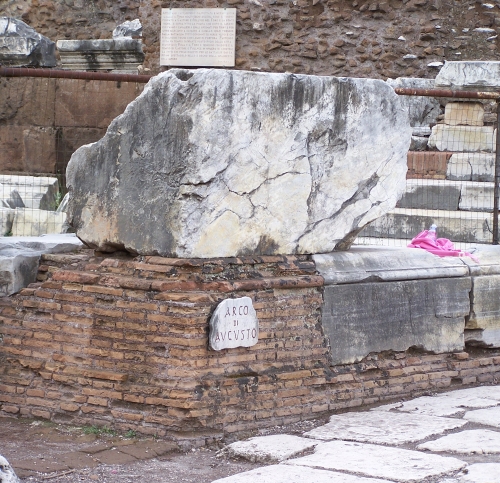
Arch of Augustus
41.8919° N · 12.4860° E · Archaeological Site
Photo: Kefas de Merciful · Public domain · Wikimedia Commons
Arch of Augustus is a former triumphal arch in Rome, Italy. Built to honour Augustus, Rome's first emperor. The free Lokali audio guide runs 6 minutes.
✓ Published October 2026 · how we write these guides
Visitor facts
| Lokali audio guide | 6 min · free |
|---|---|
| Type | Archaeological Site |
| Location | Rome, Italy |
| Coordinates | 41.8919, 12.4860 |
| Languages | 50+, in the Lokali app |
The story
Listen to the gravel under your feet. Fine dust lifts with each step, pale and dry, and the low sun warms the broken stone around you. Ahead, between two great ruined temples, there is a gap in the ground. A few worn blocks sit at your ankles. There is no towering arch here. And yet you are standing where one of the proudest monuments of Augustus once rose over the Roman Forum.
This is the Arch of Augustus, or rather, what is left of it. Most visitors walk straight past. They are looking up at the columns of the Temple of Castor and Pollux, or at the altar mound of Julius Caesar. That is fair enough. The arch has almost vanished. But the story of this empty space is one of the best in the Forum. It is about war, diplomacy, and one man's careful control of how Rome remembered him.
First, a little orientation. Find the low, rounded remains of the Temple of the Deified Julius. This temple marks the place where Caesar's body was burned after his murder. Now look toward the three tall columns of Castor and Pollux. The arch stood in the space between them. It spanned the Sacred Way, the processional road that ran through the heart of the Forum.
Who built it, and why? The man was Octavian, Caesar's adopted heir, who later took the title Augustus. He became the first Roman emperor. Ancient writers and Roman coins tell us that the Senate honoured him with arches in the Forum. Scholars still debate the details. Some believe there were two separate monuments. Others think one arch was built, then rebuilt or replaced.
The first honour likely followed the Battle of Actium in 31 BCE. There, Octavian defeated the fleets of Mark Antony and Cleopatra. That victory ended years of civil war. It left Octavian the master of the Roman world. An arch beside his adoptive father's temple sent a clear message. The heir of Caesar had won, and peace had returned.
The second story is stranger, and perhaps more interesting. In 53 BCE, a Roman army under Marcus Crassus was destroyed by the Parthians, an empire based in what is now Iran and Iraq. The Parthians captured the army's military standards — the sacred eagles carried into battle. For Romans, this was a deep humiliation. Losing the eagles was like losing a piece of the state itself.
Here is the surprise. Augustus got those standards back without fighting. Through negotiation in about 20 BCE, the Parthians returned them. Augustus presented this as a triumph equal to any battlefield victory. Roman coins from this period show a triple arch with three openings. Many historians connect that image to the arch here, dedicated around 19 BCE. A diplomatic deal, celebrated in marble, as if it were a conquest.
If you want to see that same story in sculpture, there is a famous statue of Augustus known as the Prima Porta statue. It stands today in the Vatican Museums. On his carved breastplate, a Parthian figure hands a Roman standard back. It is the same propaganda message, worn on the emperor's chest. The arch above this spot carried that message across the Sacred Way, for every passer-by to see.
Now, a second surprise, and one that is still debated. Rome kept official lists of its consuls, the two magistrates elected each year, along with records of military triumphs. These lists are known as the Fasti. Large marble fragments of them were dug up in this area in the sixteenth century. Some scholars have argued they were displayed on this arch. Others place them on a nearby building. Either way, the fragments survive today in the Capitoline Museums, on the hill above you.
Think about what that idea would mean. If the Fasti were here, then the arch was more than a victory monument. It placed Augustus at the end of centuries of Roman history, as if he were its natural conclusion. Every consul, every triumph, every generation led up to him. Whether or not the lists hung on this exact arch, the Forum around you was shaped to tell that same story.
So where did the arch go? Like much of the Forum, it was slowly taken apart over the centuries. Marble and fine stone were valuable. Builders in later Rome reused blocks, and some stone was burned in kilns to make lime for mortar. Earth and rubble then buried much of the site. Excavations in the nineteenth and twentieth centuries uncovered the foundations you see today.
Take a moment to look closely at those remains. The blocks are rough, heavy, and plain. They were never meant to be seen. They carried the weight of a structure faced with fine stone and probably topped with statues. Compare them with the Arch of Septimius Severus at the far end of the Forum, still standing almost whole. That arch is two centuries younger. It helps you imagine what once rose here.
Before you move on, stand still for a breath. On your left, the mound where Rome burned Caesar. On your right, the columns of Castor and Pollux. Under your feet, the old paving of the Sacred Way. Generals, priests, and crowds once passed through an arch at this spot. Now there is only open sky and warm stone. As you walk on, notice how often the most important places here are the emptiest ones.
Key facts
What to look for
Practical tips
Common questions
Is there a free audio guide to Arch of Augustus?
Yes — the Lokali app narrates Arch of Augustus free of charge in 50+ languages. The guide runs about 6 minutes, covers the history, what to look for on site and practical tips, and works offline once downloaded.
Where is Arch of Augustus?
Arch of Augustus is in Rome, Italy, at 41.8919, 12.4860. Tap the map link on this page for directions from where you are.
What is Arch of Augustus known for?
Built to honour Augustus, Rome's first emperor. Stood between Caesar's temple and Castor and Pollux.
What should you look for at Arch of Augustus?
Low foundation blocks beside the Temple of Caesar. Three standing columns of Castor and Pollux nearby. Worn paving stones of the old Sacred Way.
What should you know before visiting Arch of Augustus?
Start at Caesar's temple to find the arch's location. Visit the Capitoline Museums to see the Fasti fragments.
When is the best time to visit Arch of Augustus?
Come in early morning for softer light and fewer crowds.
On the map
Opens directions to Arch of Augustus from your location.
More to see in Rome


Hear Arch of Augustus in your language
The full story, narrated, in 50+ languages. Download it before you go and it plays offline, at your own pace, with no ticket and no tour group.