
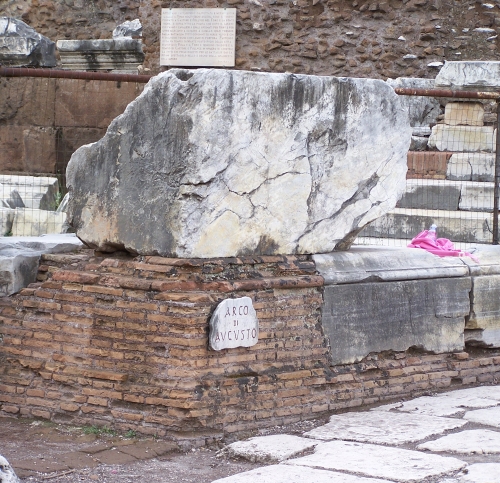
Photo: sailko · CC BY 2.5 · Wikimedia Commons
Regia is a royal palace and temple in ancient Rome. Roman tradition linked the Regia to legendary king Numa Pompilius. The free Lokali audio guide runs 6 minutes.
✓ Published October 2026 · how we write these guides
Visitor facts
| Lokali audio guide | 6 min · free |
|---|---|
| Type | Archaeological Site |
| Location | Rome, Italy |
| Coordinates | 41.8919, 12.4864 |
| Languages | 50+, in the Lokali app |
The story
Stand still for a moment and look down. Beside the Sacred Way, the main ancient road through the Roman Forum, there is a low, uneven outline of stone. Pale marble fragments sit beside darker blocks of volcanic tufa. Grass pushes up between the joints. Most visitors walk straight past it on their way to grander columns. But this modest footprint, called the Regia, was once one of the most sacred and secretive buildings in Rome.
The name means something close to the royal house. Roman tradition linked it to Numa Pompilius, the second of Rome's legendary kings. Numa was remembered as a peaceful, religious ruler who gave the city many of its rituals. Legend has it that he lived here, or at least worked here. Whether Numa truly existed is still debated. What is certain is that the Romans believed this ground belonged to the oldest layer of their city.
And archaeology supports part of that belief. Excavations here found traces of buildings going back to the late seventh or sixth century before Christ. That is the era when Rome was still ruled by kings. The site was rebuilt many times over the centuries, often after fires. But the strange thing is this... each new version kept roughly the same unusual shape. The Romans did not want to change a sacred plan, even when they rebuilt it in finer stone.
Look closely at the outline. It is not a neat rectangle. The plan is irregular, closer to a trapezoid, with one side set at an angle. This shape probably follows very old property lines and paths in the valley. For a city that loved order and symmetry, the Regia was an odd survivor. It was a reminder that Rome began as something small, local, and improvised.
After the kings were expelled, Rome became a republic. The religious duties of the king did not disappear. They passed to priests. The most important of them was the Pontifex Maximus, the chief priest of the Roman state. The Regia became his official headquarters. Here the pontiffs kept records, managed the religious calendar, and decided which days were lucky or unlucky for public business. In a city where politics and religion were tightly bound, this was real power.
Here is a detail that surprises many visitors. Julius Caesar held the office of Pontifex Maximus. That means this small building was one of his official seats. He lived close by, in the official residence of the chief priest. When you picture Caesar crossing the Forum, you can picture him walking this exact strip of ground. Just a short distance away stand the remains of the temple built in his memory, on the spot where his body was cremated.
Inside the Regia were shrines that ordinary Romans could not enter. One room was dedicated to Mars, the god of war. Ancient writers say the sacred shields and spears of Mars were kept here. According to Roman belief, if those spears moved or trembled by themselves, it was a warning. It meant danger for the state, and the priests had to perform rituals to calm the gods. Imagine the fear such a report could spread through the city.
Another shrine belonged to Ops, a goddess of plenty and the harvest. Access to it was strictly limited. Ancient sources say only the Vestal Virgins and the chief priest could enter. The Vestals were the priestesses who guarded the sacred fire of Rome. Their temple and their house stand only steps away from where you are now. The Regia, the Temple of Vesta, and the House of the Vestals formed a close religious cluster, the spiritual centre of the old city.
Now, a strange ritual connected to this spot. In mid October each year, the Romans held a horse race in honour of Mars. Ancient writers describe what happened next. One of the winning horses was sacrificed. Its tail was cut off and carried at a run to the Regia, so that its blood could drip onto the sacred hearth. Scholars still argue about the meaning. It may have been linked to the harvest, or to the end of the war season.
The building also changed in appearance. In 36 BC, a Roman general named Gnaeus Domitius Calvinus paid for a rebuilding in marble. He had won a military triumph, and paying for public buildings was how successful Romans displayed their glory. The white stone you see in fragments today belongs largely to that phase and later repairs. So the plan is ancient, but much of the visible material is from the time of the first emperors.
Lists of Rome's consuls and triumphs were once carved in marble in this area of the Forum. Some scholars connected these famous inscriptions with the walls of the Regia. Others argue they were displayed on a nearby monumental arch. The debate is not fully settled. Either way, the idea fits this place. The Regia was where Rome kept track of time itself, its years, its festivals, and the names of the people who ruled.
Look around you now. To one side are the round foundations of the Temple of Vesta. Behind you rise the columns of temples and the slope of the Palatine Hill, where emperors later built their palaces. The ground here is low, because this valley was once marshy and had to be drained. Listen for the crunch of gravel under many feet, the voices in many languages, and the swifts calling overhead.
Before you move on, take one last look at those broken stones. They do not look like much. There are no towering walls, no golden statues. Yet for more than a thousand years, Romans came here to ask what the gods wanted. As you walk along the Sacred Way, notice how close everything is. Priests, kings, and Caesar himself all crossed this same short stretch of ground.
Key facts
What to look for
Practical tips
Common questions
Is there a free audio guide to Regia?
Yes — the Lokali app narrates Regia free of charge in 50+ languages. The guide runs about 6 minutes, covers the history, what to look for on site and practical tips, and works offline once downloaded.
Where is Regia?
Regia is in Rome, Italy, at 41.8919, 12.4864. Tap the map link on this page for directions from where you are.
What is Regia known for?
Roman tradition linked the Regia to legendary king Numa Pompilius. Official headquarters of the Pontifex Maximus, Rome's chief priest.
What should you look for at Regia?
The irregular, angled outline of the building's foundations. Pale marble fragments resting beside darker volcanic tufa blocks. Round foundations of the Temple of Vesta just nearby.
What should you know before visiting Regia?
Visit early morning before Forum crowds reach the Sacred Way. Pair this stop with the nearby Temple of Vesta.
When is the best time to visit Regia?
Visit early morning before Forum crowds reach the Sacred Way.
On the map
Opens directions to Regia from your location.
More to see in Rome


Hear Regia in your language
The full story, narrated, in 50+ languages. Download it before you go and it plays offline, at your own pace, with no ticket and no tour group.