
Curia Hostilia
41.8931° N · 12.4853° E · Archaeological Site
Photo: Wikimedia Commons contributor · CC BY-SA 3.0 · Wikimedia Commons
Curia Hostilia is an archeological site in Italy. It is in Rome, Italy. Roman tradition credits King Tullus Hostilius with founding it. The free Lokali audio guide runs 6 minutes.
✓ Published October 2026 · how we write these guides
Visitor facts
| Lokali audio guide | 6 min · free |
|---|---|
| Type | Archaeological Site |
| Location | Rome, Italy |
| Coordinates | 41.8931, 12.4853 |
| Languages | 50+, in the Lokali app |
The story
Stand at the northwest corner of the Roman Forum and look down. The ground here is uneven: grey paving, broken travertine, patches of dry grass, and dust that settles on your shoes. Ahead of you rises a tall, plain brick building with a bronze-coloured door. That is the later senate house. What we have come to find is older, and it is not standing at all.
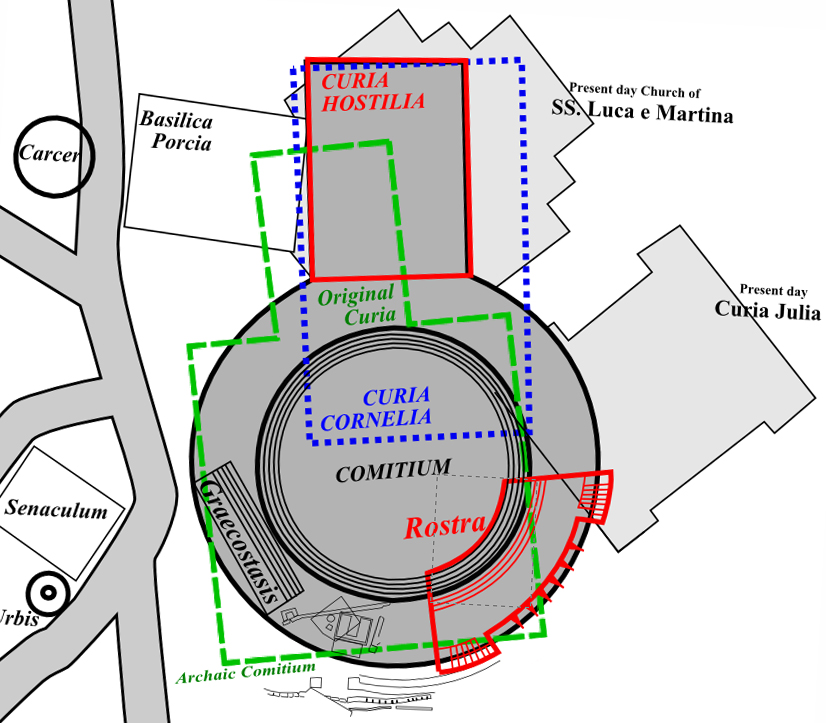
This is the area of the Curia Hostilia, the first meeting house of the Roman Senate. Romans linked its name to Tullus Hostilius, the third of the city's early kings. Most of what we hear about those kings is tradition rather than recorded history. So treat the founder story as legend. What is certain is that the building was very old, and that for centuries Rome was governed from this spot.
A curia was more than a room with benches. For the Romans, the Senate could only make proper decisions inside a consecrated space, called a templum. In such a place, priests could read the will of the gods before business began. So the senate house was a sacred building as well as a political one. Every argument made inside it took place, in a sense, under the eyes of heaven.
The building did not stand alone. It faced the Comitium, an open meeting ground where ordinary citizens gathered in assemblies. Next to it stood the Rostra, the speakers' platform. Its name came from the bronze prows of captured warships fixed to its front. Picture the arrangement: the senators above, in their roofed hall, and the voting people just below, in the open air, only a few steps away.
Here is a detail most visitors never hear. Pliny the Elder, a Roman writer of the first century, records that this building once worked as a clock. An official serving the consuls watched from the senate house. When he saw the sun standing between the Rostra and a platform reserved for foreign envoys, he called out that it was midday. Before sundials were common in Rome, the city told time by looking past this doorway.
Pliny also tells us something about its walls. After a Roman victory in Sicily in 263 BCE, the general Manius Valerius Messalla had a painting of his battle displayed on the side of the Curia Hostilia. The battle was against the Carthaginians and Hiero, ruler of Syracuse. Pliny presents this as an early landmark for painting in Rome. Imagine senators walking past a large, colourful image of war as they came to debate peace and money.
In the early first century BCE, the dictator Sulla changed both the Senate and its home. He enlarged the Senate, adding many new members. A larger body needed a larger hall, and the old building was rebuilt and expanded. For a generation, this enlarged house stood at the centre of Roman politics. It was the place for the long, bitter arguments of a republic that was slowly coming apart.
Then, in 52 BCE, came the fire. A popular and violent politician named Publius Clodius was killed by the men of his rival, Milo, on the road outside Rome. His supporters carried his body into the Forum. Ancient writers say they built a funeral pyre inside the senate house itself. They used the benches, the tables, and the records of the Senate as fuel. The flames spread, and the old curia burned down.
Pause on that image for a moment. A building tied to the earliest days of Rome was destroyed by an angry crowd mourning a street politician. It was not destroyed by a foreign army. Many historians see the event as a sign of how far public order had broken down. Within a few years, civil war would follow. The ashes on this ground mark one of the last chapters of the republic.
A new hall was begun by Faustus Sulla, the dictator's son, but it did not last long. Julius Caesar planned a fresh senate house on a slightly different line, and named it after his own family. After Caesar's murder, Augustus completed it, and it was dedicated in 29 BCE. The brick building you see today is that Curia Julia, rebuilt after a fire in the late third century under the emperor Diocletian.
So where exactly was the Curia Hostilia? Honestly, scholars still debate the precise outline. Most place it just north of the Comitium, partly under ground that later buildings and the modern street now cover. No walls of it are on display. What survives is the arrangement of the place: the slope, the open space of the assembly ground, and the later senate house standing close to where the first one was.
Very close by, look for a patch of dark stone paving behind a low fence. This is the Lapis Niger, the Black Stone. It marks a very old sacred spot. Beneath it, archaeologists found one of the earliest known Latin inscriptions. The Romans themselves were unsure what lay there. It is a reminder that this corner of the Forum was already ancient when the Senate first met here.
Now listen to the place as it is today. You hear footsteps on gravel, voices in many languages, and swifts calling above the brick walls. In summer the heat rises off the stones, and the air smells of dust and warm pine. There is no grand ruin to photograph for the Curia Hostilia. There is only ground, and the knowledge of what happened on it.
Before you move on, stand with your back to the brick senate house and face the open space where the people gathered. Somewhere under your feet, a building once stood where Rome governed itself, told the time, hung its war paintings, and finally burned. As you walk toward the rest of the Forum, notice how close everything is. In this small space, a city of a few hills became an empire.
Key facts
What to look for
Practical tips
Common questions
Is there a free audio guide to Curia Hostilia?
Yes — the Lokali app narrates Curia Hostilia free of charge in 50+ languages. The guide runs about 6 minutes, covers the history, what to look for on site and practical tips, and works offline once downloaded.
Where is Curia Hostilia?
Curia Hostilia is in Rome, Italy, at 41.8931, 12.4853. Tap the map link on this page for directions from where you are.
What is Curia Hostilia known for?
Roman tradition credits King Tullus Hostilius with founding it. It served as the Senate's first official meeting house.
What should you look for at Curia Hostilia?
The tall brick front of the later Curia Julia. The open, sunken ground of the old Comitium. The dark Lapis Niger paving behind a low fence.
What should you know before visiting Curia Hostilia?
Start at the Forum's northwest corner beside the brick Curia Julia. Visit early morning, when the open Comitium area is quieter.
When is the best time to visit Curia Hostilia?
Visit early morning, when the open Comitium area is quieter.
On the map
Opens directions to Curia Hostilia from your location.
More to see in Rome


Hear Curia Hostilia in your language
The full story, narrated, in 50+ languages. Download it before you go and it plays offline, at your own pace, with no ticket and no tour group.