
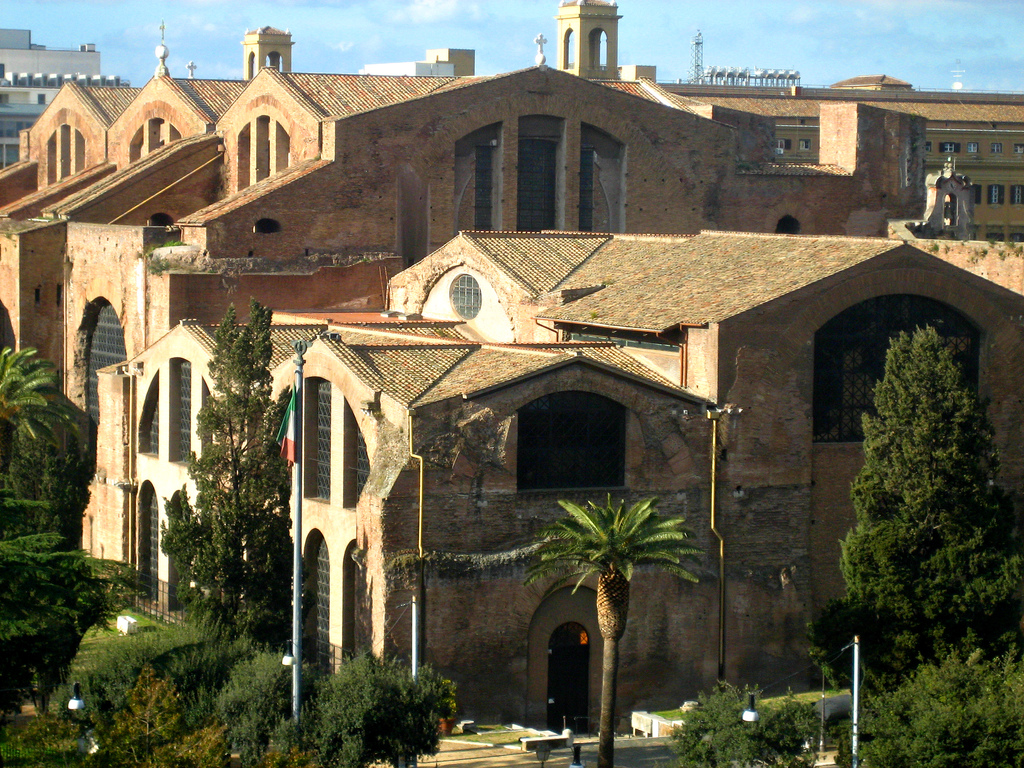
Photo: Briséis~commonswiki · CC BY-SA 3.0 · Wikimedia Commons
Museo Nazionale Romano is a museum in Italy. It is in Rome, Italy. The museum was founded in 1889 after Italian unification. The free Lokali audio guide runs 7 minutes.
✓ Published October 2026 · how we write these guides
Visitor facts
| Lokali audio guide | 7 min · free |
|---|---|
| Type | Museum |
| Location | Rome, Italy |
| Coordinates | 41.9034, 12.4990 |
| Official website | museonazionaleromano.beniculturali.it |
| Languages | 50+, in the Lokali app |
The story
Outside, the traffic of Piazza dei Cinquecento keeps moving. Buses hiss to a stop, suitcase wheels rattle toward Termini station, and scooters weave between taxis. Then you step through the doors, and the noise falls away. The air is cooler here. Marble floors carry the soft echo of footsteps. Within a few paces, you stand among faces that looked out over this city two thousand years ago.
The Museo Nazionale Romano, or National Roman Museum, is not a single building. It is one museum spread across several sites in the city. The institution was founded in 1889, soon after Rome became the capital of a unified Italy. Today its main branches are Palazzo Massimo, the Baths of Diocletian, Palazzo Altemps, and the Crypta Balbi. Each one has a different character. Together they hold one of the great collections of ancient Roman art anywhere.
Palazzo Massimo is often the best place to begin. The building itself is not ancient at all. It was built in the late nineteenth century as a Jesuit college, and its warm, ochre-toned facade looks out across the square toward the station. Inside, the collection rises floor by floor. Sculpture fills the lower levels. Wall paintings and mosaics wait higher up. And something quite unexpected is kept below ground.
On the ground floor, walk slowly past the portraits. These are not idealised gods. They are real Romans — men with heavy jowls, women with elaborate braided hair, old faces lined with worry. Roman sculptors valued a likeness, even an unflattering one. Among them stands a well-known statue of the emperor Augustus, shown with a fold of his toga drawn over his head. That gesture marked him as the chief priest of Rome, a man performing a sacred duty.
Now look for a seated bronze figure. This is the Boxer at Rest, a Greek work from the Hellenistic period — the centuries after Alexander the Great, when Greek art turned toward emotion and realism. Workers found it on the Quirinal Hill in 1885. It appeared to have been buried with care, as if someone in antiquity wanted to protect it. The boxer sits with his forearms on his knees. His head turns, as though someone has just called his name.
Go closer, and the details are hard to forget. His nose is broken. His ears are swollen and misshapen from years of blows. His hands are still wrapped in leather straps, the boxing gloves of the ancient world. And here is the detail many visitors miss — tiny inlays of copper mark fresh cuts on his face and body. Against the dark bronze, that reddish metal was meant to look like blood. Two thousand years later, he still looks tired.
Climb to the upper floors, and the mood changes completely. Here the museum displays wall paintings removed from ancient Roman houses. The most famous comes from a villa at Prima Porta, just north of Rome, linked to Livia, the wife of Augustus. It was an underground room, probably a cool retreat in summer. Its walls show a painted garden that seems to go on forever. The whole room has been reconstructed here, so you can stand inside it.
Take a moment in Livia's garden room. Fruit trees hang heavy with pomegranates and quinces. Birds perch on branches and sit on a low painted fence. The blue sky fades softly into the distance. The painters used no single central view. Instead, the garden wraps all around you, wall after wall. For a Roman sitting here on a hot afternoon, underground and out of the sun, it must have felt like a garden that never wilted.
Nearby, other rooms show paintings and stucco work from a Roman house found beside the Tiber. It came to light in the late nineteenth century, when engineers were building the high stone embankments that now line the river. Look up at the white stucco ceilings. The figures are shallow, delicate, almost like drawings pressed into plaster. Around them, floor mosaics show how much colour and pattern Romans brought into their homes.
Before you leave this building, go down to the basement. Many visitors walk straight past it. Down there is the museum's coin collection, displayed in a secure, vault-like space. Coins were the ancient world's newspapers in a way. Each new emperor put his own portrait and his own messages on them, and those coins travelled across the empire. Here you can follow centuries of Roman power through small discs of bronze, silver, and gold.
Now cross the square to the Baths of Diocletian. This was a vast public bathing complex built in the early fourth century, and it was the largest in Rome. Romans came here not only to wash, but to exercise, meet friends, and talk. In the sixteenth century, Michelangelo turned part of the great central hall into a church, Santa Maria degli Angeli. The museum occupies other parts of the old complex, where brick walls still rise high above visitors.
Inside this branch, the large cloister is a place to slow down. It is a broad, quiet courtyard lined with arcades, with greenery and ancient sculpture set along the walks. Elsewhere, the collection includes many Latin inscriptions — on tombs, altars, and public monuments. They record names, jobs, ages, and short messages from the living to the dead. Here, ordinary Romans speak to us directly, often in just a few carved lines.
The other branches are worth a separate visit. Palazzo Altemps, near Piazza Navona, is a Renaissance palace filled with ancient sculpture once owned by noble collectors. One famous group shows a Gaulish warrior killing himself after killing his wife, rather than be captured. The Crypta Balbi takes a different approach. It shows how one corner of Rome changed over many centuries, layer upon layer, from antiquity to the Middle Ages and beyond.
When you step back outside, the noise of the square returns. But look around with new eyes. Near the station, there are surviving pieces of ancient walls, standing among modern buses and shops. The brick of the Baths of Diocletian rises across the road. The faces you saw inside once walked these same hills. As you head off into the city, notice how often the ancient and the everyday still stand side by side here.
Key facts
What to look for
Practical tips
Common questions
Is there a free audio guide to Museo Nazionale Romano?
Yes — the Lokali app narrates Museo Nazionale Romano free of charge in 50+ languages. The guide runs about 7 minutes, covers the history, what to look for on site and practical tips, and works offline once downloaded.
Where is Museo Nazionale Romano?
Museo Nazionale Romano is in Rome, Italy, at 41.9034, 12.4990. Tap the map link on this page for directions from where you are.
What is Museo Nazionale Romano known for?
The museum was founded in 1889 after Italian unification. One museum is spread across four separate city sites.
What should you look for at Museo Nazionale Romano?
Copper inlays marking bloody cuts on the bronze boxer. The boxer's swollen ears and broken nose. Birds perched on the painted fence in Livia's garden room.
What should you know before visiting Museo Nazionale Romano?
Start at Palazzo Massimo, directly beside Termini station. Check whether your ticket also covers the other museum branches.
On the map
Opens directions to Museo Nazionale Romano from your location.
More to see in Rome


Hear Museo Nazionale Romano in your language
The full story, narrated, in 50+ languages. Download it before you go and it plays offline, at your own pace, with no ticket and no tour group.