
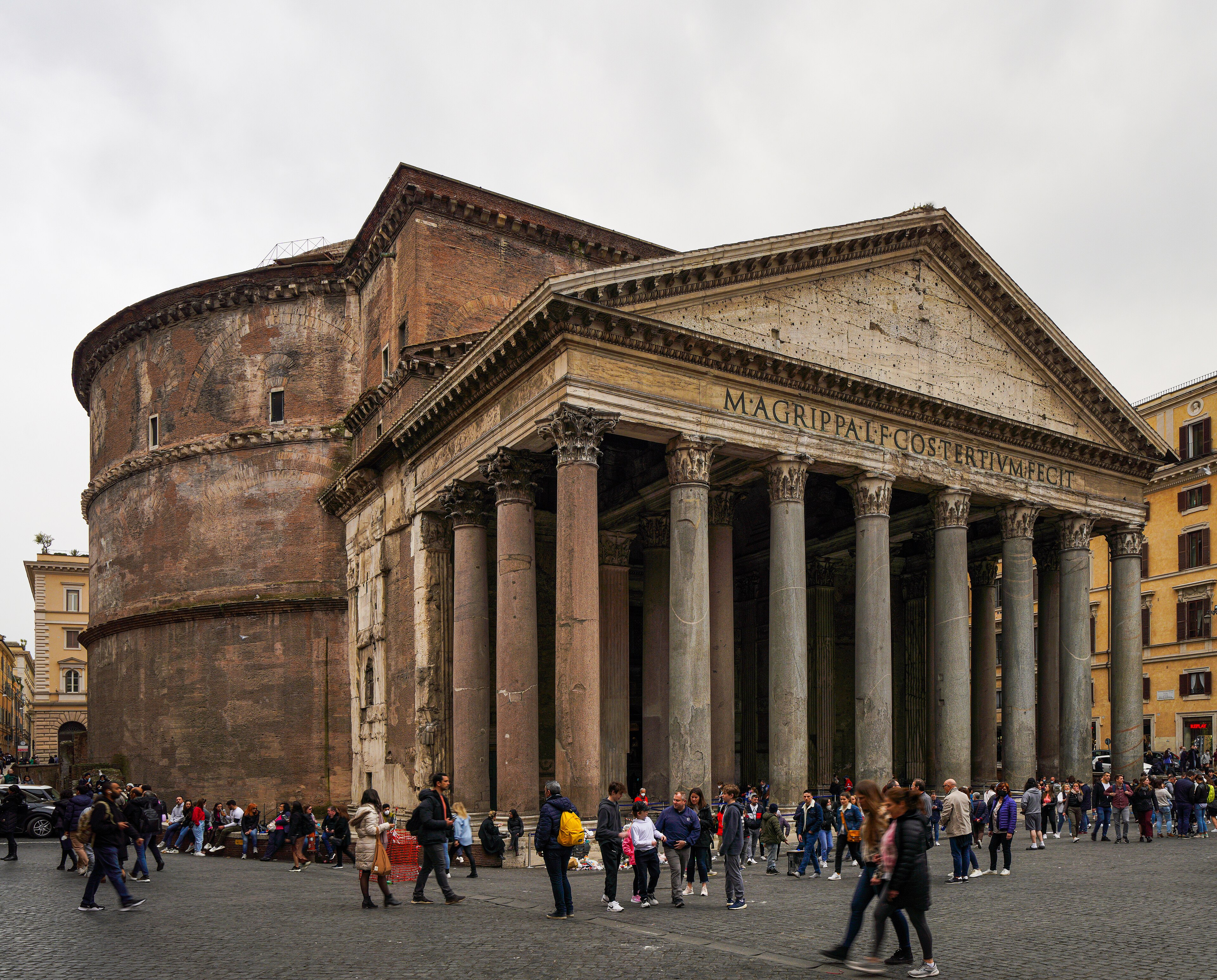
Photo: Fiat 500e · CC BY 4.0 · Wikimedia Commons
Sant'Ignazio, Rome is a church in Rome, Italy. Dedicated to Ignatius of Loyola, founder of the Jesuits. The free Lokali audio guide runs 6 minutes.
✓ Published October 2026 · how we write these guides
Visitor facts
| Lokali audio guide | 6 min · free |
|---|---|
| Type | Church |
| Location | Rome, Italy |
| Coordinates | 41.8990, 12.4797 |
| Official website | santignazio.gesuiti.it |
| Languages | 50+, in the Lokali app |
The story
Push through the heavy door and the noise of the piazza falls away. The air inside is cool and smells faintly of old stone and candle wax. Your footsteps echo across a floor of coloured marble. Then you look up, and the roof seems to open into the sky. Figures float upward, columns climb higher than any column could, and light pours down from somewhere far above. It looks real, but none of it is.
This is the Church of Saint Ignatius of Loyola, set in the old Campo Marzio district, a short walk from the Pantheon. It honours the Spanish soldier who became a priest and founded the Society of Jesus, the religious order better known as the Jesuits. Ignatius was declared a saint in 1622. Soon after, plans began for a great church in his name, here in the heart of Rome.
The church was commissioned by Cardinal Ludovico Ludovisi, the nephew of Pope Gregory the Fifteenth, the same pope who made Ignatius a saint. Work began in the 1620s. The design is linked to Orazio Grassi, a Jesuit mathematician and astronomer. Here is a surprise most visitors miss. Grassi is also remembered for a famous public argument with Galileo about the nature of comets. The man behind this building was a scientist as much as a builder.
The church served the Roman College next door, the great Jesuit school where generations of priests and scholars were trained. That is why the building feels so closely tied to learning. Mathematics, astronomy and theology all lived side by side in this corner of the city. Construction took a long time. The church was not fully consecrated until the early eighteenth century, roughly a century after the first stones were laid.
Now stand in the middle of the nave and look at the great vault above you. This is the work of Andrea Pozzo, a Jesuit lay brother and painter, created in the late seventeenth century. It shows Saint Ignatius being carried up into heaven. Around him, figures represent the four continents known to Europeans at the time: Europe, Asia, Africa and America. Rays of light travel from Christ to Ignatius, and from Ignatius out to the corners of the world.
The trick here is called quadratura. It is a style of painting that uses careful perspective to extend real architecture into painted space. Pozzo painted columns, arches and balconies that seem to continue the walls upward. From the right spot, the flat ceiling disappears. Look for a small marble disc set into the floor of the nave. Stand on it, tilt your head back, and the illusion works at its strongest.
Take a few steps away from that disc and watch what happens. The columns begin to lean. The arches bend at strange angles. The whole painted building seems to tip over. This is not a mistake. Pozzo calculated the perspective for one viewer standing in one place. It is a quiet reminder that every illusion depends on where you stand, and that the painter planned for you, the visitor, centuries before you arrived.
Now walk toward the crossing, where the dome should be. Look up. You see a tall dome with windows, a lantern and deep shadows. But there is no dome. The church was planned with one, but it was never built. One common explanation is that the money ran out. Locals also tell a story that neighbours objected because a dome would block their light and views. Treat that one as legend rather than record.
Pozzo solved the problem with paint. He created a false dome on a flat canvas, using the same tricks of perspective. Again, there is a marked spot on the floor where the effect is best. From there, the curve looks convincing. Move toward the altar and the painting slowly flattens, like a stage set seen from the wings. Pozzo later wrote an influential treatise on perspective for painters and architects, so this was a method he wanted others to learn.
The church is also a place of burial for several Jesuit saints. In the right transept, look for the altar of Saint Aloysius Gonzaga, a young Italian noble who gave up his inheritance to join the Jesuits and died while nursing plague victims in Rome. His remains rest in an urn decorated with deep blue lapis lazuli. Saint Robert Bellarmine, a theologian and cardinal, and Saint John Berchmans, a young Jesuit student, are also buried in this church.
As you move through the side chapels, notice how much of the decoration is real marble, and how much is painted to look like marble. The Jesuits wanted their churches to feel rich and full of light, to move visitors emotionally. This style is called Baroque, the dramatic art of seventeenth century Europe, designed to surprise the eye and stir the heart. Here, the line between real and painted is part of the message.
Before you leave, step back outside and turn around. The square in front of the church is small, and it was designed in the eighteenth century by the architect Filippo Raguzzini. The buildings facing the church curve and bend like pieces of fine furniture. Romans have long compared them to chests of drawers. The whole square feels like a theatre set, and the church facade is the stage.
Stand in the piazza for a moment and listen. You may hear café cups, a scooter in a side street, voices bouncing off the curved walls. Above you, the facade rises in pale stone, calm and solid. Inside, behind those doors, a painted heaven still opens over the nave. As you walk away toward the Pantheon, look up at the ordinary ceilings and cornices of Rome. After Pozzo, it is hard not to wonder what is real.
Key facts
What to look for
Practical tips
Common questions
Is there a free audio guide to Sant'Ignazio, Rome?
Yes — the Lokali app narrates Sant'Ignazio, Rome free of charge in 50+ languages. The guide runs about 6 minutes, covers the history, what to look for on site and practical tips, and works offline once downloaded.
Where is Sant'Ignazio, Rome?
Sant'Ignazio, Rome is in Rome, Italy, at 41.8990, 12.4797. Tap the map link on this page for directions from where you are.
What is Sant'Ignazio, Rome known for?
Dedicated to Ignatius of Loyola, founder of the Jesuits. Ignatius was declared a saint in 1622.
What should you look for at Sant'Ignazio, Rome?
Marble disc in the nave marking Pozzo's viewing point. Painted columns that lean when seen off-centre. The flat canvas false dome above the crossing.
What should you know before visiting Sant'Ignazio, Rome?
Find the floor marker before looking up at the vault. Walk slowly away to watch the illusion collapse.
On the map
Opens directions to Sant'Ignazio, Rome from your location.
More to see in Rome



Hear Sant'Ignazio, Rome in your language
The full story, narrated, in 50+ languages. Download it before you go and it plays offline, at your own pace, with no ticket and no tour group.