Pantheon
📍 About this place
A 2,000-year-old Roman temple with a perfectly preserved interior dome and an oculus opening to the sky. Built under Hadrian, it stands as one of the best-preserved Roman buildings and demonstrates classical architectural genius.
📖 The story
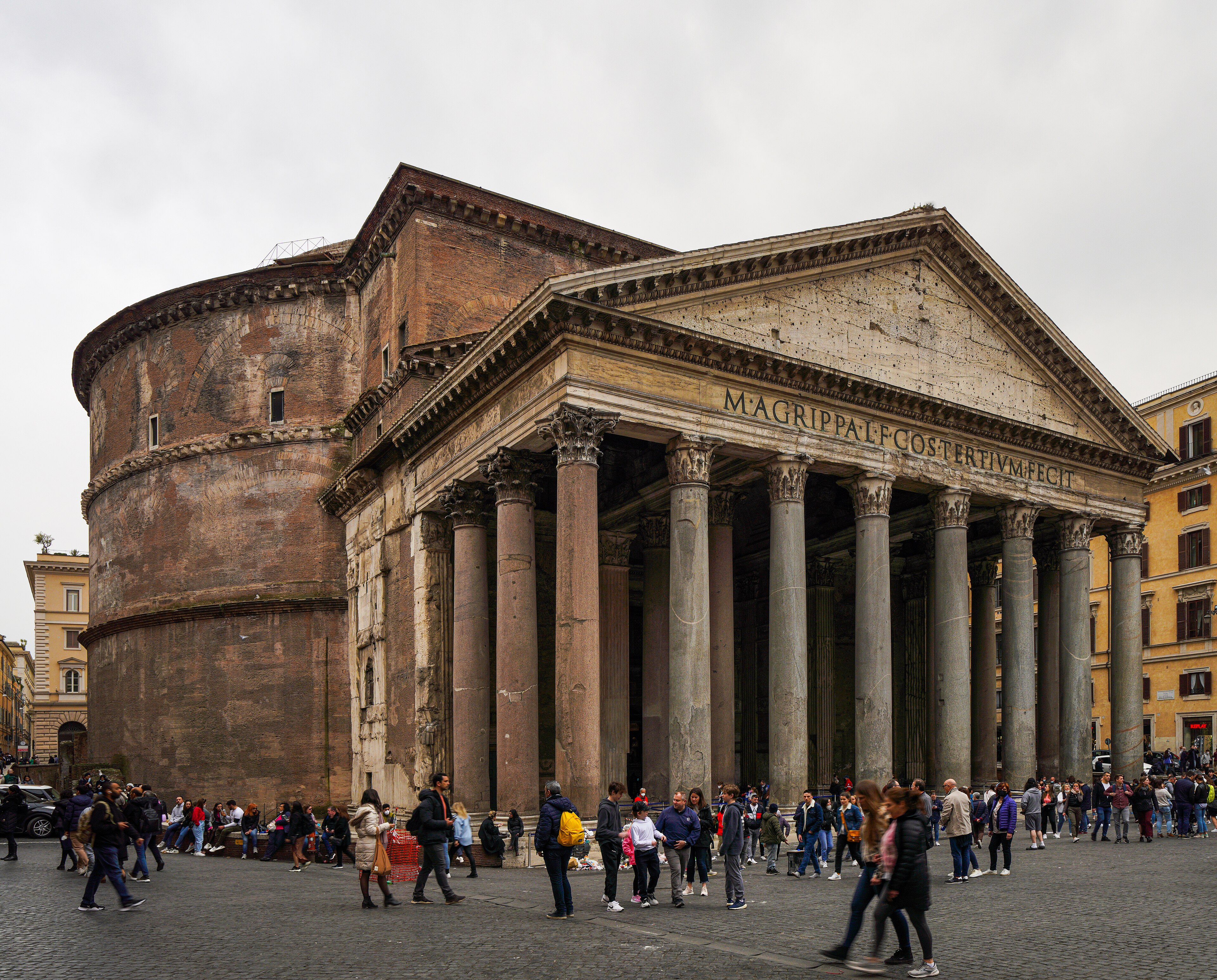
Stand in the square and look up at the row of vast granite columns, then at the inscription across the front naming Marcus Agrippa, a Roman who died long before the building you see was finished. Step through the bronze doors and the space opens into a domed hall flooded with light from a single round opening overhead. This is the Pantheon, the best-preserved building of ancient Rome.
Its survival is the first wonder. Most ancient Roman buildings stand as ruins, stripped and broken, but the Pantheon is almost whole, because it was turned into a Christian church in the seventh century and cared for ever since. What you walk into is close to what a Roman would have seen nearly nineteen centuries ago.
The building you see was raised under the emperor Hadrian, around the 120s, on the site of an earlier temple by Agrippa whose name the front still carries. Hadrian kept the old inscription rather than claiming the work for himself, which has confused visitors about the building's true age ever since.
The dome is the heart of it. It remains the largest dome of unreinforced concrete in the world, a single span the Romans achieved with skills later half-forgotten for a thousand years. Its underside is patterned with sunken squares that grow smaller toward the top, both lightening the weight and drawing the eye upward.
At the very centre is the oculus, a round opening some nine metres across, open to the sky. It is the only source of light, and it moves a great disc of sunshine slowly around the interior through the day. When it rains, the rain falls straight in, and drains set in the floor carry it away.
The proportions are deliberately perfect. The height to the top of the dome equals the width of the floor, so the interior would exactly hold a sphere. Standing in the centre, you are inside a piece of geometry made solid, which is part of why the space feels so calm and complete.
The Pantheon is also a working church and a tomb. Altars and chapels line the walls, and among those buried here are kings of Italy and the Renaissance painter Raphael, whose grave draws a quiet, steady stream of visitors paying their respects.
The columns of the porch are single shafts of grey and pink granite, quarried in Egypt and shipped across the sea, each one enormous and seamless. Run your eye down them and consider the effort of moving such weights without modern machines; the porch alone was a feat of engineering and empire.
The great bronze doors are ancient too, among the few large Roman doors to survive, still swinging on their hinges. Much other bronze that once decorated the building was stripped away over the centuries for other uses, a reminder that even this survivor was plundered in its long life.
Before you leave, stand directly under the oculus and look straight up at the circle of open sky. Romans, and then Christians, have looked up through that same opening for nearly nineteen hundred years. When you step back out into the busy square, the ordinary city feels almost startling after the still, ordered space within.
💡 Key facts
👀 What to look for
🎒 Practical tips
❓ Common questions
- How long do you need at Pantheon?
- Plan around 30-45 min on site. The free Lokali audio guide (~5 min) tells the story as you explore.
- Is there a free audio guide to Pantheon?
- Yes. The Lokali app narrates Pantheon for free in your own language — history, what to look for and practical tips, right at the site.
- What should you know before visiting Pantheon?
- Visit early in the morning to avoid crowds. Dress modestly, as in any working church. Mind the wet floor beneath the oculus after rain.
🗺️ On the map
Opens directions to Pantheon from your location.