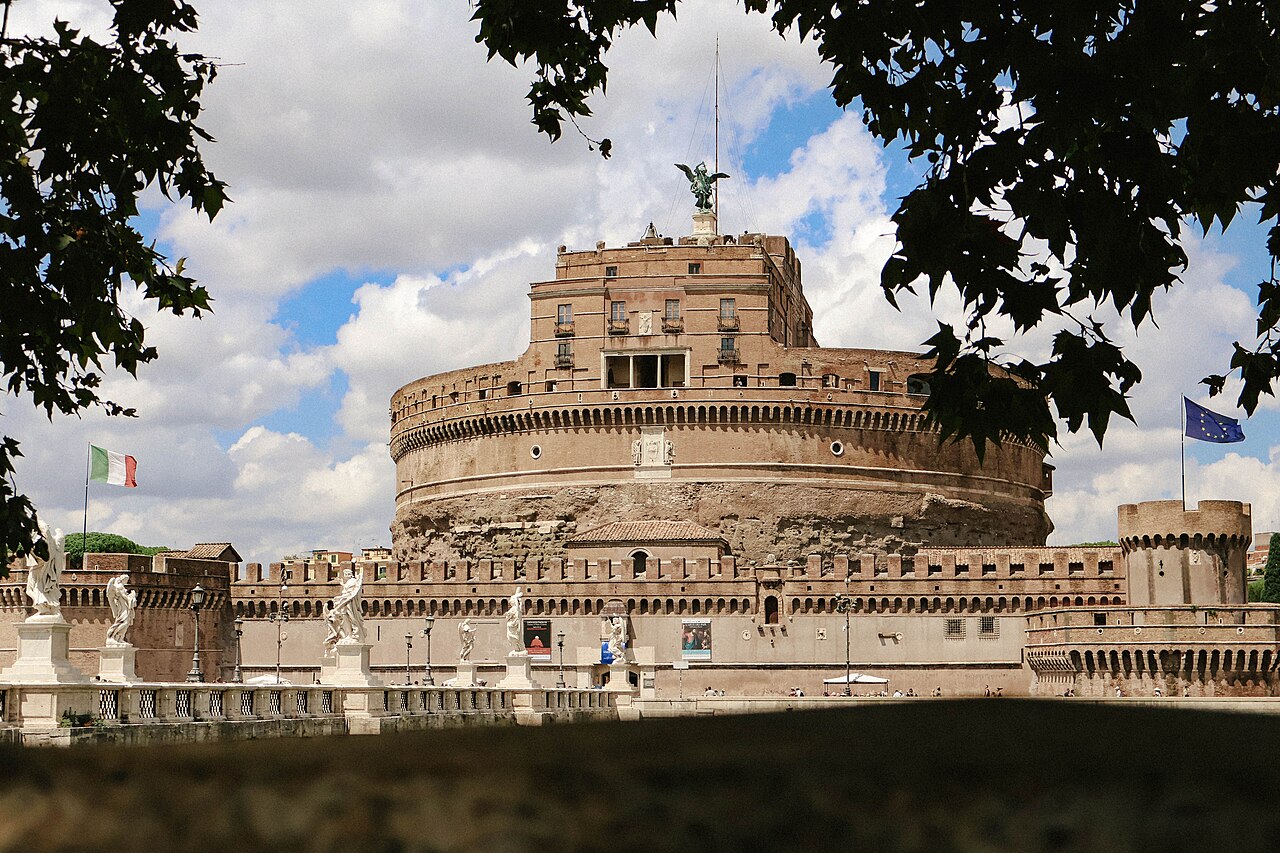
Castel Sant'Angelo is a castle in Rome, Italy. Built as the mausoleum of Emperor Hadrian in 139 CE, this cylindrical fortress later became a papal stronghold and prison. Most visitors spend 1–2 hours here. The free Lokali audio guide runs 5 minutes.
✓ Verified August 2026 · how we write these guides
Visitor facts
| Time needed | 1–2 hours |
|---|---|
| Lokali audio guide | 5 min · free |
| Type | Castle |
| Best for | History |
| Location | Rome, Italy |
| Coordinates | 41.9019, 12.4665 |
| Languages | 45, in the Lokali app |
The story
A massive round drum of brick and stone rises from the bank of the Tiber, topped by a bronze angel with outspread wings. A bridge lined with marble angels leads across the river toward it. This is Castel Sant'Angelo, a building that began as a tomb for an emperor and became, by turns, a fortress, a prison, and a refuge for popes.
It started as a mausoleum. The emperor Hadrian built it in the second century, around 139, as a grand circular tomb for himself and his family, faced in marble and crowned with statues. Much of that decoration is long gone, but the huge cylindrical core survives as the heart of everything built since.
Its position by the river, close to what became the Vatican, gave it a second life as a fortress. Over the centuries it was strengthened into a castle guarding the approach to the papal city, its old tomb chambers turned into ramparts, store-rooms, and gun positions.
A raised, walled corridor connects the castle to the Vatican, a private escape route for the popes. In times of danger a pope could slip from his palace to the safety of the fortress along this passage, and at least one did exactly that when the city was sacked in the sixteenth century.
The castle takes its name from a legend. The story tells that, during a deadly plague late in the sixth century, the Archangel Michael appeared above the building, sheathing his sword to signal the end of the sickness. The bronze angel on the top, replaced over the years, remembers that vision.
Inside, a spiral ramp built for the emperor's funeral leads up through the ancient core, and above it lie centuries of later rooms — papal apartments with painted ceilings, grim prison cells, armouries, and store-rooms. Climbing through, you pass from Roman tomb to Renaissance palace to fortress in a single route.
The prison cells are part of the darker story. Over the centuries the castle held many prisoners, some of them famous, in conditions ranging from comfortable confinement to harsh dungeons, and that history of captivity sits oddly alongside the richly painted rooms of the popes nearby.
The reward at the top is the terrace. From the open platform around the base of the bronze angel, you get one of the finest wide views in Rome, along the river, over the rooftops, and across to the great dome of Saint Peter's, close enough to feel you could almost touch it.
The bridge in front of the castle is a sight in its own right. Lined with marble angels designed by a great Baroque sculptor and his workshop, each carrying a symbol of the crucifixion, it is one of the most beautiful river crossings in the city, especially in low evening light.
The castle now works as a museum, its rooms holding sculpture, paintings, arms, and the layered history of the building itself. It is large enough to reward a couple of hours, moving slowly upward from the ancient base to the terrace at the summit.
A few practical notes. Entry is ticketed, and booking ahead saves queueing in summer; the climb involves ramps and stairs but is gradual rather than steep. Late afternoon rewards you with warm light on the terrace and on the dome of Saint Peter's, a fine time to make the climb.
Stand on the terrace by the angel before you go back down, with the river bending below and the city spread out around you. Few buildings have lived so many lives — tomb, fortress, prison, palace, and refuge — on a single spot. When you cross back over the angel-lined bridge, the long story of the place goes with you.
Key facts
What to look for
Practical tips
Common questions
How long do you need at Castel Sant'Angelo?
Plan 1–2 hours. That is the time most visitors spend at Castel Sant'Angelo. The free Lokali audio guide adds about 5 minutes of narration you can listen to as you walk, so it fits inside your visit rather than adding to it.
Is there a free audio guide to Castel Sant'Angelo?
Yes — the Lokali app narrates Castel Sant'Angelo free of charge in 50+ languages. It covers the history, what to look for on site and practical tips, and it works offline once downloaded.
Where is Castel Sant'Angelo?
Castel Sant'Angelo is in Rome, Italy, at 41.9019, 12.4665 Tap the map link on this page for directions from where you are.
What should you know before visiting Castel Sant'Angelo?
Book ahead to skip the summer queues.
What is Castel Sant'Angelo known for?
Built as the mausoleum of the emperor Hadrian.
What is the best time to visit Castel Sant'Angelo?
The rooftop terrace offers views across the Tiber toward the dome of St.
On the map
Opens directions to Castel Sant'Angelo from your location.
More to see in Rome




Hear Castel Sant'Angelo in your language
The full story, narrated, in 50+ languages. Download it before you go and it plays offline, at your own pace, with no ticket and no tour group.