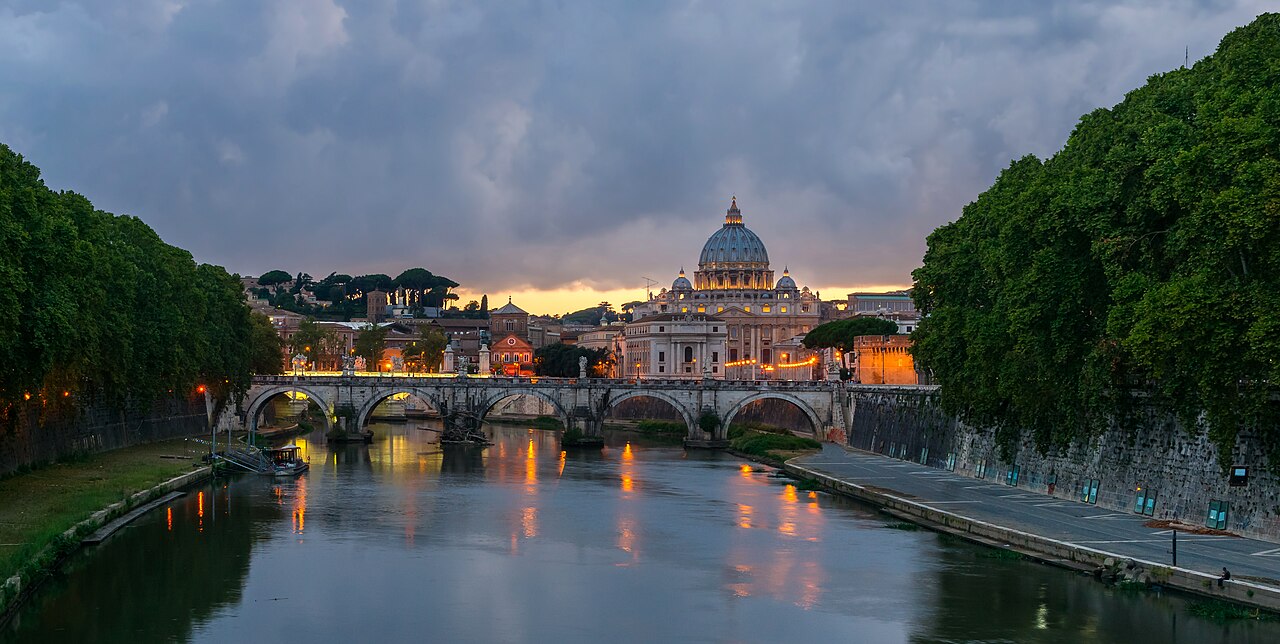
Ponte Sant'Angelo is a bridge in Rome, Italy. Roman bridge built by Hadrian in 134 AD, later renamed after the nearby castle. Most visitors spend 15–30 min here. The free Lokali audio guide runs 5 minutes.
✓ Verified August 2026 · how we write these guides
Visitor facts
| Time needed | 15–30 min |
|---|---|
| Lokali audio guide | 5 min · free |
| Type | Bridge |
| Best for | Photography |
| Location | Rome, Italy |
| Coordinates | 41.9011, 12.4665 |
| Languages | 45, in the Lokali app |
The story
You stand at the river's edge, and a line of stone angels reaches out across the water toward a great round fortress. The Tiber moves slowly and green below. Each angel holds something in its hands, lifted or cradled. Their wings catch the light. This is the Ponte Sant'Angelo, the bridge of the holy angel, and walking it is like passing through a slow procession.
The bridge is old, far older than the angels upon it. The emperor Hadrian built it in 134 AD. He raised it to carry visitors across the river to his own tomb, the huge drum of stone on the far bank that now bears the name Castel Sant'Angelo. For most of its life this was the main approach to that monument, and later the great pilgrim road toward Saint Peter's beyond.
Walk out onto the bridge itself. No cars come here now; the crossing is left to people on foot, so you can move at your own pace. Below you, the water slides between wide arches. The three central arches are Hadrian's original Roman work, still bearing weight after almost nineteen centuries. The outer spans were rebuilt in later ages as the river was tamed.
The angels came much later. In the seventeenth century the sculptor Gian Lorenzo Bernini designed ten of them, set five to a side. He gave each angel an object from the story of Christ's final hours. One holds the crown of thorns. One holds the nails. One holds the column of the scourging. One carries the cross. Read together, side by side, they tell the whole story of the Passion as you walk.
Bernini carved two of the angels with his own hands. They were judged so fine that leaving them out in the weather seemed a waste. So the two originals were kept safe indoors, in a church not far away, and faithful copies were set on the bridge in their place. The figures you pass are true to what the master shaped, down to the fall of each fold.
Look at how the angels seem to move. Their robes lift as if caught in wind. Their bodies twist. Their faces tilt with sorrow toward the things they hold. Bernini wanted hard marble to feel like living cloth and living grief, and here he reached it. As you pass between them, the light shifts across the stone and the folds seem to stir on their own.
At the city end of the bridge stand two larger, older figures. One is Saint Peter, holding the keys given to him by tradition. One is Saint Paul, holding a sword. These two were placed in the sixteenth century, before Bernini's angels arrived, to greet pilgrims at the very start of the crossing and point them toward the tombs ahead.
For long centuries this bridge carried pilgrims toward the tomb of Saint Peter across the river. The press of bodies could be dangerous. In the holy year of 1450, so many people crowded onto the span at once that a panic broke out. In the crush, many were trampled or forced over the edge into the water, and a large number died. The disaster was remembered and retold for generations.
Pause near the middle and look straight ahead toward the fortress. The round mass of Castel Sant'Angelo rises directly before you, and the line of the bridge leads your eye to its gate. The two were conceived as a single idea: the road and the tomb, the approach and the goal, joined across the river by Hadrian's design.
Now turn and look the other way, back over the city. The Tiber bends away between its high stone walls. Domes and tiled rooftops crowd the far bank. Once, small boats tied up below these embankments to unload their cargo. The bridge has watched the river rise in flood and sink again many times, and through all of it has held the same quiet angle.
Notice the smaller things as you go. The pale marble of the angels against the darker stone of the parapet. The instruments of the Passion held out toward you, one after another. The worn surface of the old paving beneath your feet, polished smooth by countless steps over countless years. Run a hand along the rail and feel how the stone has rounded.
Stand a while between two of the angels and let the sound of the river rise around you. This crossing has joined the two halves of Rome for almost two thousand years, and carried hope and grief in equal measure. When you are ready, walk on toward the fortress, and follow the same path that so many have walked before you.
Key facts
What to look for
Practical tips
Common questions
How long do you need at Ponte Sant'Angelo?
Plan 15–30 min. That is the time most visitors spend at Ponte Sant'Angelo. The free Lokali audio guide adds about 5 minutes of narration you can listen to as you walk, so it fits inside your visit rather than adding to it.
Is there a free audio guide to Ponte Sant'Angelo?
Yes — the Lokali app narrates Ponte Sant'Angelo free of charge in 50+ languages. It covers the history, what to look for on site and practical tips, and it works offline once downloaded.
Where is Ponte Sant'Angelo?
Ponte Sant'Angelo is in Rome, Italy, at 41.9011, 12.4665 Tap the map link on this page for directions from where you are.
What should you know before visiting Ponte Sant'Angelo?
Cross on foot since cars are not allowed.
What is Ponte Sant'Angelo known for?
Built by Emperor Hadrian in 134 AD.
What is the best time to visit Ponte Sant'Angelo?
Early morning light catches the travertine stone beautifully.
On the map
Opens directions to Ponte Sant'Angelo from your location.
More to see in Rome



Hear Ponte Sant'Angelo in your language
The full story, narrated, in 50+ languages. Download it before you go and it plays offline, at your own pace, with no ticket and no tour group.