Lokali
EN
Rome › Vatican City
Vatican City, Rome
Rome, Italy

Vatican City

~9 minReligious Complex★ 5

📍 About this place

An independent city-state within Rome, home to St. Peter's Basilica and the Apostolic Palace. The spiritual centre of the Roman Catholic Church and a masterpiece of Renaissance architecture, built over the burial site of Saint Peter.

📖 The story

The air changes as you cross the white boundary line painted on the cobblestones — suddenly cooler, quieter, as if the stone itself absorbs sound. You are standing in the world's smallest country, barely forty-four hectares, yet it holds more art per square metre than anywhere else on Earth. The scent of old incense drifts from somewhere unseen.

This enclave became a sovereign state only in 1929, after decades of tension between the Catholic Church and the Italian government. The Lateran Treaty carved out this tiny patch of Rome as an independent nation, with its own postal system, railway station, and Swiss Guard in striped Renaissance uniforms. Before that, popes ruled vast territories across central Italy for over a thousand years — the Papal States — until Italian unification stripped them away in 1870.

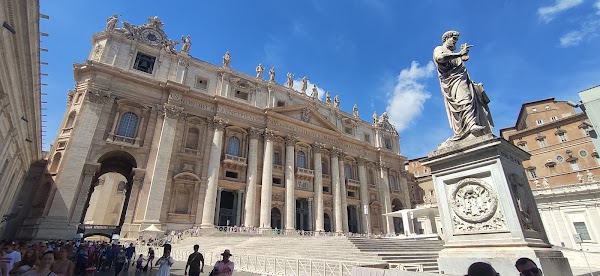
The basilica rising before you stands on the site where early Christians believed Saint Peter was buried after his execution in Nero's circus, around the year 64. Constantine built the first church here in the fourth century. That ancient structure survived a millennium before Renaissance popes decided it was crumbling beyond repair. In 1506, Pope Julius the Second laid the foundation stone for the current basilica — a project that would consume 120 years and the talents of Bramante, Raphael, Michelangelo, and Bernini.

Michelangelo's dome dominates the skyline, a double-shell construction rising 136 metres above the floor. He took over the project in 1547, already in his seventies, and worked on it until his death. The dome was finished in 1590, decades after he was gone. Inside, the scale disorients — the cherubs flanking the holy water fonts are two metres tall, but look child-sized from the nave. The bronze baldachin over the papal altar, designed by Bernini, stands as tall as a four-storey building.

The Vatican Museums stretch through fifty-four galleries, seven kilometres of corridors if you walked every hall. Popes have been collecting art here since the early sixteenth century — Egyptian mummies, Greek statues hauled from ancient ruins, Renaissance paintings commissioned directly from the artists. The Sistine Chapel sits near the end of the standard route, its ceiling painted by Michelangelo between 1508 and 1512 while lying on scaffolding, not on his back as the myth claims, but standing and craning his neck until his spine ached.

The Vatican Library holds over a million printed books and seventy-five thousand manuscripts, some dating back fifteen hundred years. Scholars apply months in advance for access. The Secret Archives — misnamed, as 'secretum' in Latin simply means private — contain correspondence from Galileo, Henry the Eighth's petition for annulment, letters from Michelangelo complaining about unpaid fees. Much of it has only been opened to researchers in recent decades.

Saint Peter's Square, designed by Bernini in the 1650s, embraces visitors with two semicircular colonnades — 284 columns, each one a single piece of travertine stone. Stand on either of the circular porphyry discs set into the pavement between the fountains and the obelisk, and the four rows of columns align perfectly into a single visual plane, a trick of perspective Bernini engineered deliberately. The Egyptian obelisk at the centre is older than Christianity itself, brought to Rome by Caligula in 37 AD and moved to this spot in 1586 — a feat requiring nine hundred men, seventy-five horses, and forty-seven cranes.

The Swiss Guard has protected the pope since 1506, recruited exclusively from Catholic men of Swiss citizenship who have completed Swiss military training. Their halberds are not ceremonial — the guards train with firearms and modern security protocols behind the Renaissance facade. On May 6, 1527, 147 Swiss Guards died defending Pope Clement the Seventh during the Sack of Rome, holding the steps long enough for him to escape through a secret passage to Castel Sant'Angelo. New recruits still swear their oath on that date each year.

The Vatican's population hovers around eight hundred, most of whom live outside the walls and commute in daily. It has its own pharmacy, supermarket, petrol station, and even a small helipad. The railway station, built in 1930, connects to Italy's network but sees almost no passenger traffic — mostly freight. The Vatican mints its own euro coins, issues its own stamps, and operates one of the world's most listened-to radio stations, broadcasting in over forty languages.

As you stand here, bells ring from the basilica — not recorded chimes but actual bronze bells, some weighing several tonnes, cast centuries ago. The light shifts as clouds pass over the dome. Tourists flow past in rivers, but if you step to the edge of the colonnade and look back across the square, you can still catch a moment of stillness, the geometry of stone and shadow, the weight of all those centuries pressing gently against the present.

Whatever your faith or lack of it, this place operates on a scale designed to awe — not through height alone, though the dome certainly soars, but through the accumulated density of human ambition, artistry, and belief compressed into a few city blocks. The marble underfoot has been polished by millions of footsteps. The air still smells faintly of candle wax and old stone.

💡 Key facts

World's smallest country at forty-four hectares
Became sovereign state in 1929 via Lateran Treaty
Saint Peter's dome rises 136 metres high
Sistine Chapel ceiling painted 1508 to 1512
Museums hold seven kilometres of galleries

👀 What to look for

Porphyry discs in square show column perspective trick
Two-metre-tall cherubs flanking holy water fonts
Swiss Guard halberds and striped Renaissance uniforms
Bernini's bronze baldachin, tall as four-storey building
Egyptian obelisk older than Christianity at square's centre

🎒 Practical tips

Arrive before opening to avoid longest queues
Dress code enforced — shoulders and knees covered
Museum route is one-way, plan three hours minimum
Climb the dome for rooftop views, 551 steps total
Free entry to basilica, museums require tickets

❓ Common questions

How long do you need at Vatican City?
Plan around 2-4 hours on site. The free Lokali audio guide (~9 min) tells the story as you explore.
Is there a free audio guide to Vatican City?
Yes. The Lokali app narrates Vatican City for free in your own language — history, what to look for and practical tips, right at the site.
What should you know before visiting Vatican City?
Arrive before opening to avoid longest queues Dress code enforced — shoulders and knees covered Museum route is one-way, plan three hours minimum.

🗺️ On the map

Opens directions to Vatican City from your location.

Google PlayGet the app
Listen to this guide — free, in your language.Get the app