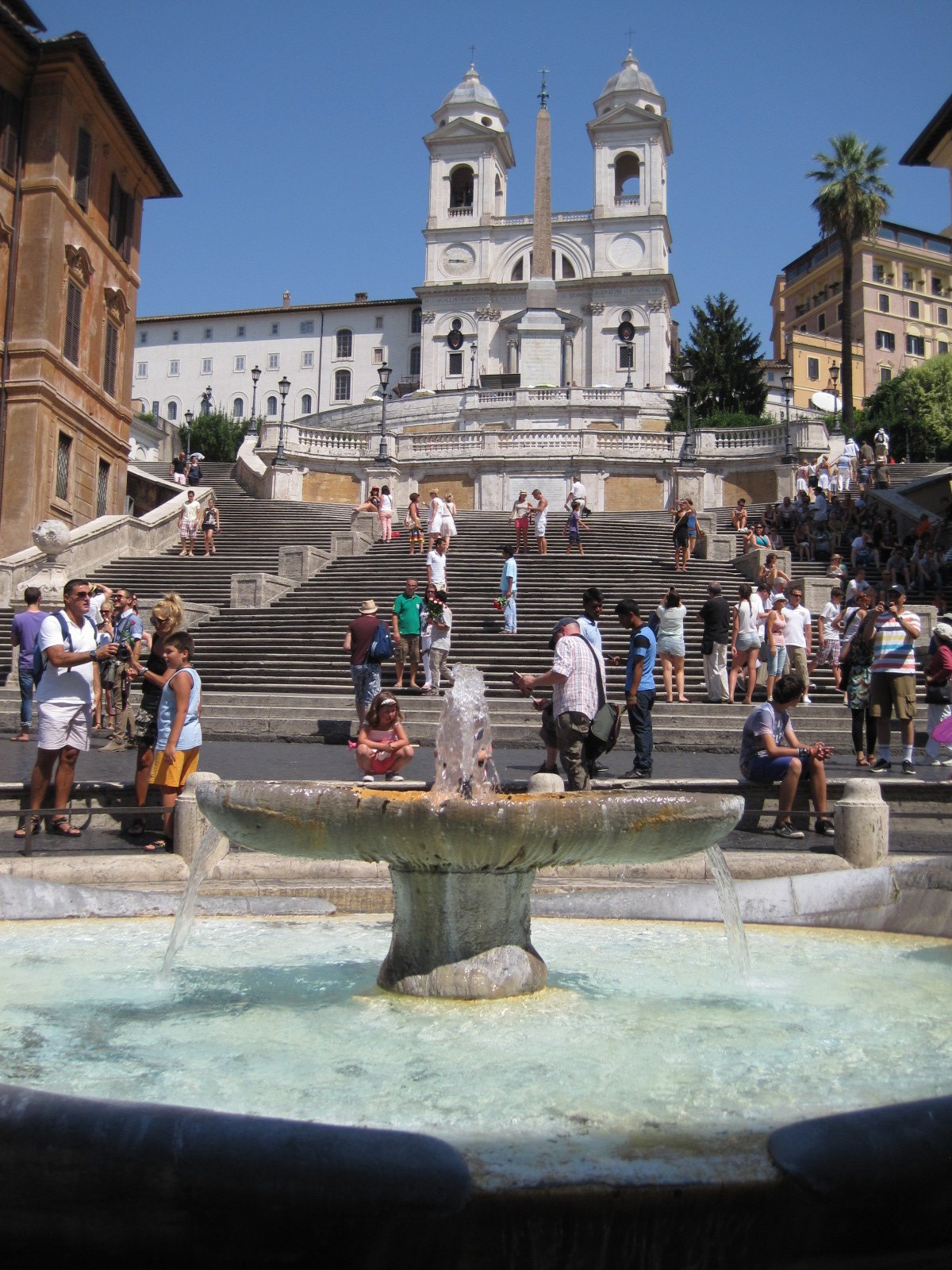
Spanish Steps is a monumental staircase of 135 steps connecting Piazza di Spagna with the church of Trinità dei Monti. It is in Rome, Italy. Most visitors spend 30–45 min here. The free Lokali audio guide runs 5 minutes.
✓ Verified August 2026 · how we write these guides
Visitor facts
| Time needed | 30–45 min |
|---|---|
| Lokali audio guide | 5 min · free |
| Type | Square |
| Best for | Photography |
| Location | Rome, Italy |
| Coordinates | 41.9058, 12.4761 |
| Languages | 45, in the Lokali app |
The story
A wide sweep of pale stone steps rises in stages from a busy square to a church on the hill above, curving and dividing and rejoining as it climbs. People sit and stand all the way up, the whole stair turned into a kind of public theatre. These are the Spanish Steps, one of the great gathering places of Rome.
There are, famously, around 135 of them, climbing from the square below to the twin-towered church of Trinita dei Monti at the top. The design sets straight flights against curving ones, with wide landings between, so the stair is less a simple climb than a piece of sculpture you walk through.
They were built in the 1720s, completed in 1725, to link the square with the French church on the hill, and paid for largely by a bequest from a French diplomat. The name, oddly, comes not from the builders but from the Spanish embassy that has long stood on the square below.
At the foot of the steps sits a low, boat-shaped fountain, half-sunk into the pavement, designed in the early seventeenth century by a member of the Bernini family. Its odd shape was a clever answer to weak water pressure at this spot, and it still trickles for visitors to drink from and cool their hands.
The square itself has drawn travellers for centuries, especially the artists and writers who came through on the grand tour of Europe. Their long presence gave the whole area a literary and artistic reputation that lingers in its cafes, galleries, and old hotels to this day.
At the foot of the steps stands the house where the English poet Keats spent his final months and died in the early nineteenth century, now a small museum to him and his circle. It is easy to walk past, but it ties this cheerful staircase to a quiet, sadder story.
The steps are at their most beautiful in spring, when banks of flowering azaleas in pots are arranged down the flights, turning the grey stone into cascades of pink and red. It is the most photographed moment of the year here, and worth timing a visit around if you can manage it.
One firm rule has changed how people use the steps: sitting on them is now forbidden, and wardens move people on and can issue fines. The old habit of lounging on the stone with an ice cream is over, so plan to climb, pause, and admire rather than settle in for a long rest.
The climb rewards you at the top. From the terrace by the church, beside its tall obelisk, you get a fine view back down the steps and out over the rooftops of the centre, one of the better free vantage points in this part of the city.
The area around the steps is the heart of luxury shopping in Rome. The streets running off the square, lined with famous fashion houses and jewellers, draw a different kind of visitor, so the neighbourhood mixes sightseers, shoppers, and the simply curious in roughly equal measure.
A few practical notes. The steps and the views are free; come early to beat both the heat and the thickest crowds, and remember that you cannot sit on the steps themselves. Comfortable shoes help for the climb, and there are cafes nearby, though prices reflect the address.
Climb to a landing, turn, and look back down over the square and the city beyond before you move on. The steps have drawn poets, painters, and travellers for three centuries to do exactly this. When you descend again into the shopping streets, the ordinary bustle of the city resumes around you at once.
Key facts
What to look for
Practical tips
Common questions
How long do you need at Spanish Steps?
Plan 30–45 min. That is the time most visitors spend at Spanish Steps. The free Lokali audio guide adds about 5 minutes of narration you can listen to as you walk, so it fits inside your visit rather than adding to it.
Is there a free audio guide to Spanish Steps?
Yes — the Lokali app narrates Spanish Steps free of charge in 50+ languages. It covers the history, what to look for on site and practical tips, and it works offline once downloaded.
Where is Spanish Steps?
Spanish Steps is in Rome, Italy, at 41.9058, 12.4761. Tap the map link on this page for directions from where you are.
What should you know before visiting Spanish Steps?
Come early to beat the heat and crowds.
What is Spanish Steps known for?
A monumental stairway of around 135 steps.
What is the best time to visit Spanish Steps?
Sit on the steps at sunset with a gelato from a nearby vendor.
On the map
Opens directions to Spanish Steps from your location.
More to see in Rome


Hear Spanish Steps in your language
The full story, narrated, in 50+ languages. Download it before you go and it plays offline, at your own pace, with no ticket and no tour group.