
Temple of Venus Genetrix
41.8942° N · 12.4848° E · Archaeological Site
Photo: Livioandronico2013 · CC BY-SA 4.0 · Wikimedia Commons
Temple of Venus Genetrix is the main temple in the Forum of Julius Caesar at Rome. Caesar vowed the temple before Pharsalus in 48 BCE. The free Lokali audio guide runs 6 minutes.
✓ Published October 2026 · how we write these guides
Visitor facts
| Lokali audio guide | 6 min · free |
|---|---|
| Type | Archaeological Site |
| Location | Rome, Italy |
| Coordinates | 41.8942, 12.4848 |
| Languages | 50+, in the Lokali app |
The story
Stand at the railing and look down. The ground of Caesar's Forum lies several metres below the modern street, and the noise of traffic on Via dei Fori Imperiali seems to stop at the edge. Below you, pale paving stones run towards a high platform of rubble and brick. On it rise three marble columns, still joined at the top by a piece of carved stone. They are pale against the sky, and slightly weathered, like old bone.
Those three columns are what remains of the Temple of Venus Genetrix. The name means Venus the Mother, or Venus the Ancestor. That second meaning matters most. Julius Caesar built this temple, and he built it for his own family. The Julian clan claimed descent from the goddess Venus. The temple was a place of worship, but it was also a family tree carved in marble.
Here is the story behind that claim. In Roman tradition, the Trojan hero Aeneas was the son of Venus. After the fall of Troy, Aeneas sailed to Italy. His son was called Iulus, and the Julian family traced its name back to him. So when Caesar honoured Venus, he was honouring his own great-grandmother many times over. Every Roman who walked past this temple was reminded where Caesar came from.
The temple began with a promise made before a battle. In 48 BCE, Caesar faced his rival Pompey at Pharsalus, in Greece. Before the fighting, he vowed a temple to Venus if she gave him victory. He won. Two years later, in 46 BCE, he dedicated the temple here, during the celebrations of his triumph. The work was not finished. The surrounding forum was still incomplete, and it was completed after his death by his heir, Augustus.
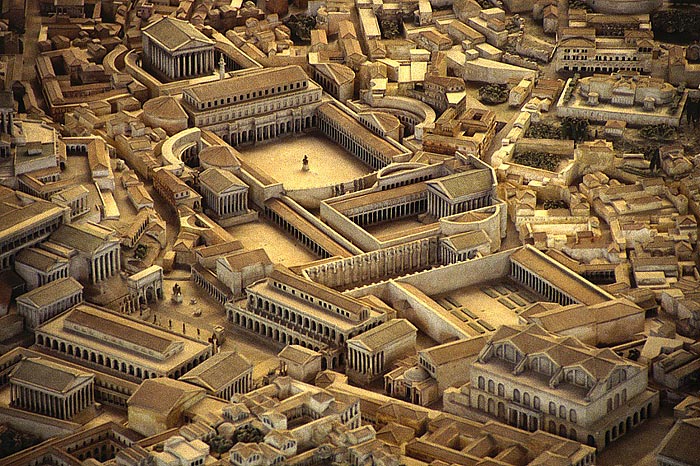
Look at the shape of the space around the platform. This was the first of the imperial forums — the series of grand public squares that later emperors built side by side. Before this, the old Roman Forum just beyond had grown over centuries, piece by piece. Caesar did something new. He bought up land, cleared it, and laid out a long rectangle with colonnades on both sides. The temple closed the far end, raised high, so every eye in the square ended on it.
Inside, the temple held treasures. A Greek sculptor named Arcesilaus made the main statue of the goddess. Ancient writers, including Pliny the Elder, describe famous paintings displayed here, and collections of engraved gems. Pliny also mentions a breastplate covered in pearls from Britain, which Caesar offered to Venus. Nothing of this survives. But imagine the cool interior, the smell of incense, and gold catching the light from the doorway.
Now the first surprise. Beside the statue of Venus, Caesar placed a gilded statue of Cleopatra, the queen of Egypt. Ancient historians report this, and it caused a scandal. A foreign queen, shown in gold, inside a temple to the mother of Rome. Cleopatra was living in Rome at the time, and her relationship with Caesar was well known. Many Romans read the statue as a sign that Caesar was thinking like a king.
The second surprise happened on the steps in front of you. The Roman biographer Suetonius tells how a group of senators came here to bring Caesar new honours. He received them while sitting in front of this temple, and he did not stand up. To Roman eyes, this was an insult. A citizen rose for the Senate. Suetonius suggests this moment helped turn many senators against him. Within a short time, Caesar was dead, killed in the Ides of March.
The temple did not stay as Caesar left it. Fire swept through this part of Rome in the late first century, and the emperor Domitian began a rebuilding. The emperor Trajan completed it and dedicated the new temple in 113 CE. Most of the marble you see today belongs to that later version, not to Caesar's original. Another fire in the late third century brought more damage, and more repairs followed under the emperor Diocletian.
Look closely at the columns. They follow the Corinthian style, the most decorative of the classical orders. Their tops are carved with curling acanthus leaves, a spiky Mediterranean plant. Their shafts are fluted, cut with long vertical channels that catch shadow. Fragments of a frieze from the Trajanic rebuilding show small winged cupids at work. These cupids were the children of Venus — a playful detail on a very political building.
The columns you see are not standing exactly as the Romans left them. For centuries, this area lay buried under later houses and streets. In the early 1930s, the area was cleared to build the wide road behind you. Archaeologists uncovered the remains of the forum, and the three columns were raised again on the platform. So you are looking at ancient stone, put back in place by modern hands.
Turn your eyes to the right of the temple as you face it. The tall brick building nearby is the Curia, the Senate house, which Caesar also began. The two were planned together. Notice, too, the line of rooms along the side of the forum. These were shops and offices. Caesar's square was a working space as well as a sacred one, full of people, business, and argument.
Take a final moment here. The traffic still moves above, and the swifts or gulls still cross the sky above the columns. Down below, the stones keep their silence. A man once sat on those steps and refused to stand for the Senate. As you walk on along the road, look for the next forums — each one an emperor answering the one before. This is where that long conversation in stone began.
Key facts
What to look for
Practical tips
Common questions
Is there a free audio guide to Temple of Venus Genetrix?
Yes — the Lokali app narrates Temple of Venus Genetrix free of charge in 50+ languages. The guide runs about 6 minutes, covers the history, what to look for on site and practical tips, and works offline once downloaded.
Where is Temple of Venus Genetrix?
Temple of Venus Genetrix is in Rome, Italy, at 41.8942, 12.4848. Tap the map link on this page for directions from where you are.
What is Temple of Venus Genetrix known for?
Caesar vowed the temple before Pharsalus in 48 BCE. Dedicated in 46 BCE during Caesar's triumph celebrations.
What should you look for at Temple of Venus Genetrix?
Three Corinthian columns still joined by a carved section. Acanthus leaves curling on the column tops. Vertical fluting cut into the marble column shafts.
What should you know before visiting Temple of Venus Genetrix?
View the temple from the railing along Via dei Fori Imperiali. Visit the Curia next to understand Caesar's paired plan.
When is the best time to visit Temple of Venus Genetrix?
Come at dusk when the street lights warm the marble.
On the map
Opens directions to Temple of Venus Genetrix from your location.
More to see in Rome



Hear Temple of Venus Genetrix in your language
The full story, narrated, in 50+ languages. Download it before you go and it plays offline, at your own pace, with no ticket and no tour group.