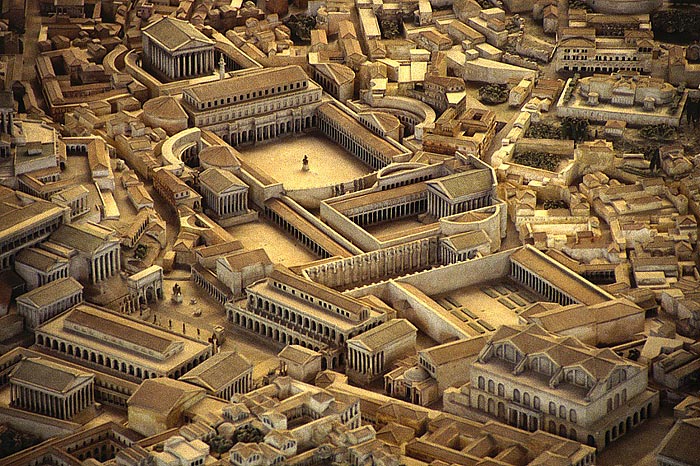
The Imperial Fora
41.8944° N · 12.4856° E · Archaeological Site
Photo: it:utente:Forma mentis · CC BY-SA 3.0 · Wikimedia Commons
The Imperial Fora are archaeological sites in Rome. Five separate fora built over about a century and a half. The free Lokali audio guide runs 7 minutes.
✓ Published October 2026 · how we write these guides
Visitor facts
| Lokali audio guide | 7 min · free |
|---|---|
| Type | Archaeological Site |
| Location | Rome, Italy |
| Coordinates | 41.8944, 12.4856 |
| Languages | 50+, in the Lokali app |
The story
Stand at the railing and look down. The modern road hums behind you, scooters and buses, the smell of warm asphalt. A few metres below, the ground drops away into another city: broken columns, pale marble slabs, grass pushing between the stones. You are standing at the level of today's Rome, and looking down at the level of ancient Rome. That gap in height is the first thing to understand here. It is the layer of everything that happened in between.
What you see below is not one forum, but five. Over about a century and a half, a series of rulers each built a grand public square next to the last one. Julius Caesar started it in the middle of the first century before Christ. Augustus followed. Then came Vespasian, then Nerva, and finally Trajan in the early second century. Each square had a temple, colonnades, and statues. Together they formed one huge ceremonial district beside the older Roman Forum.
Why build new squares at all? The old Roman Forum, just over the road, had grown crowded. It was full of law courts, shrines, and centuries of monuments. Rome was becoming the capital of a vast empire, and it needed more space for business, justice, and display. But there was another reason too... Each new forum carried its builder's name. It was a political statement in marble. It told every citizen exactly who was in charge.
Caesar's forum came first. He bought expensive private land in the heart of the city to build it. At one end stood a temple to Venus Genetrix, Venus the Mother. This was a clever choice. Caesar's family claimed to descend from the goddess herself. So the temple honoured a goddess, and at the same time it honoured Caesar's own bloodline. Three tall columns from that temple still stand today, with a fragment of their carved top resting on them.
Next to it lies the Forum of Augustus, Caesar's adopted heir. Its centrepiece was the Temple of Mars Ultor, which means Mars the Avenger. Augustus vowed to build it before the battle of Philippi, where he defeated the men who had murdered Caesar. The temple took decades to finish. Look behind its ruined columns and you will see a huge wall of dark grey stone. It is far taller than the temple needed.
That wall is one of the details most visitors miss. It was not just decoration. Behind it lay the Subura, a crowded neighbourhood of wooden apartment blocks, noise, and frequent fires. The great wall worked partly as a firebreak. It also hid the poor district from view. Notice, too, that the wall does not run perfectly straight. Many historians believe Augustus could not buy every plot of land he wanted, so the plan had to bend around it.
Further along was the Temple of Peace, built by Vespasian after Rome's war in Judaea. It was less a square than a vast garden, with pools and flower beds, and it worked almost like a museum. Treasures taken from Jerusalem were displayed here. Very little of it is visible from the road today. But one piece survives in a surprising place. A wall from this complex now forms part of the church of Saints Cosmas and Damian, just nearby.
On that ancient wall once hung a giant map of Rome, carved in marble. It showed buildings, streets, and even staircases, in remarkable detail. The map fell and broke into many pieces centuries ago. Archaeologists are still trying to fit the surviving fragments together, like the hardest jigsaw puzzle in the world. If you visit the church later, look at the outside wall. The small holes that held the marble slabs are still there.
The narrowest of the five is the Forum of Nerva. It was squeezed into a long, thin strip of land, and it doubled as a passage between busy districts. Romans sometimes called it the Transitorium, the passage forum. Domitian began it, but he was murdered before it was finished, so Nerva took the credit. Two columns survive with part of a carved frieze. Look closely and you can still pick out a figure of Minerva, goddess of wisdom and crafts.
Then comes the biggest of all — the Forum of Trajan. Trajan paid for it with treasure from his conquest of Dacia, roughly modern Romania. His architect was Apollodorus of Damascus. The project was so large that workers cut away part of a hillside to make room. The rows of grey granite column stumps you see belonged to the Basilica Ulpia, a great hall for courts and business. An ancient historian later described an emperor from Constantinople standing here, amazed into silence.
Above the basilica rises Trajan's Column. A band of carved scenes winds around it from bottom to top. If you could unroll it, it would stretch for roughly two hundred metres. It shows the Dacian wars: soldiers building camps, crossing rivers, fighting battles. Trajan himself appears again and again. His ashes were later placed in the base. The statue on top today is not Trajan, though. It is Saint Peter, placed there by a pope in the late sixteenth century.
Now look at the road you are standing on, the Via dei Fori Imperiali. It feels old, but it is not. Mussolini's government cut it through here in the early 1930s, as a straight parade route from his office toward the Colosseum. To build it, a whole neighbourhood of houses and churches was demolished. Excavations uncovered parts of the fora, but much of the ancient ground still lies under the asphalt. The bronze emperor statues along the pavement are modern copies, added in that same period.
So take a moment before you move on. Below you is marble from emperors. Around you is a road from a dictator. Above, the cars and the swifts and the noise of a living city. Every age here built on top of the last. As you walk toward the Colosseum, glance down into the gaps between the railings. Somewhere in that grass is a paving stone that a Roman citizen crossed two thousand years ago, on an ordinary afternoon, much like this one.
Key facts
What to look for
Practical tips
Common questions
Is there a free audio guide to The Imperial Fora?
Yes — the Lokali app narrates The Imperial Fora free of charge in 50+ languages. The guide runs about 7 minutes, covers the history, what to look for on site and practical tips, and works offline once downloaded.
Where is The Imperial Fora?
The Imperial Fora is in Rome, Italy, at 41.8944, 12.4856. Tap the map link on this page for directions from where you are.
What is The Imperial Fora known for?
Five separate fora built over about a century and a half. Julius Caesar began the first forum in the first century BCE.
What should you look for at The Imperial Fora?
Three standing columns of Caesar's Temple of Venus Genetrix. The tall grey firewall behind the Temple of Mars Ultor. Carved Minerva figure on the Forum of Nerva frieze.
What should you know before visiting The Imperial Fora?
Walk the road end to end for the best overview. Visit Trajan's Markets for views over the forum from above.
When is the best time to visit The Imperial Fora?
Come at dusk when floodlights pick out the columns.
On the map
Opens directions to The Imperial Fora from your location.
More to see in Rome


Hear The Imperial Fora in your language
The full story, narrated, in 50+ languages. Download it before you go and it plays offline, at your own pace, with no ticket and no tour group.