
Temple of Mars Ultor
41.8943° N · 12.4868° E · Archaeological Site
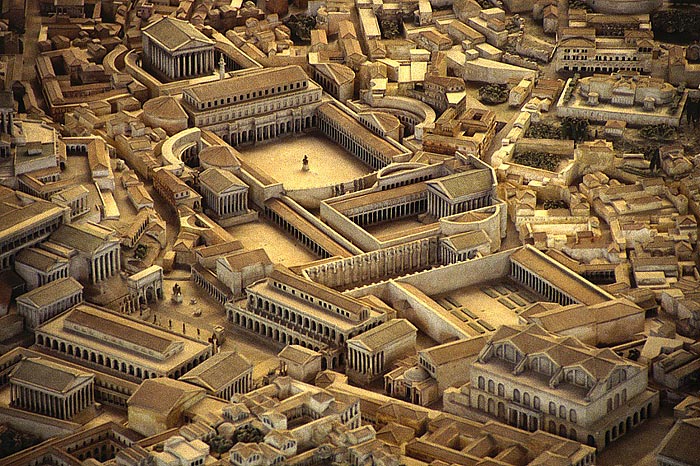
Photo: Alekjds · CC BY-SA 3.0 · Wikimedia Commons
Temple of Mars Ultor is a roman temple of the Corinthian order vowed by Octavian in 42 BCE and completed in 2 BCE, centerpiece of the Forum of Augustus. It is in Rome, Italy. Octavian vowed the temple at Philippi in 42 BCE. The free Lokali audio guide runs 7 minutes.
✓ Published October 2026 · how we write these guides
Visitor facts
| Lokali audio guide | 7 min · free |
|---|---|
| Type | Archaeological Site |
| Location | Rome, Italy |
| Coordinates | 41.8943, 12.4868 |
| Languages | 50+, in the Lokali app |
The story
Stand at the railing and look down. Below you, the ground drops away to a level far older than the street under your feet. A tall wall of grey stone rises at the back, rough and dark, almost like a cliff face. In front of it, three white columns still stand on a high platform. The traffic noise of modern Rome sits above you. The ancient city sits below. This is the Temple of Mars Ultor, the centrepiece of the Forum of Augustus.
The name means Mars the Avenger. Mars was the Roman god of war, and in Roman tradition he was also the father of Romulus, the legendary founder of the city. So this god was more than a soldier's patron. He was a kind of ancestor for every Roman. To call him the Avenger was a pointed choice. And to understand why, we need to go back to a battlefield in northern Greece.
In 44 BCE, Julius Caesar was murdered in Rome by a group of senators. His adopted heir was a young man named Octavian, the future emperor Augustus. Two years later, in 42 BCE, Octavian and his allies faced Caesar's killers, Brutus and Cassius, at the Battle of Philippi. Before the fighting, Octavian vowed a temple to Mars if the god helped him avenge his adoptive father. The assassins were defeated. Both of them died by suicide. The vow now had to be paid.
It took a very long time. The temple was finally dedicated in 2 BCE, roughly forty years after the battle. By then, Octavian was no longer a young avenger. He was Augustus, the first emperor, and the sole master of the Roman world. So the building carried two messages at once. It honoured a personal promise to Caesar's memory. It also celebrated the new order that Augustus himself had built.
Now look again at that great grey wall at the back. Here is the first surprise. This wall was not decoration. It separated the gleaming forum from the Subura, a crowded and poor neighbourhood of cramped housing just behind it. Fire was a constant danger in that district. The wall is made of a volcanic stone that resists flames, and it acted as a firebreak. It also hid the untidy city from view. Inside, everything was marble and order. Outside, ordinary Romans lived in noise and smoke.
There is a second detail most visitors miss. Look at the shape of the space. The forum is not perfectly symmetrical. One back corner is cut short. The Roman writer Suetonius explains why. Augustus did not want to force the owners of nearby houses to give up their property. So he made his forum narrower than he had planned. An emperor who could command armies chose, at least here, to work around his neighbours.
The temple itself stood on a tall podium, reached by a broad flight of steps. Its columns were of the Corinthian order, the style with capitals carved like curling acanthus leaves. They were cut from bright white marble quarried at Luna, near modern Carrara in Tuscany. Today only three columns stand on the right side, with part of the steps and the podium. But their height still gives you the scale. Imagine a whole forest of them, along the front and down both sides.
Inside the temple stood statues of gods connected to Augustus and his family. Mars was the central figure. Many scholars believe Venus stood nearby, because the Julian family claimed descent from her, and the deified Julius Caesar may have been there too. The details of the arrangement are still debated. But the idea is clear. War, divine ancestry and the family of Augustus were bound together in one room.
The temple also guarded a treasure of pride. Decades earlier, in 53 BCE, a Roman army under Crassus had been destroyed by the Parthians, a powerful empire to the east. Roman military standards, the sacred eagle emblems of the legions, were lost. In 20 BCE, Augustus recovered them, not through battle but through diplomacy. He presented this as a great victory. The returned standards were later kept here, in the temple of the Avenger. Revenge, in this case, came at the negotiating table.
The building had working roles in public life. The Senate met here to discuss matters of war and to vote on triumphs. Governors leaving for military provinces set out from this place. Roman boys of good family came here when they put on the toga of manhood, the plain white garment that marked them as adult citizens. So this was not a quiet shrine. It was a stage for the moments that turned boys into men and generals into heroes.
Around the temple, long colonnades lined both sides of the square. They opened into two large curved halls. In these halls stood statues of great Romans of the past. On one side, the legendary hero Aeneas, escaping burning Troy. On the other, Romulus, the founder of Rome. Along the porticoes stood other famous leaders, each with a short inscription. Walking here, a Roman citizen moved through a sculpted history of the city, carefully arranged so that it led to Augustus.
The centuries after Rome's fall were not kind to the forum. Marble was stripped and reused. Houses and churches were built over the ruins. In the Middle Ages, the Knights of Saint John took over part of the site, and their building still rises above the ancient wall. Then, in the 1930s, the modern avenue called Via dei Fori Imperiali was cut through the area. Excavations uncovered much of the forum, but the road also covered parts of it, and it still does.
So take a last look from where you stand. Follow the three columns up to their carved tops. Let your eye travel across the dark firewall, and the medieval windows above it. Listen to the scooters and buses on the avenue. As you walk on, notice how the level of the street hides another city just below it. Rome is built in layers, and here you can see straight down through them, to a promise made after a murder, long ago.
Key facts
What to look for
Practical tips
Common questions
Is there a free audio guide to Temple of Mars Ultor?
Yes — the Lokali app narrates Temple of Mars Ultor free of charge in 50+ languages. The guide runs about 7 minutes, covers the history, what to look for on site and practical tips, and works offline once downloaded.
Where is Temple of Mars Ultor?
Temple of Mars Ultor is in Rome, Italy, at 41.8943, 12.4868. Tap the map link on this page for directions from where you are.
What is Temple of Mars Ultor known for?
Octavian vowed the temple at Philippi in 42 BCE. The temple was dedicated in 2 BCE.
What should you look for at Temple of Mars Ultor?
The three Corinthian columns still standing on the right. The tall grey firewall behind the temple podium. The irregular cut-off corner at the back of the forum.
What should you know before visiting Temple of Mars Ultor?
View the site from the railing on Via dei Fori Imperiali. Visit in early morning for softer light on the columns.
When is the best time to visit Temple of Mars Ultor?
Visit in early morning for softer light on the columns.
On the map
Opens directions to Temple of Mars Ultor from your location.
More to see in Rome



Hear Temple of Mars Ultor in your language
The full story, narrated, in 50+ languages. Download it before you go and it plays offline, at your own pace, with no ticket and no tour group.