
Forum of Augustus
41.8942° N · 12.4867° E · Archaeological Site
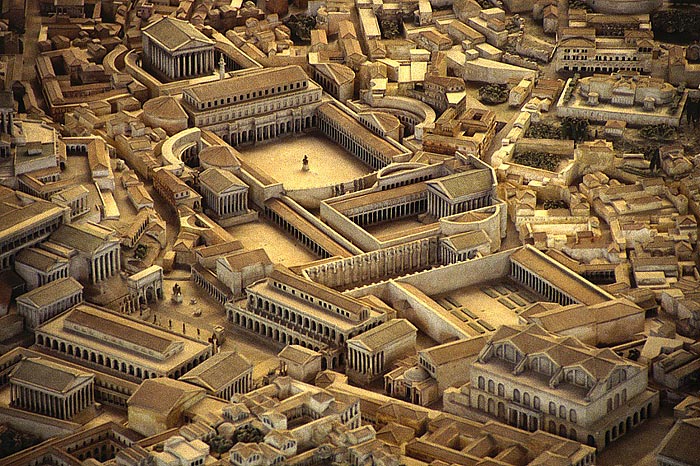
Photo: Chabe01 · CC BY-SA 4.0 · Wikimedia Commons
Forum of Augustus is the second of the so-called imperial fora at Rome, built by Augustus. Temple vowed before the Battle of Philippi in 42 BCE. The free Lokali audio guide runs 6 minutes.
✓ Published October 2026 · how we write these guides
Visitor facts
| Lokali audio guide | 6 min · free |
|---|---|
| Type | Archaeological Site |
| Location | Rome, Italy |
| Coordinates | 41.8942, 12.4867 |
| Languages | 50+, in the Lokali app |
The story
Stand at the railing and look down. The ground drops away below the modern street, and the noise of traffic stays up here with you. Down there, fragments of white marble lie in the grass, and three tall columns rise against a dark wall of grey stone. In the late afternoon, the light catches the column tops and leaves the wall in shadow. This is the Forum of Augustus. It is the public square that Rome's first emperor built to tell the world exactly who he was.
The story begins with a promise. In 42 BCE, the young Octavian, who would later take the name Augustus, fought at Philippi in northern Greece. His enemies there were the men who had murdered Julius Caesar, his adoptive father. Before the battle, he vowed a temple to Mars, the god of war. He won. The temple he promised would carry a pointed name — Mars Ultor, which means Mars the Avenger.
Keeping that promise took a long time. The temple was dedicated in 2 BCE, roughly four decades after the vow. By then, Octavian was no longer a young general. He was Augustus, the sole master of the Roman world. So the building that began as personal revenge became something much larger. It became a statement about the whole Roman state, its past, and its future.
Now look at the shape of the square below you. It is not perfectly regular. The Roman writer Suetonius explains why. Augustus did not want to force private owners out of their homes. He bought the land instead, and he could not buy all of it. So the forum ended up narrower than he planned. It is a small, very human detail. Even the most powerful man in Rome had to work around his neighbours.
Now turn your eyes to that great grey wall at the back. It is one of the most surprising things here. It was built of volcanic stone, which resists fire, and it rose very high. Behind it lay the Subura, a crowded district of tall wooden apartment blocks. Fires broke out there often. The wall protected the shining new forum from the flames. It also hid the poor neighbourhood from view. Both purposes mattered.
The temple itself stood against that wall, raised on a high podium. Its columns were carved from Luna marble, the bright white stone quarried near modern Carrara in Tuscany. The three columns you can still see belong to the side of that temple. Imagine many more of them in a long, gleaming row, with wide steps leading up from the square. Inside stood statues of Mars and Venus, the gods that Augustus linked to his own family line.
Here is a detail many visitors miss. The temple held real treasures of war. In 20 BCE, Augustus recovered Roman military standards that the Parthians had captured years before. The Parthians ruled a great empire to the east, in what is now Iran and Iraq. Losing those standards had been a deep humiliation for Rome. Augustus won them back through diplomacy, not battle. He placed them in this temple and presented the result as a great victory.
On each side of the square ran long covered colonnades. Behind them opened two large curved spaces called exedrae, shaped like half-circles. Along their walls stood rows of statues. On one side was Aeneas, the Trojan hero who, in Roman legend, carried his father out of burning Troy. On the other side was Romulus, the legendary founder of Rome. Around them stood famous Romans of the past.
Under each statue was a short inscription praising the man's deeds. Some of these texts survive, so scholars know how the gallery worked. The message was clear. Rome's whole history led, step by step, to one man. And in the middle of the square, a statue of Augustus himself rode in a triumphal chariot. Every visitor walked between the heroes of the past and the ruler of the present.
The upper level of the colonnades carried another surprise. Rows of female figures held up the structure, like stone columns shaped as women. These are called caryatids. They copied the famous figures on the Erechtheion, a temple on the Acropolis in Athens. Between them were large shields carved with faces of gods. Augustus was borrowing the prestige of classical Greece and putting it to work for Rome.
This forum was not only for display. Roman law and ritual happened here. Young men of good families came to put on the toga of adulthood for the first time. The Senate met in the temple to discuss matters of war and peace. Generals who returned in triumph brought offerings here. For centuries, this square was where Rome's public life touched its military power.
The forum did not survive intact. Over the Middle Ages, its marble was stripped and burned for lime. Houses and churches grew up over the ruins. Above the old colonnade, the knights of a military religious order built a residence, which you can still see today. Then, in the 1930s, the regime of Mussolini cut the wide modern avenue beside you through the area. That road still covers part of the ancient forum.
So take one more look before you walk away. Find the three columns, and the dark wall behind them. Notice how far below the street the ancient pavement lies. Every step you take along this avenue runs over layers of Rome. Listen to the traffic, then look back down at the quiet grass and the broken white stone. Two thousand years ago, this was the loudest, proudest square in the city.
Key facts
What to look for
Practical tips
Common questions
Is there a free audio guide to Forum of Augustus?
Yes — the Lokali app narrates Forum of Augustus free of charge in 50+ languages. The guide runs about 6 minutes, covers the history, what to look for on site and practical tips, and works offline once downloaded.
Where is Forum of Augustus?
Forum of Augustus is in Rome, Italy, at 41.8942, 12.4867. Tap the map link on this page for directions from where you are.
What is Forum of Augustus known for?
Temple vowed before the Battle of Philippi in 42 BCE. Temple of Mars Ultor dedicated in 2 BCE.
What should you look for at Forum of Augustus?
Three standing Corinthian columns from the temple's side. The tall grey fire wall rising behind the temple. Remains of the curved exedrae flanking the square.
What should you know before visiting Forum of Augustus?
View from the railings along Via dei Fori Imperiali first. Come in late afternoon for warm light on the columns.
When is the best time to visit Forum of Augustus?
Come in late afternoon for warm light on the columns.
On the map
Opens directions to Forum of Augustus from your location.
More to see in Rome



Hear Forum of Augustus in your language
The full story, narrated, in 50+ languages. Download it before you go and it plays offline, at your own pace, with no ticket and no tour group.