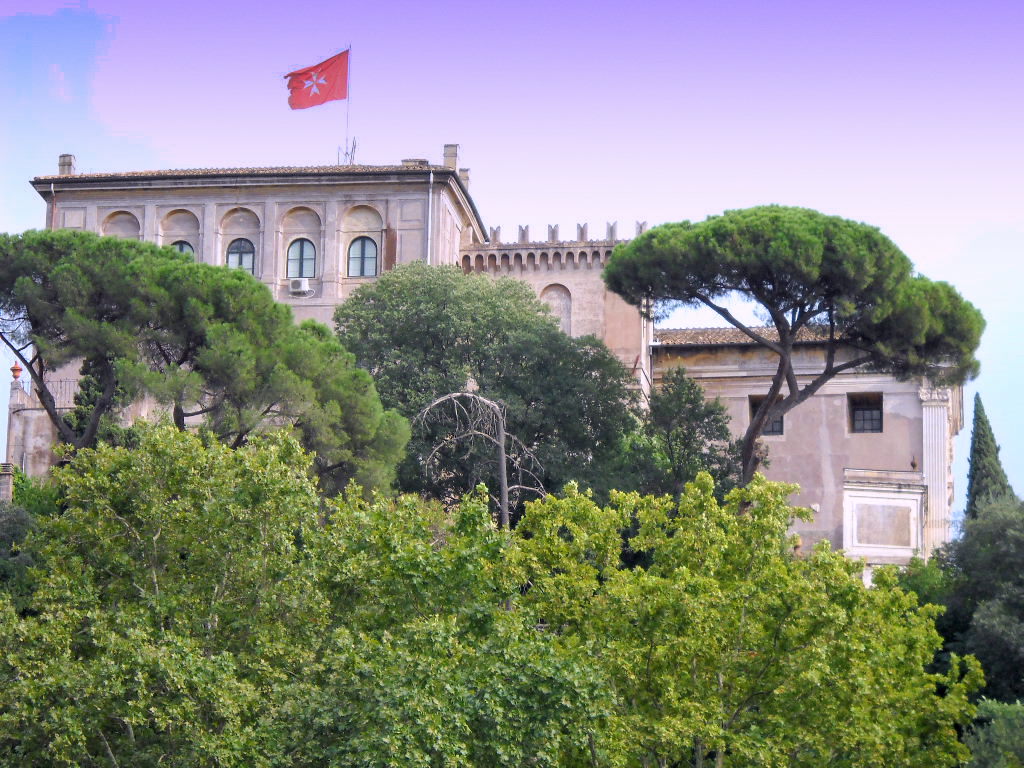
Villa del Priorato di Malta
41.8836° N · 12.4775° E · Palace
Photo: Gobbler · CC BY-SA 3.0 · Wikimedia Commons
Villa del Priorato di Malta is a building in Rome, Italy. Piranesi designed the square and priory church in the 1760s. The free Lokali audio guide runs 7 minutes.
✓ Published October 2026 · how we write these guides
Visitor facts
| Lokali audio guide | 7 min · free |
|---|---|
| Type | Palace |
| Location | Rome, Italy |
| Coordinates | 41.8836, 12.4775 |
| Official website | orderofmalta.int |
| Languages | 50+, in the Lokali app |
The story
Listen for a moment. The traffic of Rome has dropped away behind you, and up here on the Aventine Hill the air feels cooler. You hear gravel under shoes, low voices, perhaps a bird in the cypress trees. In front of you stands a tall green door set into a pale wall. People are waiting in a quiet line. Each one bends down, puts an eye to a small brass keyhole, and stays very still. Then they straighten up and smile. That small moment is why most visitors climb this hill.
You are standing in the Piazza dei Cavalieri di Malta, the Square of the Knights of Malta. Behind that door is the Villa del Priorato di Malta, the Roman priory of one of the oldest religious orders in Europe. The Order of Malta began in the Middle Ages as a brotherhood that cared for sick pilgrims in Jerusalem. Over the centuries it became a military order of knights, then an organisation devoted mainly to medical and charitable work. It still exists today, and this hilltop is one of its homes.
Before the view, look at the square itself. The walls are not plain. They carry tall stone panels, slim obelisks, and carved reliefs of armour, swords, ships, and shields. These are military trophies, symbols of the knights who once fought at sea. The decoration feels a little strange, almost theatrical. That is deliberate. This square was designed in the 1760s by Giovanni Battista Piranesi, a Venetian artist famous across Europe for his dramatic etchings of Roman ruins.
Here is the first surprise. Piranesi spent his life drawing architecture, and his prints shaped how generations of travellers imagined ancient Rome. Yet this square, and the priory church behind the wall, are the only buildings he ever actually designed and saw built. He was a printmaker who dreamed in stone, and on this hill he finally got to build. The work was commissioned by Cardinal Giovanni Battista Rezzonico, a nephew of Pope Clement XIII, who served as the Order's prior in Rome.
Now, the keyhole. When your turn comes, lean in close and let your eye adjust. Through the small opening you see a long avenue of clipped hedges, dark green and perfectly straight. They form a tunnel of leaves. At the far end, framed in the middle, is the dome of Saint Peter's Basilica, floating above the city. It looks almost too neat to be real, like a painted stage set. Many people step back and look again, just to be sure.
That precise alignment is the second surprise. Nothing in the frame is an accident. The garden path, the hedges, and the keyhole all line up with a dome that stands several kilometres away. Whether every detail was planned by Piranesi himself, or refined by later gardeners, is not completely clear. But the effect works because someone cared about one single line of sight. In a city full of enormous monuments, the most memorable view here is one you see through a hole smaller than a coin.
You will often hear a popular claim about this view. People say that from one keyhole you can see three countries at once: the Order of Malta, Italy, and the Vatican. It is a lovely story, and partly true. The Order of Malta has a special legal status, and its main properties in Rome enjoy privileges similar to an embassy. The city between here and the dome is Italy, and the dome stands in Vatican City. So treat the three countries as a charming way to describe the view, not as a strict legal fact.
The history of this hilltop goes back much further than Piranesi. The Aventine is one of the seven hills of ancient Rome. In the Middle Ages, religious communities settled here, away from the crowded lowlands near the river. Tradition says the site passed through several owners, including a monastery and, later, the Knights Templar, before it came to the Knights of Malta. The details of that early chain are debated, so take it as the hill's long religious story rather than exact record.
Behind the wall stands the church of Santa Maria del Priorato, rebuilt by Piranesi. Its white facade is covered in the same kind of symbolic carvings you see in the square: ships, snakes, towers, and emblems of the Order. Piranesi died in 1778, and he is buried inside this church. There is a quiet logic to that. The man who spent his life drawing Rome rests in the one corner of Rome he shaped with his own design.
The gardens and church are not usually open to casual visitors. The Order sometimes allows guided visits by advance booking, so most people know this place only through the keyhole. That is part of its character. You stand outside a closed door, in a public square, and still receive the best view on the hill. It is a private garden that shares one perfect glimpse with anyone willing to wait their turn.
The neighbourhood around you rewards a slow walk. A short stroll back along the street brings you to the early Christian basilica of Santa Sabina, with its plain brick walls and calm interior. Next to it is the Giardino degli Aranci, the Orange Garden, a small park of bitter orange trees. From its terrace you look out over the rooftops of Rome and the bend of the river Tiber. Locals come here to read, to talk, or simply to sit.
The Aventine is also one of the quietest residential corners of central Rome. The streets are lined with villas, high garden walls, and old trees. You will hear church bells more often than car horns. Notice how different this feels from the Forum or the area near the Trevi Fountain, only a short distance away. Up here, the city slows down. Even the queue at the keyhole tends to be patient, as if the place asks for a lower voice.
Before you leave, stand in the middle of the square and turn slowly. Look at the obelisks, the carved armour, the cypress trees above the wall. Look at the green door, now a little worn by thousands of hands and faces. Then think of that small dome waiting at the end of the hedges. As you walk away, Rome will open up again in full size. But for a few seconds, you saw it through a keyhole... small, quiet, and perfectly framed.
Key facts
What to look for
Practical tips
Common questions
Is there a free audio guide to Villa del Priorato di Malta?
Yes — the Lokali app narrates Villa del Priorato di Malta free of charge in 50+ languages. The guide runs about 7 minutes, covers the history, what to look for on site and practical tips, and works offline once downloaded.
Where is Villa del Priorato di Malta?
Villa del Priorato di Malta is in Rome, Italy, at 41.8836, 12.4775. Tap the map link on this page for directions from where you are.
What is Villa del Priorato di Malta known for?
Piranesi designed the square and priory church in the 1760s. Only architecture Piranesi ever saw built in his lifetime.
What should you look for at Villa del Priorato di Malta?
The brass keyhole set into the tall green door. Saint Peter's dome framed by a tunnel of hedges. Carved armour, ships and shields on the square's walls.
What should you know before visiting Villa del Priorato di Malta?
Come early morning to avoid the long keyhole queue. Let your eye adjust before looking for the dome.
When is the best time to visit Villa del Priorato di Malta?
Come early morning to avoid the long keyhole queue.
On the map
Opens directions to Villa del Priorato di Malta from your location.
More to see in Rome


Hear Villa del Priorato di Malta in your language
The full story, narrated, in 50+ languages. Download it before you go and it plays offline, at your own pace, with no ticket and no tour group.