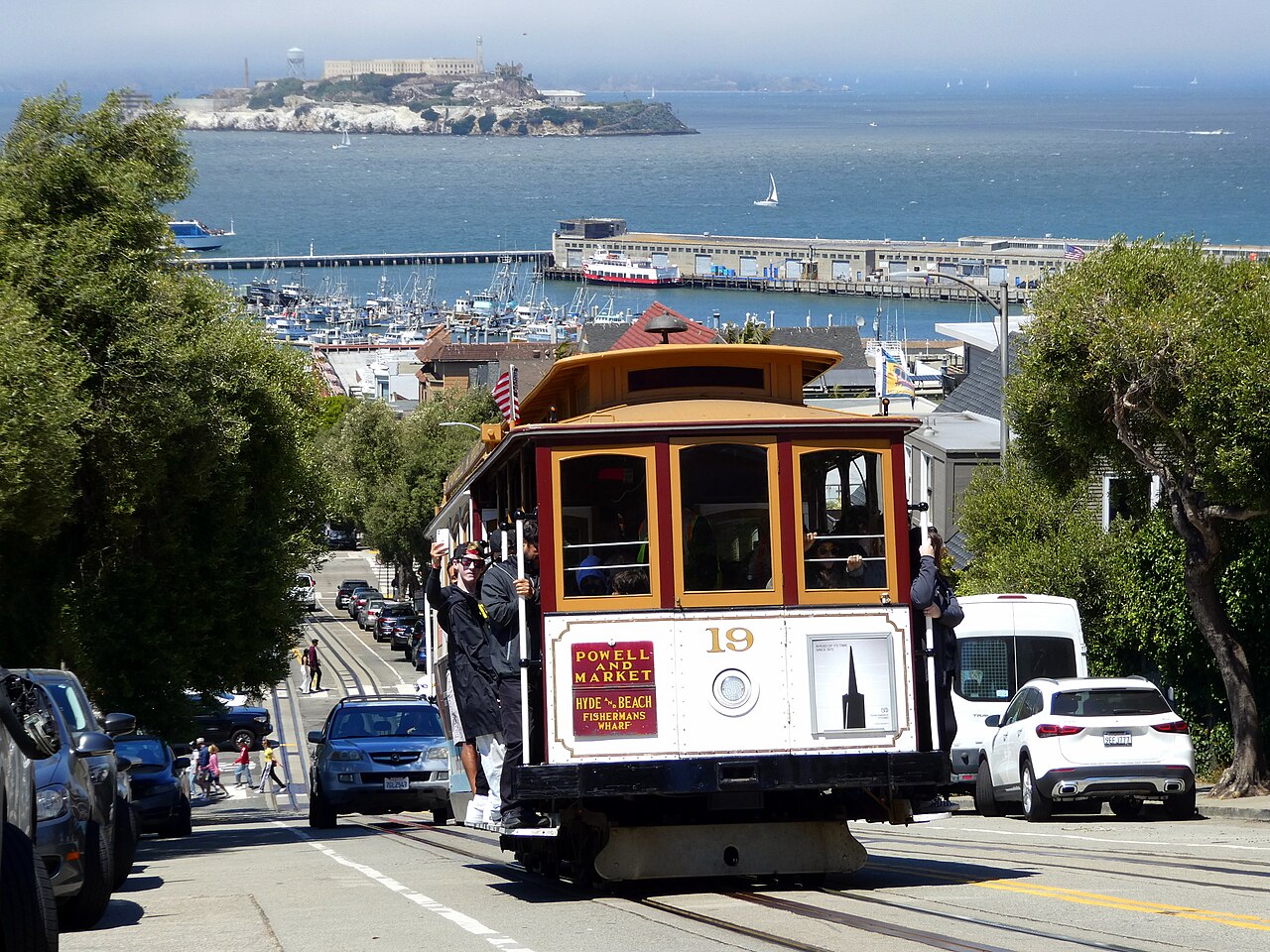
Cable Cars
37.7952° N · 122.4069° W · Historic Transport
Cable Cars is a historic transport in San Francisco, United States. Three remaining cable car lines (Powell-Mason, Powell-Hyde, California Street) operate since the 1870s, climbing San Francisco's steep hills. Most visitors spend 20–40 min here. The free Lokali audio guide runs 6 minutes.
✓ Verified August 2026 · how we write these guides
Visitor facts
| Time needed | 20–40 min |
|---|---|
| Lokali audio guide | 6 min · free |
| Type | Historic Transport |
| Best for | Editors' pick |
| Location | San Francisco, United States |
| Coordinates | 37.7952, -122.4069 |
| Languages | 45, in the Lokali app |
The story
You hear it before you ever see it. A deep, steady hum rises from a narrow slot in the middle of the street, low and constant. Then comes the bright clang of a brass bell. A small wooden car rolls into view, packed with riders, climbing a hill so steep it hardly seems possible. This is the cable car, and it has carried people through the hills of San Francisco for more than a century.
The whole idea began with a problem. In the nineteenth century, teams of horses pulled heavy cars up the city's steep and slippery hills. On wet stone, the struggling horses often slipped and fell, sometimes badly hurt. A man named Andrew Hallidie watched this and thought there had to be a better way. He had worked for years with strong wire rope. Why not, he wondered, use it to pull the cars instead?
His first cable line opened for business in 1873. It ran down a steep city hill, pulled along by a moving cable hidden just beneath the street. The cars themselves had no engine at all. They simply gripped onto the moving rope and let it carry them smoothly along. The strange idea worked, and within a few short years, cable lines had spread out across much of the growing city.
Here is how the system actually works. Under the street runs a long, endless loop of steel cable. It never stops moving, pulled along by great spinning wheels housed in a central building. The cable travels at one steady speed, a little under ten miles per hour, day and night. To go forward, the car grips this moving cable. To stop, it simply lets the cable go and brakes.
The person who runs each car is called the gripman. He stands at a tall lever set in the middle of the car, watching the road ahead. To move, he pulls hard on the lever, and a strong grip closes onto the cable below. To stop, he releases that grip and works the brakes with his feet and hands. The job takes real strength and great care. It is part skill and part art.
Listen closely for the bell as you ride. The gripman rings it to warn other cars and people waiting at every busy corner. Each gripman rings with a rhythm and a style all his own. Once each year, the city holds a friendly contest to find the very finest bell ringer among them. Over the long years, that clanging sound has become one of the true voices of San Francisco itself.
Three cable lines still run through the city today. Two of them climb from near Union Square, up and over the hills, toward the water at the northern shore. The third runs back and forth along California Street. Together, these three are the very last system of their kind still working anywhere in the entire world. Every other city that once had them gave their cable cars up long ago.
Riding one is a simple and wonderfully slow pleasure. You can sit inside on smooth, worn wooden benches, sheltered from the wind. Or, far better, you can stand out on the open outer step and hold tight to a brass pole. From there, with the wind full in your face, the whole city slides slowly past you, hill after hill, the blue bay flashing between the buildings.
The grades on some streets are steep enough to make you grip your seat a little tighter. The car climbs slowly to the very top of a hill, pauses there for a breath, and then tips forward to begin the descent. For one long moment, you find yourself looking straight down the slope toward the water far below. Riders gasp aloud, and then they laugh. It is a small thrill, repeated all day long.
You can learn how it all works up close. In a building where the lines come together, the great wheels turn steadily, day and night, winding the heavy cables in their endless loops. A small museum inside lets you stand and watch the powerful machinery at its work. The deep, rumbling sound of it fills the whole room, constant and strong, like the heartbeat of the system itself.
In 1964, the entire cable car system was named a national landmark. It remains the only such landmark in the country that actually moves from place to place. The city once fought hard to keep the cars running, back when some officials wished to remove them to save money. Today the cars carry both curious visitors and ordinary people heading home from work, riding along side by side.
Step off at the top of a hill and watch the next car pull slowly away. The cable still hums on beneath your feet, just as it has for so very long. The sound of the bell fades gently down the slope. These cars could so easily have vanished, like so much else from the past. Instead they still climb, still ring, still carry the whole city up its hills, one slow and steady rise at a time.
Key facts
What to look for
Practical tips
Common questions
How long do you need at Cable Cars?
Plan 20–40 min. That is the time most visitors spend at Cable Cars. The free Lokali audio guide adds about 6 minutes of narration you can listen to as you walk, so it fits inside your visit rather than adding to it.
Is there a free audio guide to Cable Cars?
Yes — the Lokali app narrates Cable Cars free of charge in 50+ languages. It covers the history, what to look for on site and practical tips, and it works offline once downloaded.
Where is Cable Cars?
Cable Cars is in San Francisco, United States, at 37.7952, -122.4069. Tap the map link on this page for directions from where you are.
What should you know before visiting Cable Cars?
Board at a turnaround to avoid long waits.
What is Cable Cars known for?
Andrew Hallidie's first cable line opened in 1873.
What is the best time to visit Cable Cars?
Ride the Powell-Hyde line at dusk; it crests Nob Hill with the bay opening below.
On the map
Opens directions to Cable Cars from your location.
More to see in San Francisco


Hear Cable Cars in your language
The full story, narrated, in 50+ languages. Download it before you go and it plays offline, at your own pace, with no ticket and no tour group.