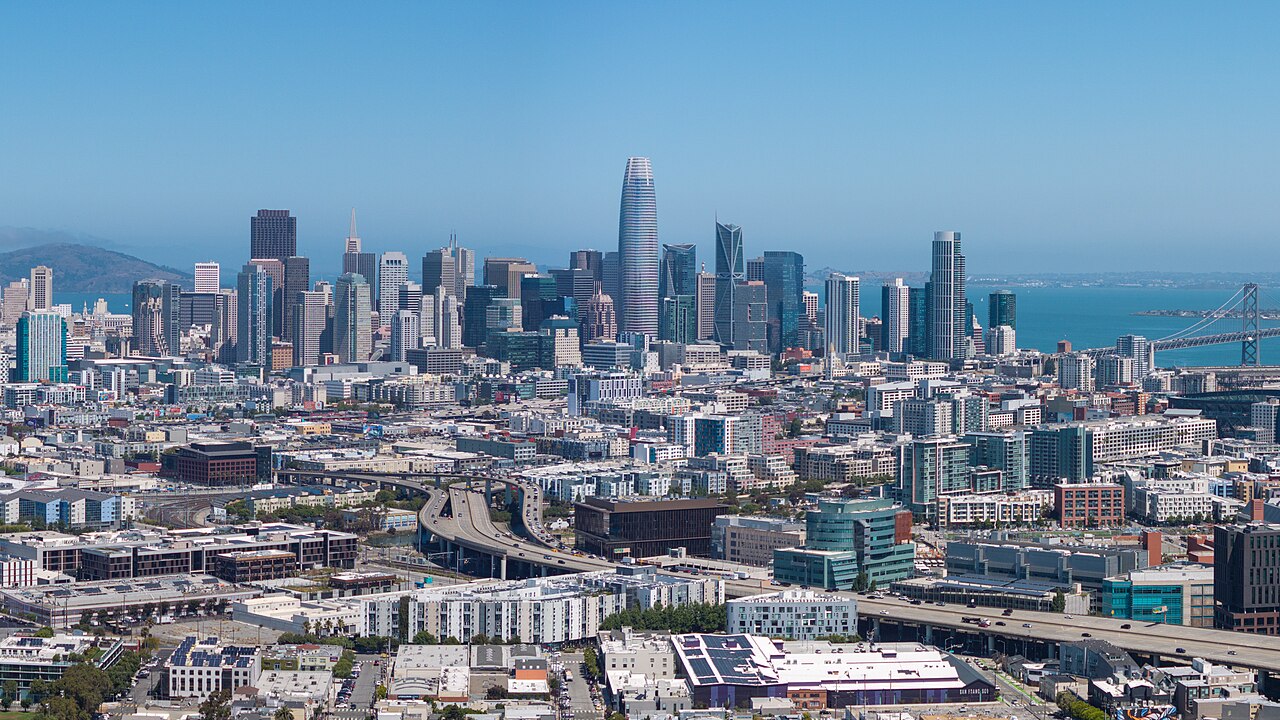
Twin Peaks is a viewpoint in San Francisco, United States. Two peaks at 922 feet above sea level offering 360-degree views of San Francisco, the bay, and surrounding hills. Most visitors spend 1–1.5 hours here. The free Lokali audio guide runs 5 minutes.
✓ Verified August 2026 · how we write these guides
Visitor facts
| Time needed | 1–1.5 hours |
|---|---|
| Lokali audio guide | 5 min · free |
| Type | Viewpoint |
| Best for | Photography |
| Location | San Francisco, United States |
| Coordinates | 37.7549, -122.4477 |
| Languages | 45, in the Lokali app |
The story
The climb leaves you a little breathless, and then the whole city opens below. Streets run in long straight lines toward the distant water. Hills rise and fall behind the rooftops like waves frozen in place. The wind pushes hard at your back. From up here, San Francisco looks like a map you could reach down and touch. This is Twin Peaks, two grassy hills standing near the very center of the city.
Two hills rise here side by side, each a little over nine hundred feet tall. They are among the highest points in all of San Francisco. On a clear day, you can see the bay, the bridges, the downtown towers, and the wide ocean beyond. On a foggy day, the clouds pour in from the sea, and the city below simply vanishes beneath your feet into soft gray.
Long before any streets arrived, people lived across this land. The Yelamu, a group of the Ohlone people, knew these hills well. They hunted and gathered food across the open slopes for many generations. The grasses and wildflowers you see around you now grow much as they did in those days, holding the shape of an older San Francisco that has mostly disappeared.
When Spanish settlers came, they gave the two hills a name of their own. As the city later grew, these peaks kept their wild and rounded shape while streets and houses spread everywhere around them. Most of San Francisco's hills were eventually built over with homes. These two were largely left bare. That early choice is the reason the views from the top remain so wide and open today.
Look closely at the ground beneath your feet. This is one of the last patches of natural grassland left in the entire city. Small native plants cling to the windy slopes. In spring, wildflowers bloom in waves of color across the green. A rare butterfly, the Mission blue, lives here and in only a few other places on earth. Its survival depends on these protected hills.
To the north stands a tall red and white tower with three sharp prongs. That is Sutro Tower, raised in 1973 to carry television and radio signals across the city. It rises high above the fog, taller than any hill nearby. Some people find it strange and ugly, while others have grown to love it. Either way, it has become a familiar mark on the skyline.
There is a popular overlook here called Christmas Tree Point. From its low stone wall, the downtown towers line up neatly before you. The long street called Market runs straight as an arrow toward them. At night, the whole grid of the city glows with countless lights. Cars trace slow, patient lines of red and white through the darkness below.
The weather up here can change with surprising speed. Bright sunshine may turn to thick fog within minutes. The wind is almost always present, cool and strong off the ocean. Many visitors arrive dressed for a warm summer day and leave shivering and surprised. These hills seem to make their own weather, caught as they are between the cold sea and the wide bay.
A narrow road loops up and around between the two peaks. You can drive much of the way toward the top and park nearby. But to reach the true summit of each peak, you must walk. A short, steep trail climbs the last stretch to each one. The effort is small, just a few minutes, and the reward is the whole city laid out in a circle around you.
Turn slowly in place and take in the full view. To the east lie the bay and its long gray bridges. To the north stands the famous bridge that crosses to the green headlands. To the west spreads the wide and restless ocean. Few places anywhere let you see so much of a single city all at once, in one quiet, sweeping turn.
Stay a while as the light begins to shift. At sunset, the low sun turns the windows of distant houses to gold across the hills. Then, one by one, the street lamps flicker on below. The fog often returns at dusk, sliding silently in from the sea. It softens every hard edge and slowly wraps the towers and streets in a blanket of gray.
These hills stood here long before the city did, and they hold their quiet still. Cars come and go in the parking lot. Cameras click and voices rise and fade. Yet the wind and the grass pay no mind to any of it. Stand a moment longer before you head back down. The city will be waiting below, and these patient slopes will keep their long watch over it.
Key facts
What to look for
Practical tips
Common questions
How long do you need at Twin Peaks?
Plan 1–1.5 hours. That is the time most visitors spend at Twin Peaks. The free Lokali audio guide adds about 5 minutes of narration you can listen to as you walk, so it fits inside your visit rather than adding to it.
Is there a free audio guide to Twin Peaks?
Yes — the Lokali app narrates Twin Peaks free of charge in 50+ languages. It covers the history, what to look for on site and practical tips, and it works offline once downloaded.
Where is Twin Peaks?
Twin Peaks is in San Francisco, United States, at 37.7549, -122.4477. Tap the map link on this page for directions from where you are.
What should you know before visiting Twin Peaks?
Drive or take transit, since the climb is steep.
What is Twin Peaks known for?
Two hills rise over nine hundred feet high.
What is the best time to visit Twin Peaks?
Go in late afternoon when the sun angles low across the city.
On the map
Opens directions to Twin Peaks from your location.
More to see in San Francisco


Hear Twin Peaks in your language
The full story, narrated, in 50+ languages. Download it before you go and it plays offline, at your own pace, with no ticket and no tour group.