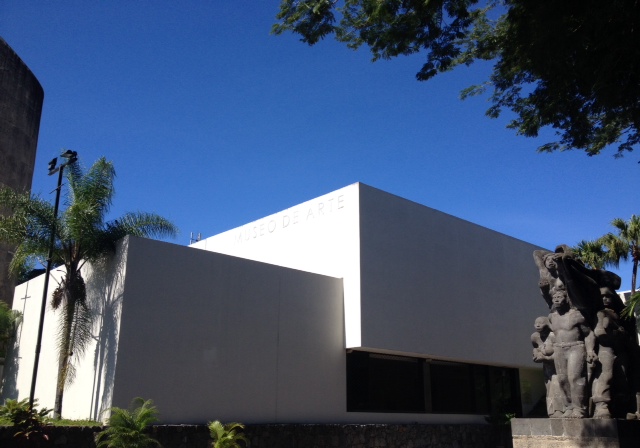
MARTE - Museum of Art of El Salvador
13.6858° N · 89.2287° W · Museum
Photo: MARTE El Salvador · CC BY-SA 4.0 · Wikimedia Commons
MARTE - Museum of Art of El Salvador is the Museum of Art of El Salvador showcases contemporary and modern Central American art, with rotating exhibitions, sculpture gardens, and a focus on post-war Salvadoran creativity. It is in San Salvador, El Salvador. Most visitors spend 1–2 hours here. The free Lokali audio guide runs 5 minutes.
✓ Verified August 2026 · how we write these guides
Visitor facts
| Time needed | 1–2 hours |
|---|---|
| Lokali audio guide | 5 min · free |
| Type | Museum |
| Best for | Editors' pick |
| Location | San Salvador, El Salvador |
| Coordinates | 13.6858, -89.2287 |
| Languages | 45, in the Lokali app |
The story
You leave the heat and bright sun of the street behind. The doors close softly, and the air turns cool and still. White walls stretch ahead of you. Quiet rooms open one into the next. You have entered MARTE, the Museum of Art of El Salvador. This is the country's main home for painting and sculpture, and it gathers the work of generations under one calm roof.
The museum stands in Colonia San Benito, a district in the western part of San Salvador. The area holds hotels, restaurants, and other cultural sites. Just nearby rises the large Monument to the Revolution, a landmark many visitors know. MARTE fits naturally into this corner of the city. It gives the neighborhood a quiet, thoughtful center, away from the rush of traffic outside.
MARTE opened in 2003. By the standards of the great world museums, that makes it young. But the art inside reaches back much further. The collection follows Salvadoran creativity across the twentieth century and into the present day. In a single visit, you can trace how local artists saw their country change through war, peace, and the slow passage of ordinary life.
Walk into the main halls and notice the space itself. The rooms are wide and bright. The walls are plain and pale, so nothing competes with the art. Movable panels divide the space for different shows. This simple design is on purpose. The building steps back. It lets each painting and sculpture speak clearly, without noise or distraction around it.
Spend time with the twentieth-century paintings. Many of them glow with strong, warm color. You will see fields and volcanoes. You will see village streets and busy markets. You will see the faces of farmers, mothers, and children. Salvadoran artists often turned to the land and the people around them. Their work holds deep feeling for home, for soil, and for memory.
Look closely and you begin to read a national story. Some works celebrate the beauty of the countryside. Others carry sorrow and struggle. The twentieth century was hard for El Salvador, marked by poverty and a long civil war. Artists did not look away. They put what they saw onto the canvas, so that later visitors like you could feel it too.
The museum does not only preserve the past. It also looks forward. Temporary exhibitions arrive throughout the year. Some feature living Salvadoran artists. Others bring work from across Latin America and beyond. Because of this, no two visits are quite the same. There is almost always something new on the walls, waiting to be discovered in the side galleries.
Move slowly from room to room. Let your eyes rest on one piece at a time. Read the small labels beside the works. They often share the name of the artist and the year. These details help you place each image in its moment. A date can change how you see a painting, turning a simple scene into a record of its time.
Notice the sculptures as well. Some stand alone in the open floor. They invite you to walk around them and study every side. Form, shadow, and balance all come into play. A sculpture asks for a different kind of looking than a painting does. Take the extra moment. Step around it and watch how it shifts as you move.
The museum also serves the people of the city directly. Students come on school trips. Local artists visit for ideas. Families spend a quiet afternoon together among the works. A place like MARTE helps a country hold on to its own culture. It says that Salvadoran art matters, and that it deserves a careful, lasting home of its own.
Think about how rare such a place can be. Art is often lost when times are hard. Paintings are sold, scattered, or simply forgotten. A museum gathers these works and keeps them safe in one location. It turns private treasures into a shared inheritance. Everyone who walks through the door becomes, for an hour, a keeper of that memory.
Before you finish, return to a single work that caught your eye. Stand with it a little longer. Notice the brushstrokes, the colors, and the small choices the artist made. Museums reward slow attention more than speed. One painting truly seen will stay with you far longer than twenty glimpsed in a hurry on the way past.
When you step back out into the sunlight, the city will look slightly changed. You have just seen how Salvadoran artists viewed these same streets, hills, and skies. Their colors may linger in your eyes. That is the quiet gift of a museum like MARTE. It hands you a new way of seeing the country waiting just beyond its doors.
Key facts
What to look for
Practical tips
Common questions
How long do you need at MARTE - Museum of Art of El Salvador?
Plan 1–2 hours. That is the time most visitors spend at MARTE - Museum of Art of El Salvador. The free Lokali audio guide adds about 5 minutes of narration you can listen to as you walk, so it fits inside your visit rather than adding to it.
Is there a free audio guide to MARTE - Museum of Art of El Salvador?
Yes — the Lokali app narrates MARTE - Museum of Art of El Salvador free of charge in 50+ languages. It covers the history, what to look for on site and practical tips, and it works offline once downloaded.
Where is MARTE - Museum of Art of El Salvador?
MARTE - Museum of Art of El Salvador is in San Salvador, El Salvador, at 13.6858, -89.2287. Tap the map link on this page for directions from where you are.
What should you know before visiting MARTE - Museum of Art of El Salvador?
Check current temporary exhibitions before you arrive.
What is MARTE - Museum of Art of El Salvador known for?
Opened in 2003 in Colonia San Benito.
What is the best time to visit MARTE - Museum of Art of El Salvador?
The sculpture garden is a quiet refuge.
On the map
Opens directions to MARTE - Museum of Art of El Salvador from your location.
More to see in San Salvador


Hear MARTE - Museum of Art of El Salvador in your language
The full story, narrated, in 50+ languages. Download it before you go and it plays offline, at your own pace, with no ticket and no tour group.