
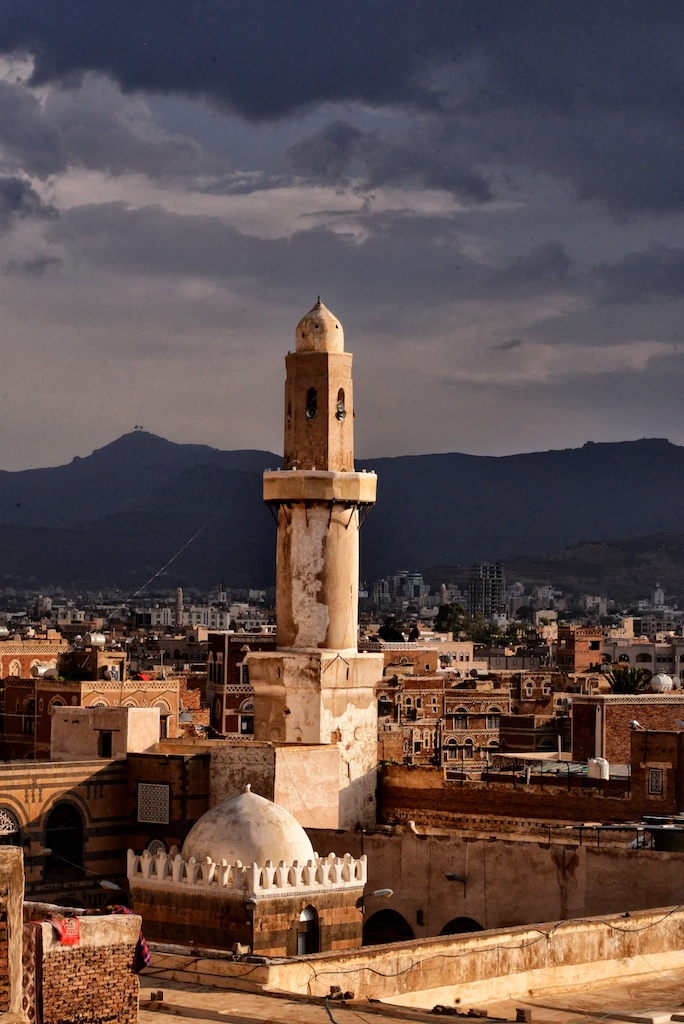
Photo: Om Eshak · CC BY 4.0 · Wikimedia Commons
Al-Saleh Mosque is a mosque in Sana'a, Yemen. Largest mosque in Yemen, opened in 2008. The free Lokali audio guide runs 6 minutes.
✓ Published October 2026 · how we write these guides
Visitor facts
| Lokali audio guide | 6 min · free |
|---|---|
| Type | Mosque |
| Location | Sanaa, Yemen |
| Coordinates | 15.3258, 44.2077 |
| Languages | 50+, in the Lokali app |
The story
Listen first. Out here, the noise of Sanaa's traffic grows thinner. Wide paved ground opens up around you, and the air at this altitude feels light and dry. Then the eye climbs. Six tall minarets rise from the corners of one great building, pale against a sky that is often a hard, clear blue. You are standing before the largest mosque in Yemen, a place built to be seen from far across the city.
This is the Al-Saleh Mosque. It sits in the southern part of Sanaa, near Al-Sabeen Square, a large open space used for national parades and public gatherings. That setting matters. This mosque was not built in the narrow lanes of the old walled city. It was built on open ground, in a modern district, with space around it to show its full size. It opened in 2008 and quickly changed the skyline of the capital.
The name gives away its origin. The mosque was commissioned under Ali Abdullah Saleh, who led Yemen for more than three decades. Large state-sponsored mosques are a familiar idea across the Arab world, and this one followed that pattern. It was a statement of faith, but also a statement of national ambition. A leader, a capital, and a country wanted a monument on a grand scale, and this building was the result.
Now look at the minarets again. There are six of them, and each one is very tall. Commonly cited figures put them at around one hundred metres. Count them slowly, from one corner to the next. Six minarets is an unusual number. Most mosques have one, two, or four. Here is the first surprise for many visitors: very few mosques in the world have six, so the number itself signals ambition.
The design draws on Yemen's own building traditions. Yemen has one of the most distinctive architectural cultures on Earth. In the old city of Sanaa, tower houses rise several stories high, decorated with white geometric bands around their windows. The architects of this mosque borrowed from that language. Look for patterned stonework, carved details, and contrasting tones in the facade. It is a modern building, but it is speaking in a local accent.
The main prayer hall sits beneath a large central dome, with smaller domes around it. Inside, the hall is very large. Widely reported estimates say the mosque can hold tens of thousands of worshippers at once, with figures around forty thousand often mentioned. Imagine the space full on a Friday, the main congregational prayer day in Islam. Rows of people stand shoulder to shoulder, and the call to prayer moves out across the square from those tall minarets.
Pause on the materials around you. Much of the exterior is faced in stone, with lighter and darker surfaces set against each other. In bright highland sun, those contrasts become sharp and clean. Run your eye along the arches and the window frames. You will see repeating geometric patterns. In Islamic art, geometry often takes the place of figures. Repetition, symmetry, and careful proportion are ways of expressing order and devotion without images.
Here is a second surprise. The great doors and the interior decoration were made with very careful craftsmanship, and visitors often comment on the carved wood and the detailed ceilings. If you are able to enter, look up before you look around. Ceilings in large mosques are often where the finest work hides. Many people walk straight across the carpet toward the prayer niche and never notice what is above their heads.
That prayer niche is called the mihrab. It is a recess in the wall that shows the direction of Mecca, the direction every Muslim faces in prayer. Every mosque has one, from the smallest village room to the largest hall. Near it, you will usually find the minbar, a raised pulpit with steps, where the imam gives the Friday sermon. These two features give the whole hall its orientation. Everything faces the same way.
The history of this building did not stand still after it opened. Yemen entered a long and painful conflict in the 2010s. Control of Sanaa changed hands, and the political meaning of a mosque named after a former president changed with it. The building has been referred to by a different name, Al-Shaab Mosque, which means the People's Mosque. Ali Abdullah Saleh himself was killed in December 2017. The stone stayed the same while the country around it changed.
It helps to set this building beside the other great mosque of the city. The Great Mosque of Sanaa, in the old town, is one of the oldest mosques in the Islamic world, with roots going back to the earliest era of Islam. That mosque is low, layered, and worn by centuries of use. This one is new, tall, and planned all at once. Between them, you can see two very different ideas of how a city honours its faith.
If you are visiting, remember that this is a working place of worship first. Dress modestly. Women usually cover their hair, and everyone removes their shoes before entering the prayer hall. Prayer times shape the rhythm of the day here, so visitors are often asked to wait or step aside while people pray. Ask before photographing worshippers. A quiet greeting and a respectful pace will open more doors than any camera.
Before you leave, step back to the edge of the open ground. Turn and take in the whole building in one view. Notice how the six minarets frame the domes, and how the light moves across the pale stone as the hours pass. Listen for the sounds of the city returning around you, the cars, the voices, perhaps a call to prayer drifting across the square. Then, as you walk away, look back once more. The minarets will stay with you for a long way.
Key facts
What to look for
Practical tips
Common questions
Is there a free audio guide to Al-Saleh Mosque?
Yes — the Lokali app narrates Al-Saleh Mosque free of charge in 50+ languages. The guide runs about 6 minutes, covers the history, what to look for on site and practical tips, and works offline once downloaded.
Where is Al-Saleh Mosque?
Al-Saleh Mosque is near Sanaa, Yemen, at 15.3258, 44.2077. Tap the map link on this page for directions from where you are.
What is Al-Saleh Mosque known for?
Largest mosque in Yemen, opened in 2008. Six minarets, each reportedly around one hundred metres tall.
What should you look for at Al-Saleh Mosque?
All six minarets visible together from the square's edge. Geometric patterns carved around the arches and windows. Light and dark stone contrasts across the facade.
What should you know before visiting Al-Saleh Mosque?
Dress modestly; women should bring a headscarf. Remove shoes before stepping onto the prayer hall carpet.
On the map
Opens directions to Al-Saleh Mosque from your location.
More to see near Al-Saleh Mosque
Hear Al-Saleh Mosque in your language
The full story, narrated, in 50+ languages. Download it before you go and it plays offline, at your own pace, with no ticket and no tour group.