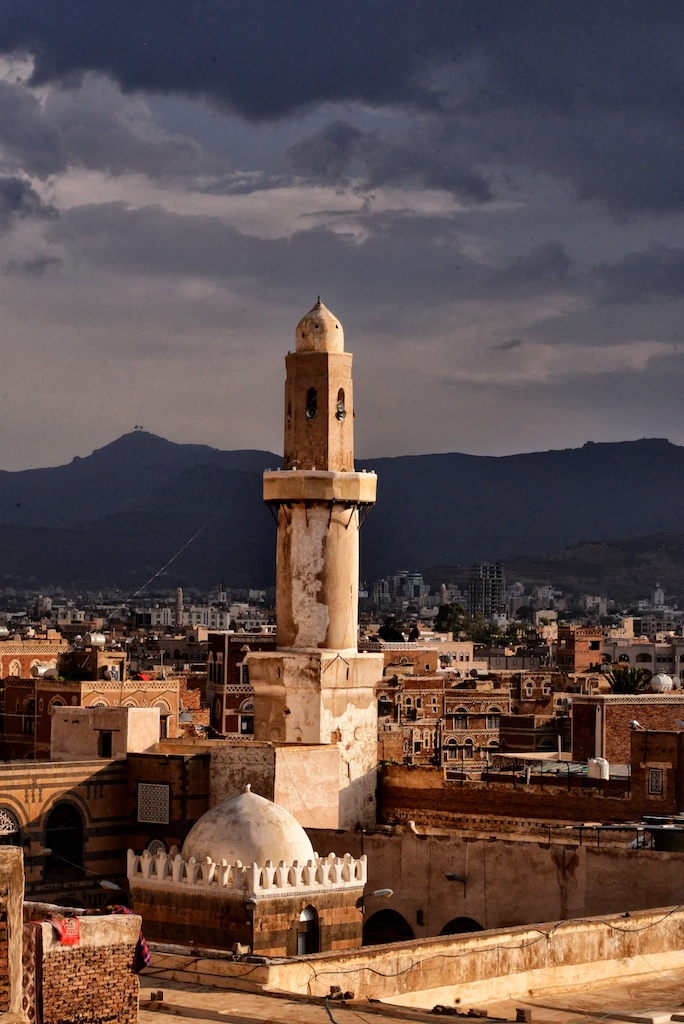
Photo: Rod Waddington from Kergunyah, Australia · CC BY-SA 2.0 · Wikimedia Commons
Great Mosque of Sanaa is a mosque in Sanaa, Yemen. Tradition dates its founding to the Prophet's lifetime. The free Lokali audio guide runs 7 minutes.
✓ Published October 2026 · how we write these guides
Visitor facts
| Lokali audio guide | 7 min · free |
|---|---|
| Type | Mosque |
| Location | Sanaa, Yemen |
| Coordinates | 15.3531, 44.2149 |
| Languages | 50+, in the Lokali app |
The story
Start with your feet. The stone underfoot is cool, worn smooth by many generations of bare soles. Around you, the noise of the old city softens. Somewhere a door closes, a pigeon lifts off a ledge, and a voice recites quietly in the shade of the arcades. The light here is sharp and high, because Sanaa sits on a mountain plateau. It falls in bright squares across the courtyard and leaves the colonnades in deep shadow.
This is the Great Mosque of Sanaa, one of the oldest mosques in the Islamic world. Its exact origins are tied to tradition rather than to a single surviving document. According to long-held Yemeni tradition, it was founded during the lifetime of the Prophet Muhammad, in the early seventh century. Some accounts say he gave the instruction for it to be built. That claim places this mosque among the very first in Islam.
What we can say with more confidence is that the building did not stay the same. Like most ancient mosques, it grew and changed over centuries. Historical sources describe a major enlargement under the Umayyads, the first great dynasty of caliphs, who ruled from Damascus. That expansion is usually linked to the caliph al-Walid the First in the early eighth century. Later rulers repaired, rebuilt, and extended it again. So the mosque you see is many layers of care, laid one over another.
Now look at the plan of the space. A wide open courtyard sits at the centre. Covered prayer halls with rows of columns surround it on its sides. This courtyard-and-arcade layout is one of the oldest patterns in mosque architecture. It gives shade, air, and room for large gatherings. Notice how the columns are not all identical. That variety is a clue in itself... and it leads to one of the old stories of this place.
Locals say that some of the stones and columns came from Ghumdan. Ghumdan was a legendary palace of pre-Islamic Yemen, often described as a tower of many stories. Medieval writers praised it in poetry, and its ruins were said to stand near this site. The idea that its materials were reused here is a popular tale, and it is hard to prove. But the reuse of older stone was very common in early mosques. So the story is plausible, even if it is not documented.
Raise your eyes to the ceilings, if you are inside the prayer hall. Parts of the mosque are known for their carved and painted wooden ceilings. These panels show geometric patterns and fine decoration. Wood was valuable on this high plateau, and craftsmen treated it with great respect. Historians of Islamic art study these ceilings closely, because some sections are considered very early. They are easy to miss. Most visitors look straight ahead, not up.
Here is the first surprise. In 1972, workers were restoring the mosque after heavy rains damaged part of the roof. Between the ceiling and the roof, they found a sealed space. Inside was a huge mass of old parchment and paper fragments. These were damaged Qur'an manuscripts and other texts. In Islamic practice, worn sacred texts are not thrown away. They are stored respectfully. Someone, long ago, had placed them here, out of sight.
That discovery became famous among scholars around the world. The fragments are now known as the Sanaa manuscripts. Some of them are among the oldest Qur'an manuscripts known to exist. And here is the second surprise. One of them is a palimpsest. That means a parchment where an earlier text was scraped off and written over. With modern imaging, researchers can read the lower, older layer. A forgotten loft in this building changed how scholars study the early history of the Qur'an.
The mosque sits inside the Old City of Sanaa, and the two cannot really be separated. The Old City was added to the UNESCO World Heritage List in the 1980s. As you walk out, you will see why. The tower houses rise several stories high. Their lower floors are often stone, and the upper floors are brick. White gypsum outlines the windows and edges, like patterns drawn in chalk on a dark surface.
Look for the arched windows above the doorways and shutters. Many of them hold coloured glass or thin translucent stone set in gypsum frames. In Yemen these fan-shaped windows are called qamariya, from the Arabic word for moon. In the evening, lamps inside the houses make them glow red, yellow, and blue. The Old City is a place where people still live, work, and pray, not a museum of empty shells.
It is also important to be honest about the present. Yemen has lived through years of war, and the Old City has suffered damage, neglect, and flooding. UNESCO has placed it on its list of World Heritage in Danger. Local craftspeople and residents keep repairing roofs, walls, and gypsum work with traditional methods. Every patch of fresh white plaster you see is a small act of care for a very old city.
Remember that the Great Mosque is first of all a working place of worship. It is not built as a tourist site. Prayer times shape the rhythm of the day here. Men come and go, wash before prayer, and sit in quiet conversation in the shade. Access for visitors can depend on local rules and on the time of day. Dress modestly, move gently, and ask before you take photographs of people.
Before you leave, stand for a moment at the edge of the courtyard. Feel the change in temperature between the sun and the shade of the arcades. Listen to how the sound of the street falls away inside these walls. Then, as you step back into the lanes, look up at the minarets above the rooftops. The same skyline has guided people to this spot for well over a thousand years. Now it guides you back into the city.
Key facts
What to look for
Practical tips
Common questions
Is there a free audio guide to Great Mosque of Sanaa?
Yes — the Lokali app narrates Great Mosque of Sanaa free of charge in 50+ languages. The guide runs about 7 minutes, covers the history, what to look for on site and practical tips, and works offline once downloaded.
Where is Great Mosque of Sanaa?
Great Mosque of Sanaa is in Sanaa, Yemen, at 15.3531, 44.2149. Tap the map link on this page for directions from where you are.
What is Great Mosque of Sanaa known for?
Tradition dates its founding to the Prophet's lifetime. Enlarged under the Umayyads in the early eighth century.
What should you look for at Great Mosque of Sanaa?
Columns of different styles around the courtyard. Carved and painted wooden ceiling panels inside. Minarets rising above the Old City rooftops.
What should you know before visiting Great Mosque of Sanaa?
Dress modestly, covering shoulders and legs. Avoid arriving during the main prayer times.
On the map
Opens directions to Great Mosque of Sanaa from your location.
More to see near Great Mosque of Sanaa

Hear Great Mosque of Sanaa in your language
The full story, narrated, in 50+ languages. Download it before you go and it plays offline, at your own pace, with no ticket and no tour group.