
Photo: Wikimedia Commons contributor · CC BY-SA 3.0 · Wikimedia Commons
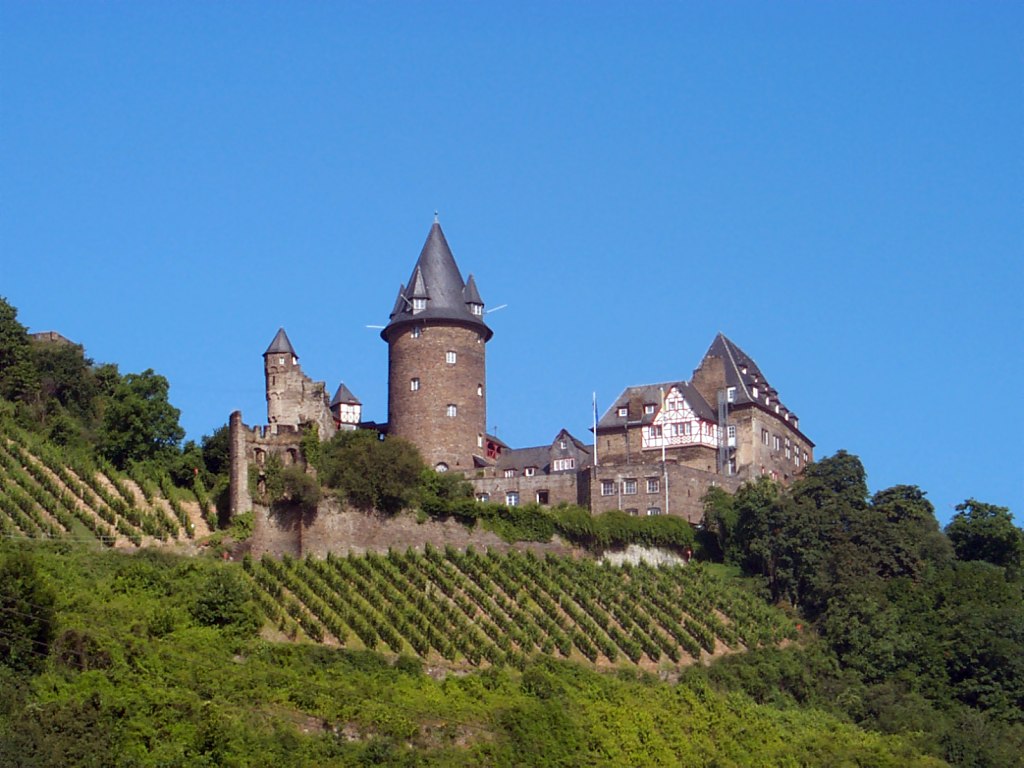
Rheinfels Castle is a castle in Germany. Founded in the mid-thirteenth century by the Counts of Katzenelnbogen. The free Lokali audio guide runs 8 minutes.
✓ Published October 2026 · how we write these guides
Visitor facts
| Lokali audio guide | 8 min · free |
|---|---|
| Type | Castle |
| Location | Sankt Goar, Germany |
| Coordinates | 50.1542, 7.7044 |
| Languages | 50+, in the Lokali app |
The story
Listen first. Under your feet, the gravel crunches. Above you, the wind moves across broken walls of grey and rust-coloured stone. Far below, a barge engine hums as it pushes against the current of the Rhine. And somewhere in the shadows nearby, a tunnel mouth breathes out cool, damp air that smells of earth and old rock. Welcome to Rheinfels Castle, high above the small town of Sankt Goar. What you see is a ruin. But it is the ruin of a place that was once one of the largest fortresses on the whole river.
Let us begin with why anyone built here at all. Look down at the water. The Rhine was the great highway of medieval Europe. Wine, timber, salt and cloth moved along it every day. Whoever controlled a narrow stretch of the river could stop the boats and demand a toll. This castle was founded in the middle of the thirteenth century by the Counts of Katzenelnbogen, a noble family from this region. Their main business here was simple. They collected money from passing ships.
That business made enemies. Not long after the castle was built, a league of Rhine cities grew tired of paying tolls to the lords along the river. They gathered an army and laid siege to Rheinfels. According to the castle's own story, the siege dragged on for more than a year — and the walls held. The attackers finally gave up and went home. It was an early sign of what this place would become. A fortress that was very, very hard to take.
The Katzenelnbogen family grew rich on the river trade. They were even known for an early taste for Riesling, the white grape that still covers the slopes of this valley today. But noble lines can end suddenly. In the late fifteenth century, the last count died without a male heir. The castle and its lands passed by marriage to the Landgraves of Hesse, a powerful ruling house further inland. For the next three centuries, Rheinfels belonged to Hessian princes.
Under Hessian rule, the castle changed character. In the sixteenth century, one branch of the family made Rheinfels its home, and the old fortress was expanded into a grand Renaissance residence. Renaissance here means the period when European builders turned back to classical ideas of proportion and comfort. Picture large windows, decorated halls and gardens alongside the thick defensive walls. The castle was no longer only a toll station. It was a seat of power, with a court, servants and guests.
Now walk with me towards the outer defences. As warfare changed, so did Rheinfels. Gunpowder made tall medieval walls easy targets. So the builders went outwards and downwards. They added low, angled bastions and deep ditches, designed to absorb cannon fire. Notice how the outer works spread across the hillside, much wider than the original core. At its greatest extent, this fortress covered a very large area of the ridge. Standing here, it is easy to forget that you are seeing only a fraction of it.
And here is the first surprise that many visitors miss. Rheinfels is not only above ground. Beneath your feet runs a network of tunnels and mine galleries cut into the rock. Defenders used these passages to move unseen, to reach enemy lines, and to plant explosives under attackers who dug too close. Some of these passages are still open today. Walking through them is one of the most memorable things you can do here. The ceilings are low, the walls are rough, and the darkness is complete beyond the reach of a torch.
Those tunnels mattered in the castle's most famous test. In 1692, during a long war between France and much of Europe, a large French army under King Louis the Fourteenth besieged Rheinfels. The Hessian garrison inside was much smaller. Yet the defenders held out, and the French withdrew without taking the fortress. It was a remarkable result. Many castles along the Rhine fell to French forces in those years. This one did not.
The second surprise comes a century later. Rheinfels survived cannon, siege and mines — but not politics. In the 1790s, during the wars that followed the French Revolution, French troops returned to the Rhine. This time the garrison surrendered without a real fight. A few years later, the French blew up large parts of the fortress so it could never be used against them again. The great castle that had resisted kings was brought down by explosives in a matter of days.
What happened next was quieter, but just as destructive. For years after the explosions, the ruin served as a quarry. People from the area carried away cut stone to build houses, walls and barns. Some of the stones of Rheinfels may still sit in buildings down in Sankt Goar today. Only in the nineteenth century, as travellers and painters began to love the romantic ruins of the Rhine, did people start to see the castle as something worth protecting. In the twentieth century, the town itself became its owner.
Step now to the edge of the walls and look across the river. On the opposite bank sits the town of Sankt Goarshausen, with another castle, called Burg Katz, on the hillside above it. A little further upstream, the river bends around the Loreley, a tall rock linked to a famous legend. Locals say a beautiful maiden once sat on that rock, combing her golden hair and singing, while boatmen crashed onto the rocks below. It is a story, not history. But this stretch of water truly was dangerous for sailors.
This whole landscape is protected as part of the Upper Middle Rhine Valley, a UNESCO World Heritage Site. Look at how the elements fit together. Steep vineyards climb the slopes in narrow terraces. Railway lines run along both banks, close to the water. Small towns sit on narrow strips of flat land between river and cliff. And above them, castle after castle watches the river. Rheinfels is one part of a much larger picture, shaped over centuries by trade, faith, war and wine.
Before you go, pause for a moment. Put your hand on the stone if you can reach it. Feel how cold it is, even on a warm day. Listen again to the river below, and to the trains that pass along the banks. The boats still move up and down this water, just as they did when the counts collected their tolls. As you walk back down towards Sankt Goar, look up once or twice. Watch how the broken walls sit against the sky... still guarding a river that no longer pays them anything.
Key facts
What to look for
Practical tips
Common questions
Is there a free audio guide to Rheinfels Castle?
Yes — the Lokali app narrates Rheinfels Castle free of charge in 50+ languages. The guide runs about 8 minutes, covers the history, what to look for on site and practical tips, and works offline once downloaded.
Where is Rheinfels Castle?
Rheinfels Castle is near Sankt Goar, Germany, at 50.1542, 7.7044. Tap the map link on this page for directions from where you are.
What is Rheinfels Castle known for?
Founded in the mid-thirteenth century by the Counts of Katzenelnbogen. Built to collect tolls from boats on the Rhine.
What should you look for at Rheinfels Castle?
Low tunnel entrances cut directly into the hillside rock. Angled bastions built low to absorb cannon fire. Burg Katz on the hillside across the river.
What should you know before visiting Rheinfels Castle?
Bring a torch or phone light for the underground tunnels. Wear sturdy shoes for uneven gravel and slippery stone steps.
On the map
Opens directions to Rheinfels Castle from your location.
More to see near Rheinfels Castle



Hear Rheinfels Castle in your language
The full story, narrated, in 50+ languages. Download it before you go and it plays offline, at your own pace, with no ticket and no tour group.