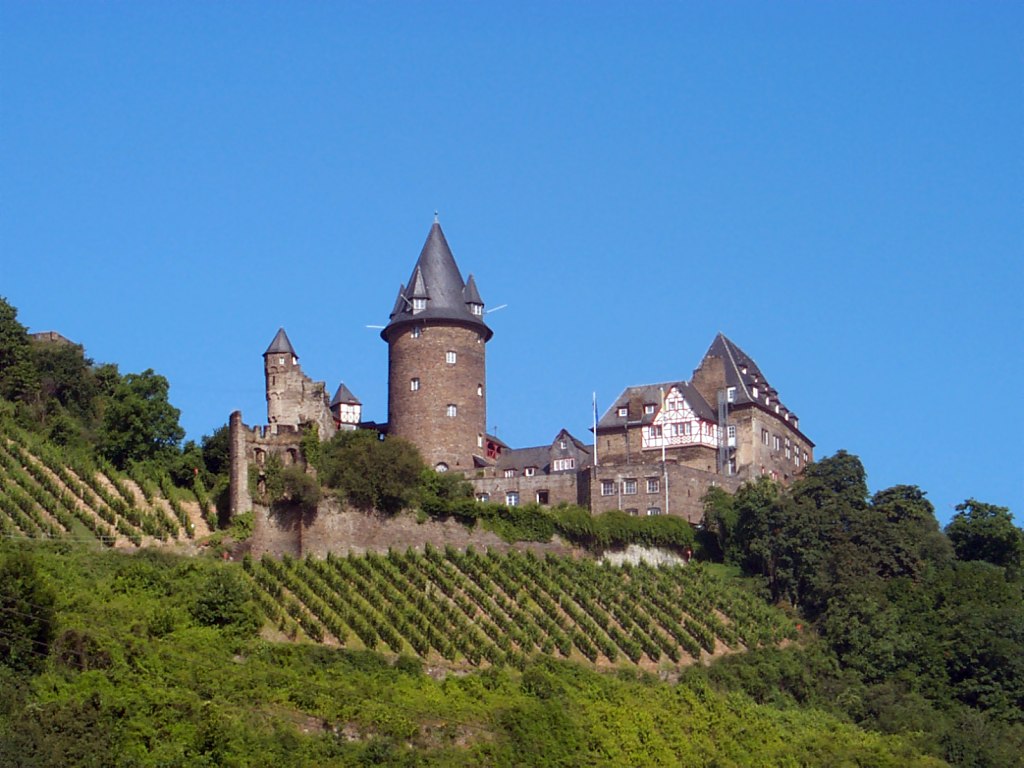
Stahleck Castle
50.0581° N · 7.7656° E · Castle
Photo: Wikimedia Commons contributor · Public domain · Wikimedia Commons
Stahleck Castle is a castle in Germany. First recorded in the first half of the twelfth century. The free Lokali audio guide runs 7 minutes.
✓ Published October 2026 · how we write these guides
Visitor facts
| Lokali audio guide | 7 min · free |
|---|---|
| Type | Castle |
| Location | Rüdesheim am Rhein, Germany |
| Coordinates | 50.0581, 7.7656 |
| Languages | 50+, in the Lokali app |
The story
Listen first. Below you, the Rhine moves slowly in its wide green bed, and a freight barge pushes upstream with a low diesel hum. A train rattles along the riverbank. Up here, the wind runs through oak and slate, and the stone under your hand is cool even on a warm day. This is Stahleck Castle. It stands high above the small wine town of Bacharach, a short journey down the river from Rüdesheim.
That location matters, so let us be clear about it. Rüdesheim is the bigger hub, with its ferries and its crowded lanes. Stahleck stands on the opposite bank, on the left bank of the Rhine, above Bacharach. Many visitors arrive by boat or train from Rüdesheim and climb up from the old town. If you came that way, you have already seen the river change. Here the valley tightens, and the hills grow steep and dark with vineyards.
This whole stretch of river belongs to the Upper Middle Rhine Valley. UNESCO listed it as a World Heritage Site in 2002. The listing does not cover one building. It covers a whole landscape of castles, terraced vineyards, river towns and steep slate slopes. Stahleck is one piece of that larger picture. From the walls, you can see how each castle on this river watched the water. Every castle had a reason to be where it is.
The castle appears in written records in the first half of the twelfth century. It was built on a narrow ridge of rock. The river protected one side, and steep slopes protected two more. The weak side was the hill behind, where the ground rises gently. So the builders cut a deep ditch into the rock there and raised a thick shield wall behind it. Walk around to that uphill side and you can still read the plan. Danger came from the hill, not from the river.
Why build here at all? Look down at the water. For centuries the Rhine was one of the great trade roads of Europe. Wine, timber, cloth and salt moved along it. Lords along the river collected tolls from passing boats. Bacharach itself grew rich as a wine market. Barrels from the surrounding slopes gathered here before they travelled north. A castle on this ridge meant control of the town, and control of the river below.
In the twelfth century, Stahleck was linked to the Archbishops of Cologne, who were powerful princes as well as churchmen. Later the castle passed to the Counts Palatine of the Rhine. These were among the highest nobles in the Holy Roman Empire. One count, Hermann of Stahleck, took his name from this rock. So for a time, a castle above a small wine town sat close to the centre of imperial politics.
Here is a story that many visitors miss. In 1194, a young noblewoman named Agnes, daughter of the Count Palatine, married Henry of Brunswick, a son of the rival Welf family. Her family belonged to the circle of the Hohenstaufen emperors, and the two dynasties were bitter enemies. Tradition places the wedding here, and says it happened in secret, without the emperor's approval. The marriage helped ease the feud between the two houses. A love match, perhaps... and also a political earthquake.
The castle you see is not entirely medieval. In 1689, during the Nine Years' War, French troops swept through the Palatinate and the Rhineland. They destroyed many fortresses in this region, and Stahleck was one of them. The walls were blown apart and left as a ruin. For more than two centuries it stood broken on the ridge. Romantic travellers in the nineteenth century loved ruins like this one, and painters drew them again and again.
Then, in the 1920s, the story changed. A Rhineland society for the protection of monuments and landscape took on the ruin. Work began to rebuild the castle in a medieval style. The goal was not a palace for one family. The new Stahleck became a youth hostel. That is still its job today. So when you hear voices in the courtyard, they may belong to school groups, cyclists or hikers staying the night.
That is the second surprise. You can sleep inside a Rhine castle without being a prince. Young travellers, families and walkers book rooms here, eat in the castle, and look out from the windows at night. The lights of passing barges move slowly across the dark water. The modern restoration is easy to spot if you look closely. Some stone is sharp and clean. Older stone is rougher, darker and stained with lichen.
On your way up or down, you probably passed a ruined Gothic chapel on the slope below. This is the Werner Chapel. Its tall, empty window frames are open to the sky, like stone lace. Its history is painful. It is tied to a medieval accusation against the town's Jewish community, which led to violence. Today the ruin is a place for remembrance, and many visitors pause there quietly. It is worth a few minutes of your time.
Before you leave, walk to a viewpoint on the walls. Look along the river first. Count the hills, the vineyard terraces and the towers. Then look down at Bacharach. You will see slate roofs, half-timbered houses and the town walls with their old towers. Some of those walls still climb the slope toward the castle. The castle and the town were built as one system, and you can still see the line between them.
Now stay still for one more moment. Feel the wind come up from the valley, carrying the smell of damp stone and leaves. The barge you heard at the beginning may be gone by now, and another is already coming. This castle was destroyed, abandoned and rebuilt, yet the river below has not stopped moving. As you walk down the path, listen to the town. Glasses, voices, a church bell... the same valley, still busy, still watching the water.
Key facts
What to look for
Practical tips
Common questions
Is there a free audio guide to Stahleck Castle?
Yes — the Lokali app narrates Stahleck Castle free of charge in 50+ languages. The guide runs about 7 minutes, covers the history, what to look for on site and practical tips, and works offline once downloaded.
Where is Stahleck Castle?
Stahleck Castle is near Rüdesheim am Rhein, Germany, at 50.0581, 7.7656. Tap the map link on this page for directions from where you are.
What is Stahleck Castle known for?
First recorded in the first half of the twelfth century. Later held by the powerful Counts Palatine of the Rhine.
What should you look for at Stahleck Castle?
The deep rock-cut ditch on the uphill side. The thick shield wall facing the hill. Clean restored stone beside darker, lichen-covered older stone.
What should you know before visiting Stahleck Castle?
Stahleck sits above Bacharach, not in Rüdesheim itself. Reach Bacharach from Rüdesheim by train or Rhine boat.
On the map
Opens directions to Stahleck Castle from your location.
More to see in Rüdesheim am Rhein


Hear Stahleck Castle in your language
The full story, narrated, in 50+ languages. Download it before you go and it plays offline, at your own pace, with no ticket and no tour group.