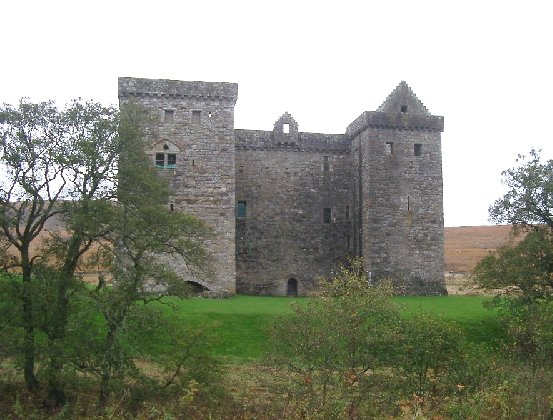
Hermitage Castle
55.2556° N · 2.7933° W · Castle
Photo: Kirsty Smith · CC BY-SA 2.0 · Wikimedia Commons
Hermitage Castle is a Semi-ruined castle in Scotland. Main stone castle largely rebuilt in the later fourteenth century. The free Lokali audio guide runs 7 minutes.
✓ Published October 2026 · how we write these guides
Visitor facts
| Lokali audio guide | 7 min · free |
|---|---|
| Type | Castle |
| Location | Scottish Borders, United Kingdom |
| Coordinates | 55.2556, -2.7933 |
| Official website | historicenvironment.scot |
| Languages | 50+, in the Lokali app |
The story
Listen for a moment. Wind moves across open moorland. A burn runs over stones somewhere close by. Sheep call from the hillside. Underfoot, the grass is soft and often damp. In front of you rises a block of grey-brown stone so plain and so heavy that it looks less like a building and more like part of the hill. This is Hermitage Castle, in the valley of Liddesdale, deep in the Scottish Borders.
First, notice how alone it is. There is no village wrapped around these walls and no town square at the gate. The nearest settlement is a few miles away. That isolation is the key to this place. For centuries, this valley sat close to the frontier between Scotland and England. Armies, raiders and rival families all passed through these hills. The castle was built to watch the route and to hold it.
Historians often call Liddesdale one of the most violent valleys in Britain. From the late medieval period into the sixteenth century, the Borders were the country of the reivers. Reivers were raiding families who lived by stealing cattle and settling feuds, on both sides of the border. Names like Armstrong and Elliot belong to this valley. Loyalty usually went to the family name first, and to a king only second. A fortress here had to deal with all of that.
Now look closely at the walls. They are tall and almost blank. The windows are few and small, more like slits than openings. This is a building designed to keep people out, not to let light in. The stone you see is mostly the result of rebuilding in the later fourteenth century, when a powerful family turned an earlier castle into this compact, tower-like fortress. Comfort was not the priority. Survival was.
Here is the detail that most visitors notice only after a few minutes. On the east and west sides, enormous pointed arches rise high between the corner towers. They look almost like the doorway of a great church. But they are not doorways. Look along the top of the walls and you will see rows of square holes. Those holes once held timber beams. Many historians believe these supported a wooden fighting gallery, built out from the wall, so defenders could drop missiles straight down on attackers below.
So the castle you see today is the stone skeleton. Imagine it dressed in timber, with walkways along the top and smoke rising from inside. It would have looked rougher and busier than this quiet ruin. The empty square holes are the last trace of that wooden layer. Once you notice them, you start to see the castle as it worked, rather than as a picture postcard.
The castle also carries darker stories. Some are history. Some are legend, and it is worth keeping the two apart. One of the most quoted episodes comes from the fourteenth century. Contemporary accounts say that a Scottish knight, Sir Alexander Ramsay, was imprisoned here by his rival, William Douglas, and starved to death. The rivalry was about power and royal favour in the Borders. It shows how dangerous ambition could be in this valley.
Then there is the legend. Locals tell of an earlier lord, a member of the de Soulis family, who was said to practise black magic and to terrorise the people of the valley. According to the popular tale, the people finally seized him and boiled him alive in a cauldron of lead, on a stone circle in the hills nearby. There is no reliable evidence for any of this. But the story was turned into a ballad in the age of Walter Scott, and it still clings to these stones.
The most famous visitor arrived in 1566. Mary, Queen of Scots, was staying at Jedburgh, some distance to the north. She heard that James Hepburn, Earl of Bothwell, had been badly wounded in a fight with Border raiders and was lying here at Hermitage. Mary rode across the rough hill country to see him, and rode back the same day. It was a hard journey over bog and moor.
What happened next is the surprise in the story. Soon after that ride, Mary fell seriously ill at Jedburgh, and for a time people feared she would die. She recovered. But the visit gained a heavier meaning later. Within a year, Bothwell would become her third husband, and that marriage helped to bring down her reign. Many people look back at this hurried ride to Hermitage as an early sign of the bond between them.
After the crowns of Scotland and England were united in the early seventeenth century, the border lost its old purpose. Liddesdale was no longer a frontier, and the reivers were broken up. A fortress like this one had little reason to exist. The castle slowly fell out of use and began to decay. In the nineteenth century, repairs were made to stop the walls from collapsing, and today the site is cared for by Historic Environment Scotland.
If you step inside, you will find that the interior is open to the sky. The floors that once divided the castle into rooms have gone. Look up at the inner walls and you can still see the outlines of fireplaces, doorways and the sockets for floor beams, stacked one above another. The sound changes in here, too. The wind drops, and footsteps and voices echo off the stone. It is easy to imagine how dark and cramped it once felt.
Before you leave, walk around the outside. Look at the low grassy banks and ditches near the walls. These earthworks are part of the castle's defences and earlier history. A short walk to the west, near the burn, there are also the low remains of an old chapel and its graveyard. The name of the castle is often linked to a religious hermitage in this valley, and the chapel is a quiet reminder of that idea.
Now stand still once more and look back at the castle against the hills. Notice how the colour of the stone changes as clouds move over the sun, from grey to warm brown and back again. Listen to the water and the wind. The raiders, the knights and the queen have all gone. What remains is this heavy, patient building, still watching the valley, as you walk away from it.
Key facts
What to look for
Practical tips
Common questions
Is there a free audio guide to Hermitage Castle?
Yes — the Lokali app narrates Hermitage Castle free of charge in 50+ languages. The guide runs about 7 minutes, covers the history, what to look for on site and practical tips, and works offline once downloaded.
Where is Hermitage Castle?
Hermitage Castle is near Scottish Borders, United Kingdom, at 55.2556, -2.7933. Tap the map link on this page for directions from where you are.
What is Hermitage Castle known for?
Main stone castle largely rebuilt in the later fourteenth century. Mary, Queen of Scots rode here to visit Bothwell in 1566.
What should you look for at Hermitage Castle?
Huge pointed arches spanning between towers on two sides. Rows of square beam holes near the top of walls. Tiny slit-like windows set deep into the thick stone.
What should you know before visiting Hermitage Castle?
Bring waterproof boots; the grass around the castle is often wet. Pack layers, as the open moor is windy even in summer.
When is the best time to visit Hermitage Castle?
Pack layers, as the open moor is windy even in summer.
On the map
Opens directions to Hermitage Castle from your location.
More to see in Scottish Borders


Hear Hermitage Castle in your language
The full story, narrated, in 50+ languages. Download it before you go and it plays offline, at your own pace, with no ticket and no tour group.