
Melrose Abbey
55.5996° N · 2.7187° W · Archaeological Site
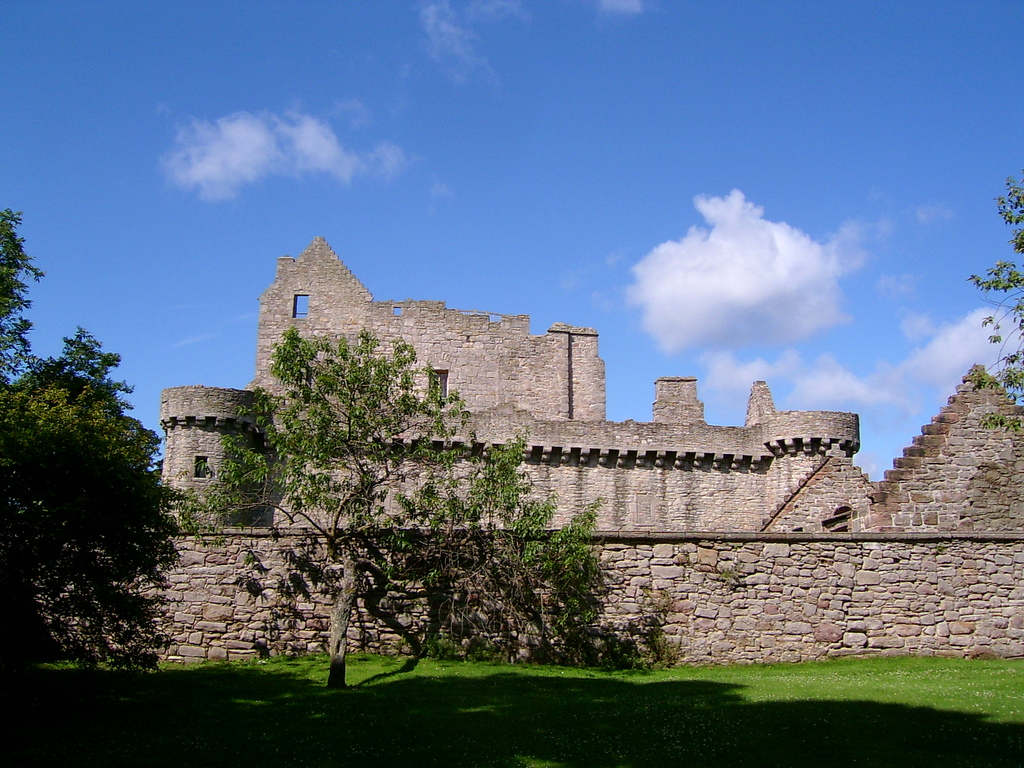
Photo: Holger Uwe Schmitt · CC BY-SA 4.0 · Wikimedia Commons
Melrose Abbey is a partly ruined monastery in Melrose, Scotland. Founded in 1136 under King David the First. The free Lokali audio guide runs 7 minutes.
✓ Published October 2026 · how we write these guides
Visitor facts
| Lokali audio guide | 7 min · free |
|---|---|
| Type | Archaeological Site |
| Location | Scottish Borders, United Kingdom |
| Coordinates | 55.5996, -2.7187 |
| Languages | 50+, in the Lokali app |
The story
Listen for a moment. Rooks call from the trees along the edge of the grounds. Gravel crunches underfoot, and somewhere beyond the walls a car moves slowly through the small town. In front of you, the stone rises in shades of rose and rust. This is a soft red sandstone, and on a damp day it darkens almost to the colour of wine. Even roofless and broken, Melrose Abbey still feels like a building that wants you to look up.
The story begins in 1136. King David the First of Scotland invited a community of Cistercian monks to settle here. The Cistercians were a strict reforming order of the Benedictine family. They valued silence, hard work and simple worship. The first monks came north from Rievaulx Abbey in Yorkshire. Melrose became the first Cistercian house in Scotland, and over time it grew into one of the richest abbeys in the kingdom.
The name, however, is older than these walls. A few kilometres to the east, at a bend in the River Tweed, there was an earlier monastery known today as Old Melrose. Monks from the island of Iona founded that community centuries before. Saint Cuthbert, one of the most loved saints of northern Britain, began his religious life there. So when the Cistercians arrived, they carried a name that already had deep roots in this valley.
Now look at the position of the abbey. It sits on low, fertile ground close to the Tweed, with the three peaks of the Eildon Hills rising to the south. The Cistercians chose sites like this on purpose. They needed water for drinking, for cooking and for carrying away waste. They also needed good land. The monks became skilled farmers, and much of the abbey's wealth came from sheep and the wool trade.
That wealth, and this location, came at a cost. Melrose stood on the main road between England and Scotland. During the long wars between the two kingdoms, armies passed through again and again. In 1385, an English army under King Richard the Second burned the abbey badly. Much of what you see today belongs to the great rebuilding that followed, through the late fourteenth century and into the fifteenth. That is why the stonework here looks so refined.
Walk toward the south transept, the arm of the church that reaches out to the side. Look up at the great window. Its stone tracery, the carved framework that once held the glass, curves and flows like flames. This late Gothic style was more common in France and England than in Scotland. The masons who worked here clearly knew the latest fashions. Even without glass, the shapes frame the sky beautifully.
Here is a detail many visitors miss. Somewhere in this part of the abbey, an inscription records a master mason named John Morow. It says he was born in Paris and that he had charge of work at several Scottish churches, including Melrose. It is rare to find a medieval builder's name preserved in stone like this. Take a moment to search the walls for carved lettering — it is a direct link to a real working man.
Now for the abbey's most playful surprise. High on the outside walls, especially along the south side, you will find a crowd of carved figures. There are saints and dragons, monks and musicians, strange faces and grinning creatures. The best known is a pig playing the bagpipes. Nobody knows exactly why the carvers made it. Perhaps it was humour, or perhaps a gentle warning about foolishness. Either way, it has made visitors smile for hundreds of years.
Melrose is also linked to one of Scotland's most famous kings. Robert the Bruce asked for his heart to be taken on crusade after his death. According to the traditional story, the heart was later brought back and buried here. During excavations in the twentieth century, a lead casket containing a heart was found in the grounds. It was reburied in the late 1990s, and a carved stone now marks the spot. Nobody can prove the heart is Robert's — but the story is very much alive.
The abbey also holds a darker legend. Locals tell of Michael Scot, a real medieval scholar who later gained a reputation as a wizard. Folklore says he lies buried somewhere within these walls, together with his books of magic. This is legend, not history. Still, it shows how the abbey shaped the imagination of the Borders long after the monks were gone.
The final blows came in the sixteenth century. English armies attacked again in the 1540s, during a violent campaign that Scots later called the Rough Wooing. It was an attempt to force a royal marriage between the two kingdoms. Then came the Protestant Reformation of 1560, which ended monastic life across Scotland. The community slowly faded away. Later, part of the old church was adapted for use as a parish church, before it too was abandoned.
In the nineteenth century, Melrose found new admirers. The novelist and poet Sir Walter Scott lived nearby at Abbotsford. In his poem The Lay of the Last Minstrel, he wrote that if you would view fair Melrose aright, you should go visit it by the pale moonlight. Those lines brought romantic travellers here in great numbers. Today the abbey is cared for by Historic Environment Scotland, and a small museum nearby displays objects found on the site.
As you explore, look down as well as up. Low stone foundations mark the cloister, the kitchens, the chapter house and the living quarters of the lay brothers. The lay brothers were working members of the community who did much of the farm labour. Follow the line of the great drain that once carried water through the precinct. These plain outlines show the daily routine that once filled this ground — prayer, meals, work and sleep, repeated over centuries.
Before you leave, stand still for one last moment and face the east end of the church. Notice how the light falls on the red stone, and how the empty windows hold pieces of sky. The rooks are still calling. The Eildon Hills still rise beyond the town. As you walk back toward the gate, glance up once more at the carved figures on the walls. Somewhere among them, a stone pig is still playing his pipes.
Key facts
What to look for
Practical tips
Common questions
Is there a free audio guide to Melrose Abbey?
Yes — the Lokali app narrates Melrose Abbey free of charge in 50+ languages. The guide runs about 7 minutes, covers the history, what to look for on site and practical tips, and works offline once downloaded.
Where is Melrose Abbey?
Melrose Abbey is near Scottish Borders, United Kingdom, at 55.5996, -2.7187. Tap the map link on this page for directions from where you are.
What is Melrose Abbey known for?
Founded in 1136 under King David the First. First Cistercian abbey established anywhere in Scotland.
What should you look for at Melrose Abbey?
The carved pig playing bagpipes high on the walls. Flame-like stone tracery in the south transept window. The marked stone over the buried heart casket.
What should you know before visiting Melrose Abbey?
Walk the outside south wall to see the carvings. Bring binoculars for figures high on the roofline.
When is the best time to visit Melrose Abbey?
Come late afternoon for warm light on red stone.
On the map
Opens directions to Melrose Abbey from your location.
More to see in Scottish Borders


Hear Melrose Abbey in your language
The full story, narrated, in 50+ languages. Download it before you go and it plays offline, at your own pace, with no ticket and no tour group.