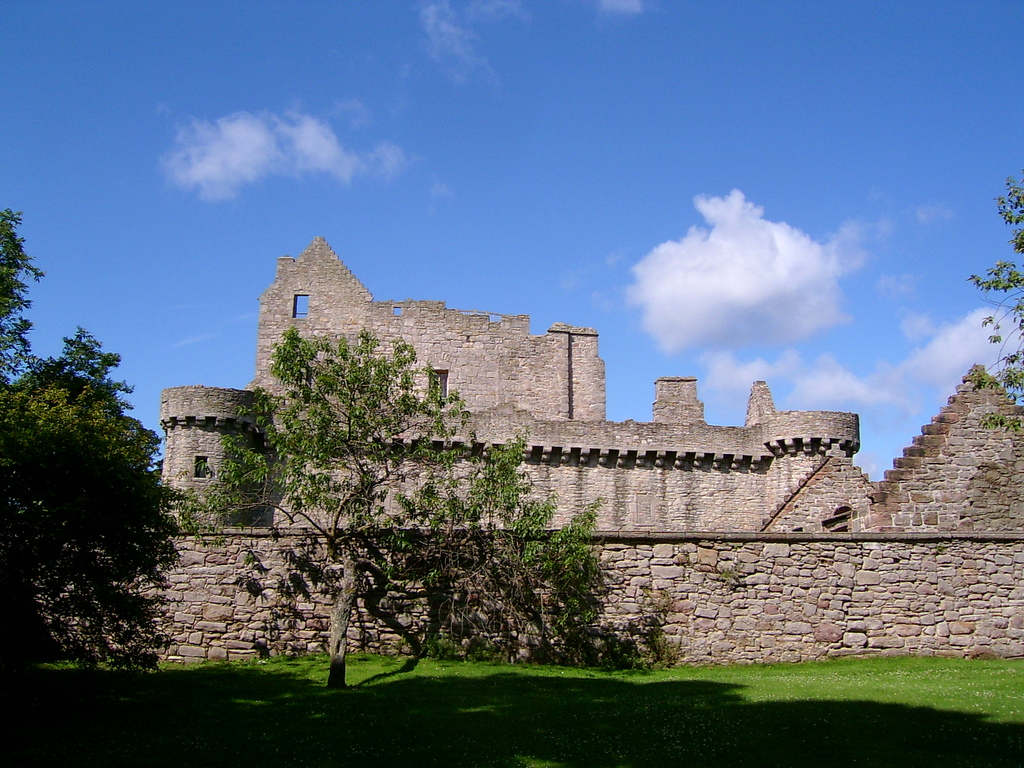
Photo: Photograph by Stuart Yeates, from en:Flickr · CC BY-SA 2.0 · Wikimedia Commons
Craigmillar Castle is a castle in Edinburgh, Scotland, UK. Tower house built by the Preston family around 1400. The free Lokali audio guide runs 7 minutes.
✓ Published October 2026 · how we write these guides
Visitor facts
| Lokali audio guide | 7 min · free |
|---|---|
| Type | Castle |
| Location | Edinburgh, United Kingdom |
| Coordinates | 55.9257, -3.1409 |
| Official website | historicenvironment.scot |
| Languages | 50+, in the Lokali app |
The story
Feel the stone steps under your feet. They dip in the middle, worn smooth by centuries of boots and shoes. The air inside the walls is cool, even on a warm day. It smells of damp rock and moss. Listen, and you may hear rooks calling from the trees outside, and the faint hum of the city in the distance. You are standing in one of the best-preserved medieval castles in Scotland, and many visitors to Edinburgh never find it.
Craigmillar Castle sits on a low rocky ridge a few kilometres southeast of the city centre. The word "craig" is Scots for a rock or a crag, and the castle grows straight out of one. Look at the base of the walls and you can see where the builders set their stones directly on the bedrock. The castle and the hill feel like one object. This is part of why it has survived so well.
The heart of the castle is the tower house, the tall block of stone at the centre. It was built around the late fourteenth or early fifteenth century by the Preston family. They held these lands for generations. A tower house was a fortified home. It was meant to keep a family safe from raids, but it was also a place to live, cook, sleep, and receive guests. The walls here are very thick, and the windows at the bottom are small for a reason.
The tower follows an L-shaped plan. One wing sticks out from the main block and holds the entrance and the stair. This layout made the doorway easier to defend. Anyone coming in had to turn a corner and climb a narrow spiral. As you go up, notice how the steps turn. Spiral stairs like this gave a defender above an advantage over an attacker below. It is a simple idea, and it worked for centuries.
Now climb to the great hall. This was the main room of the tower, where the family ate, held court, and entertained. The fireplace is huge — wide enough to stand in. Imagine it full of burning logs, with smoke rising and the long table lit by firelight. The ceiling above you is a stone vault. That stone vault helped protect the upper floors from fire. It also made the hall feel solid and grand.
In the fifteenth century the Prestons added a curtain wall around the tower. This is the outer ring of stone you walked through on your way in. It changed the castle from a single tower into a full courtyard castle. Look closely at the wall and you will find small openings shaped a little like upside-down keyholes. These are gunholes. They were made for early firearms. They are among the earlier examples of gun defences in Scotland, and they show that the age of cannon had already arrived.
The castle did not escape the wars of the sixteenth century. In the 1540s, English armies invaded Scotland during the conflict often called the Rough Wooing. The name sounds gentle, but it was brutal. King Henry the Eighth of England wanted the infant Mary, Queen of Scots, to marry his son. When the Scots refused, English troops burned towns and castles. Craigmillar was among them. The Prestons repaired and rebuilt it afterwards.
That same Mary is the person most closely linked to Craigmillar. In 1566 she came here as a young queen. She had recently given birth to her son James, and she was ill and exhausted. Craigmillar was close to Edinburgh but quieter than the royal palace of Holyrood. She stayed here to recover. Her marriage to her husband, Lord Darnley, had become deeply unhappy, and his behaviour had made him many enemies at court.
Here is the part that surprises many visitors. During Mary's stay, a group of powerful nobles met at Craigmillar. They discussed how the queen might be freed from Darnley. Historians often call this agreement the Craigmillar Bond. Exactly what was said, and how much Mary knew, is still debated. What is certain is what came next. In February 1567, Darnley was killed in Edinburgh, at a house called Kirk o' Field. The plot may have taken shape within these very walls.
There is a local tradition connected to Mary's visit. Just to the south of the castle is an area called Little France. Locals say it got its name from the French servants and courtiers in Mary's household, who lodged nearby while she stayed here. Mary had grown up in France, so the story feels natural. Treat it as a popular tale rather than proven fact, but the name is still on the map today.
In the seventeenth century the castle passed to a new owner, Sir John Gilmour, a lawyer. He made it more comfortable and added a range of rooms on the west side of the courtyard. Over time, though, families wanted lighter, more modern houses. In the eighteenth century the Gilmours moved out, and the castle slowly fell into ruin. It is now cared for by Historic Environment Scotland. Because it was abandoned rather than demolished, so much of the old structure still stands.
Now look for the small surprise in the landscape. From the top of the tower, look down into the grounds. You may be able to make out the shape of an old fishpond. Its outline is often described as forming the letter P — a nod, people say, to the Preston family. There is also an eerie old story. Legend has it that a skeleton was once found standing upright inside a sealed-off space in the castle walls. No one knows who it was. It is a tale, but it fits a place this old.
Before you go down, take in the view. To the north you can see Arthur's Seat, the old volcanic hill above Edinburgh. On a clear day you can see toward the city and the sea. Feel the wind up here. It has been crossing this ridge for as long as the castle has stood. As you walk back through the courtyard, run your hand along the stone. Notice the moss in the joints, the patches of newer repair, and the light falling through the empty windows. These walls still carry the shape of the people who lived here.
Key facts
What to look for
Practical tips
Common questions
Is there a free audio guide to Craigmillar Castle?
Yes — the Lokali app narrates Craigmillar Castle free of charge in 50+ languages. The guide runs about 7 minutes, covers the history, what to look for on site and practical tips, and works offline once downloaded.
Where is Craigmillar Castle?
Craigmillar Castle is in Edinburgh, United Kingdom, at 55.9257, -3.1409. Tap the map link on this page for directions from where you are.
What is Craigmillar Castle known for?
Tower house built by the Preston family around 1400. Mary, Queen of Scots stayed here to recover in 1566.
What should you look for at Craigmillar Castle?
Inverted keyhole gunholes in the outer curtain wall. The huge fireplace in the vaulted great hall. Walls built directly onto the natural bedrock.
What should you know before visiting Craigmillar Castle?
Wear sturdy shoes for worn, uneven spiral stairs. Climb to the tower roof for views over Edinburgh.
On the map
Opens directions to Craigmillar Castle from your location.
More to see in Edinburgh


Hear Craigmillar Castle in your language
The full story, narrated, in 50+ languages. Download it before you go and it plays offline, at your own pace, with no ticket and no tour group.