
Photo: Philipp Pilhofer · CC BY-SA 3.0 · Wikimedia Commons
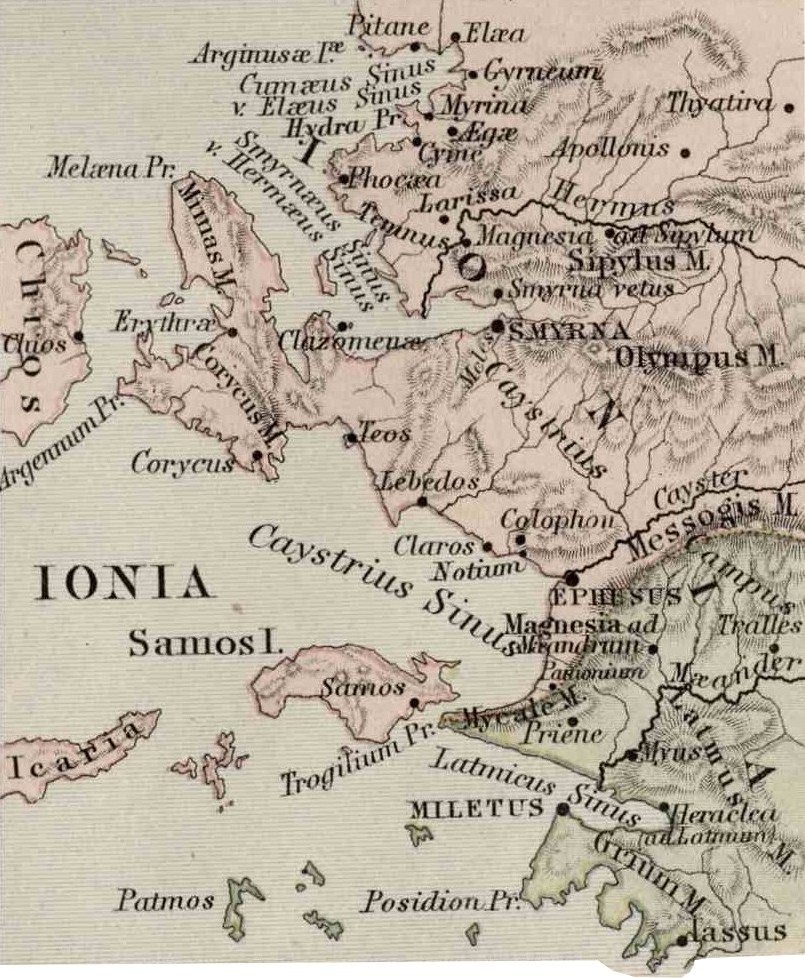
Teos is a maritime city of Ionia. Teos was one of twelve cities of ancient Ionia. The free Lokali audio guide runs 7 minutes.
✓ Published October 2026 · how we write these guides
Visitor facts
| Lokali audio guide | 7 min · free |
|---|---|
| Type | Archaeological Site |
| Location | Seferihisar district, Türkiye |
| Coordinates | 38.1772, 26.7850 |
| Languages | 50+, in the Lokali app |
The story
Listen first. Wind moves through the olive trees, and somewhere a tractor hums across a field. Under your feet, the dry earth gives way to pale marble. Fragments lie scattered in the grass like dropped dice. A column drum here, a carved block there. The sea is close enough to smell, salt mixed with warm resin from the pines. This is Teos, one of the old Greek cities of Ionia, on the coast of what is now the Seferihisar district, south of Izmir.
Ionia was the name the ancient Greeks gave to this stretch of the Aegean coast and its nearby islands. Twelve cities here formed a loose league, sharing festivals and a sense of common identity. Teos was one of those twelve. Its neighbours included places whose names still echo through history books — Ephesus, Miletus, Smyrna's later rival cities. For centuries, this headland was a working port, a centre of trade, and a place where poetry and theatre mattered deeply.
The city sat on a narrow neck of land between two harbours. That gave Teos a rare advantage. Ships could shelter on one side or the other, depending on the wind. As you walk the site, try to picture water on both flanks. The modern village of Sığacık, with its stone castle and fishing boats, sits beside one of those old harbour areas. The other lies toward the open bay, where the shoreline has shifted over the centuries.
Now — the first surprise. Teos is the hometown of Anacreon, one of the best-known lyric poets of ancient Greece. He lived in the sixth century BCE. He wrote short, light songs about wine, love, and the pleasures of growing old gracefully. His verses were copied and imitated for more than two thousand years. Many later poets wrote in his style, and the word "Anacreontic" entered European languages to describe that kind of playful drinking song.
Anacreon's life also connects to a dramatic moment for the whole city. In the sixth century BCE, the Persian Empire pushed west across Anatolia. Rather than live under Persian rule, many people of Teos took to their ships and sailed north. They founded a new city called Abdera, on the coast of Thrace, in what is now northern Greece. Teians also played a part in founding Phanagoria, on the shores of the Black Sea. Some later returned, and Teos lived on.
Walk toward the largest cluster of marble and you reach the heart of the site — the Temple of Dionysus. Dionysus was the Greek god of wine, theatre, and ecstatic celebration. The temple is credited to Hermogenes, a Hellenistic architect admired by later Roman writers. The Roman author Vitruvius, who wrote a famous handbook on architecture, discussed Hermogenes and his ideas about proportion. So the building around you was part of a real debate about how temples should look.
The temple follows the Ionic order. That is the style with slender columns and capitals carved into elegant spiral scrolls, called volutes. Look closely at the fallen pieces and you may find curving fragments of those scrolls. Archaeologists have worked to raise some columns back into place. Seeing them standing again helps you judge the scale. Stand at the base and look up. Then imagine a full ring of columns, a roof, painted details, and the smoke of offerings drifting out.
Here is the second surprise. Teos became home to the guild of the Artists of Dionysus in the Hellenistic period. This was an organised body of actors, musicians, and performers — something like an ancient professional union. They travelled to festivals across the Greek world. Their link with Dionysus made Teos a natural base. Inscriptions also record that many cities and rulers recognised Teos as sacred and inviolable to the god, a kind of protected status.
Teos is also known for an unusual set of inscriptions from the fifth century BCE, often called the Teian curses. They are public curses written into the law of the city. They called down ruin on anyone who harmed the community. Targets included people who blocked grain imports or plotted against the citizens. It is a rare, direct look at what a small Greek city feared most — hunger, betrayal, and danger from outside.
Beyond the temple, the city spreads up the gentle slopes. On the hillside, look for the curve of the theatre, where seating was set into the ground. There is also a smaller roofed building, often described as an odeion or council house, with neat rows of stone seats. This was a city of public speaking and performance. Sitting on one of those benches, you are in the same posture as citizens who came here to listen and argue.
The sea around Teos also saw war. In 190 BCE, a naval battle took place near here, known as the Battle of Myonessus. Roman and Rhodian ships fought the fleet of the Seleucid king Antiochus the Third. The Seleucids were a dynasty that ruled a large empire after Alexander the Great. The defeat weakened Antiochus, and Roman influence in this region grew. Teos continued under Roman rule, and the city slowly faded in later centuries.
Systematic excavations have continued in recent years, led by Turkish archaeologists. New finds keep adding detail to the story. Signs on the site explain different buildings, and work areas are sometimes fenced off. Much of Teos still lies under fields and olive groves. That is part of its quiet appeal. You are not walking through a finished museum. You are walking across a city that is still being uncovered, one trench at a time.
As you leave, turn back once more toward the temple. Notice how the marble catches the light, white against the dark green of the olive trees. Listen again for the wind and the distant sea. The poets, actors, and sailors of Teos knew these same sounds. Then follow the road toward Sığacık, where the harbour still holds boats, and where life on this headland goes on.
Key facts
What to look for
Practical tips
Common questions
Is there a free audio guide to Teos?
Yes — the Lokali app narrates Teos free of charge in 50+ languages. The guide runs about 7 minutes, covers the history, what to look for on site and practical tips, and works offline once downloaded.
Where is Teos?
Teos is near Seferihisar district, Türkiye, at 38.1772, 26.7850. Tap the map link on this page for directions from where you are.
What is Teos known for?
Teos was one of twelve cities of ancient Ionia. Lyric poet Anacreon was born here in the sixth century BCE.
What should you look for at Teos?
Spiral volute fragments from the temple's Ionic column capitals. Re-erected columns showing the true height of the temple. Curved hillside outline where the theatre seating once stood.
What should you know before visiting Teos?
Wear sturdy shoes for uneven ground and loose marble fragments. Bring water and a hat; shade on the site is limited.
When is the best time to visit Teos?
Visit early morning or late afternoon to avoid midday heat.
On the map
Opens directions to Teos from your location.
More to see near Teos



Hear Teos in your language
The full story, narrated, in 50+ languages. Download it before you go and it plays offline, at your own pace, with no ticket and no tour group.