
Photo: Saffron Blaze · CC BY-SA 3.0 · Wikimedia Commons
Aspendos is an ancient Greco-Roman city in Antalya province of Turkey. Built in the second century under emperor Marcus Aurelius. The free Lokali audio guide runs 7 minutes.
✓ Published October 2026 · how we write these guides
Visitor facts
| Lokali audio guide | 7 min · free |
|---|---|
| Type | Archaeological Site |
| Location | Serik, Türkiye |
| Coordinates | 36.9389, 31.1722 |
| Languages | 50+, in the Lokali app |
The story
Run your hand along the stone of the entrance passage. It is cool, even in the heat of a southern Turkish afternoon. The limestone has a warm, honey-brown colour, and under your fingers you can feel the tool marks of Roman masons. Then the passage opens. In front of you rises a wall of seats that curves around you like a cupped hand. Behind you stands a stage building so complete that it looks ready for tonight's show.
This is the theatre of Aspendos, a short drive inland from the coast near Serik, in the province of Antalya. Many Roman theatres survive across the Mediterranean. Very few survive like this. Here the seating, the stage wall and the outer shell all still stand together. For a moment, it is easy to forget that almost two thousand years separate you from the people who first sat on these benches.
The theatre dates to the second century of our era, during the reign of the emperor Marcus Aurelius. We even know the name of its architect. An inscription on the building credits a man called Zenon, the son of Theodorus. That is rare. Most ancient builders remain anonymous. Zenon was a local man, and his theatre was a gift to his own city, paid for by wealthy citizens who wanted their names remembered alongside it.
Look at how the seats are laid out. The lower rows rest against the natural slope of the hill, which saved huge amounts of building material. A wide walkway divides the seating into a lower and an upper section. The capacity is often given as several thousand people, though estimates vary from source to source. Climb to the top later, and you will see how carefully every row is angled toward the stage.
Now turn to face the stage building. The Romans called this tall back wall the scaenae frons, the decorated front of the stage. Once it held two levels of columns, statues in niches, and small pediments, the triangular roofs you see above Greek temples. Most of the columns are gone today. But the wall itself, with its doors and its rows of openings, still rises to its full height. That full height is the first thing most visitors miss — and the most remarkable.
If you stand in the middle of the orchestra, the flat half-circle in front of the stage, try a small experiment. Speak in a normal voice, or drop a coin on the stone. Ask a friend to listen from the upper rows. The acoustics here are famous. The curved seating and the tall stage wall work together to carry sound upward, so a performer did not need to shout to reach the back.
The city of Aspendos is far older than its theatre. It grew up beside a river the ancient Greeks called the Eurymedon, known today as the Köprüçay. According to Greek tradition, settlers from Argos, in mainland Greece, founded it. In the fifth century before our era, the Athenian general Cimon defeated a Persian force near the mouth of this river. The city later became known for its horses and for its silver coins.
When Alexander the Great marched along this coast, Aspendos agreed to pay him tribute, then tried to back out of the deal. Alexander returned with his army, and the city quickly accepted harsher terms. Later it passed under Roman rule and grew wealthy. The theatre you are standing in is a product of that prosperity, built in a long period of peace, when cities competed to show off their public buildings.
Here is the second surprise. Part of the reason this building survives so well is that people never stopped using it. In the thirteenth century, the Seljuk Turks, a dynasty that ruled much of Anatolia before the Ottomans, repaired the theatre. They used it as a caravanserai, a roadside inn and palace for travellers and traders. Look closely at the stage building for traces of red painted decoration in a zigzag pattern. Those marks come from the Seljuk period, not the Roman one.
The theatre also carries a local legend. People say that a king of Aspendos promised his daughter to the man who built the most useful work for the city. One suitor built the long aqueduct that you can still see across the plain. Another built this theatre. As the king walked the top rows, he heard a whisper, carried clearly from below, saying the princess should be his. The king gave his daughter to the theatre builder. It is only a story — but the acoustics make it easy to believe.
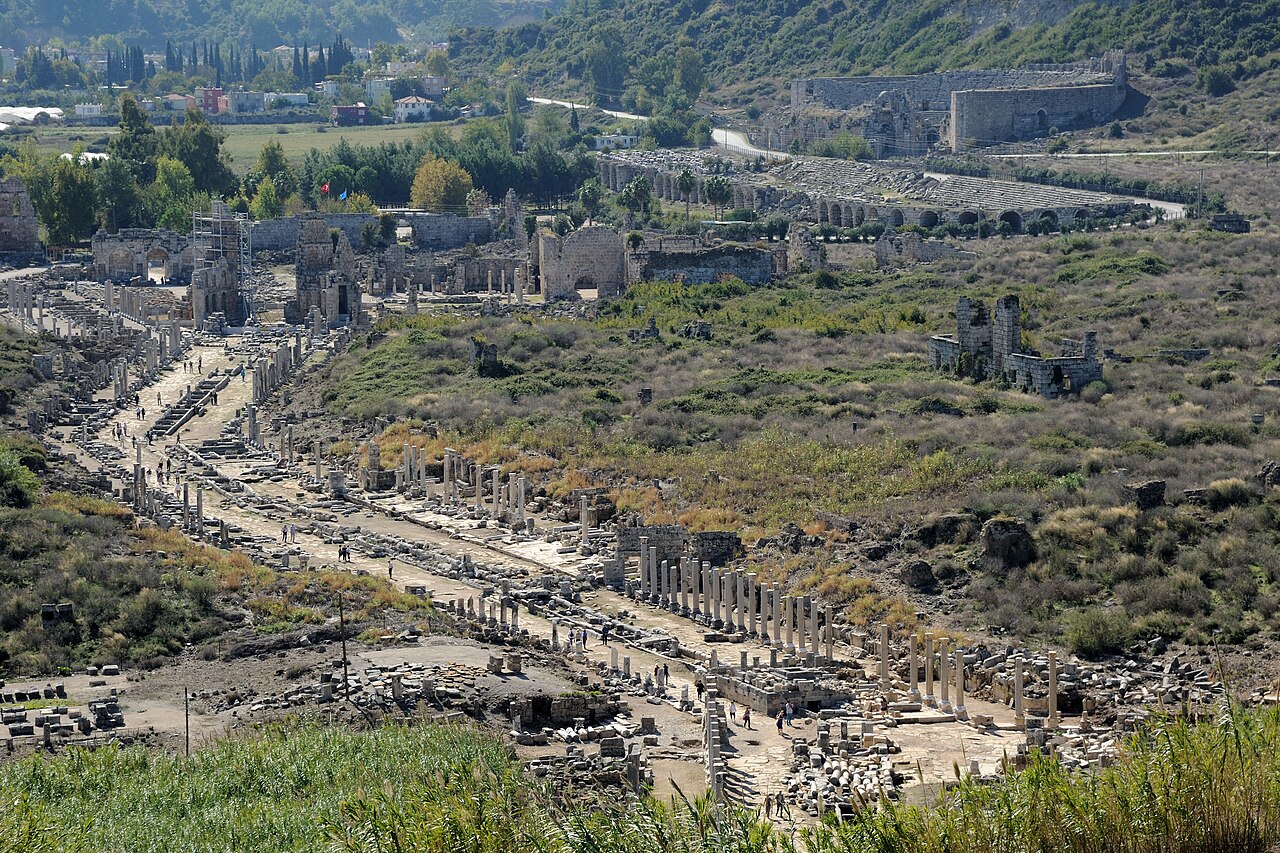
That aqueduct is real, and worth a short detour. Its arches march across the fields north of the theatre and are among the best preserved Roman water systems in the region. Engineers used tall pressure towers to push water across the valley. Up on the hill behind the theatre you can also find the remains of the ancient city's centre, including a basilica, a market area and a monumental fountain. Fewer visitors make that climb, so it is often quiet.
The stage is still in use. In the twentieth century, the theatre was reopened for performances, and today it hosts concerts and an opera and ballet festival. On those nights, the seats fill again, the lights warm the old stone, and music rises into the sky above the hill. If you are here in the right season, it is worth checking whether a performance is scheduled. Seeing the building full of people shows you what it was made for.
Before you leave, stand for a moment on the upper walkway and look down. Notice how the shadows move across the seats as the sun shifts. Listen to the voices of other visitors carrying across the stone, clearer than they should be at this distance. On your way out, run your hand once more along the entrance passage. You are touching the same wall that Roman crowds brushed past on their way to the show.
Key facts
What to look for
Practical tips
Common questions
Is there a free audio guide to Aspendos?
Yes — the Lokali app narrates Aspendos free of charge in 50+ languages. The guide runs about 7 minutes, covers the history, what to look for on site and practical tips, and works offline once downloaded.
Where is Aspendos?
Aspendos is near Serik, Türkiye, at 36.9389, 31.1722. Tap the map link on this page for directions from where you are.
What is Aspendos known for?
Built in the second century under emperor Marcus Aurelius. An inscription names the architect as Zenon, son of Theodorus.
What should you look for at Aspendos?
Red zigzag paint traces on the stage building. Tool marks on the stone of the entrance passage. Empty niches where statues once stood on the stage wall.
What should you know before visiting Aspendos?
Arrive early morning to avoid heat and tour groups. Test the acoustics from the centre of the orchestra.
When is the best time to visit Aspendos?
Check the festival schedule for an evening performance.
On the map
Opens directions to Aspendos from your location.
More to see near Aspendos



Hear Aspendos in your language
The full story, narrated, in 50+ languages. Download it before you go and it plays offline, at your own pace, with no ticket and no tour group.