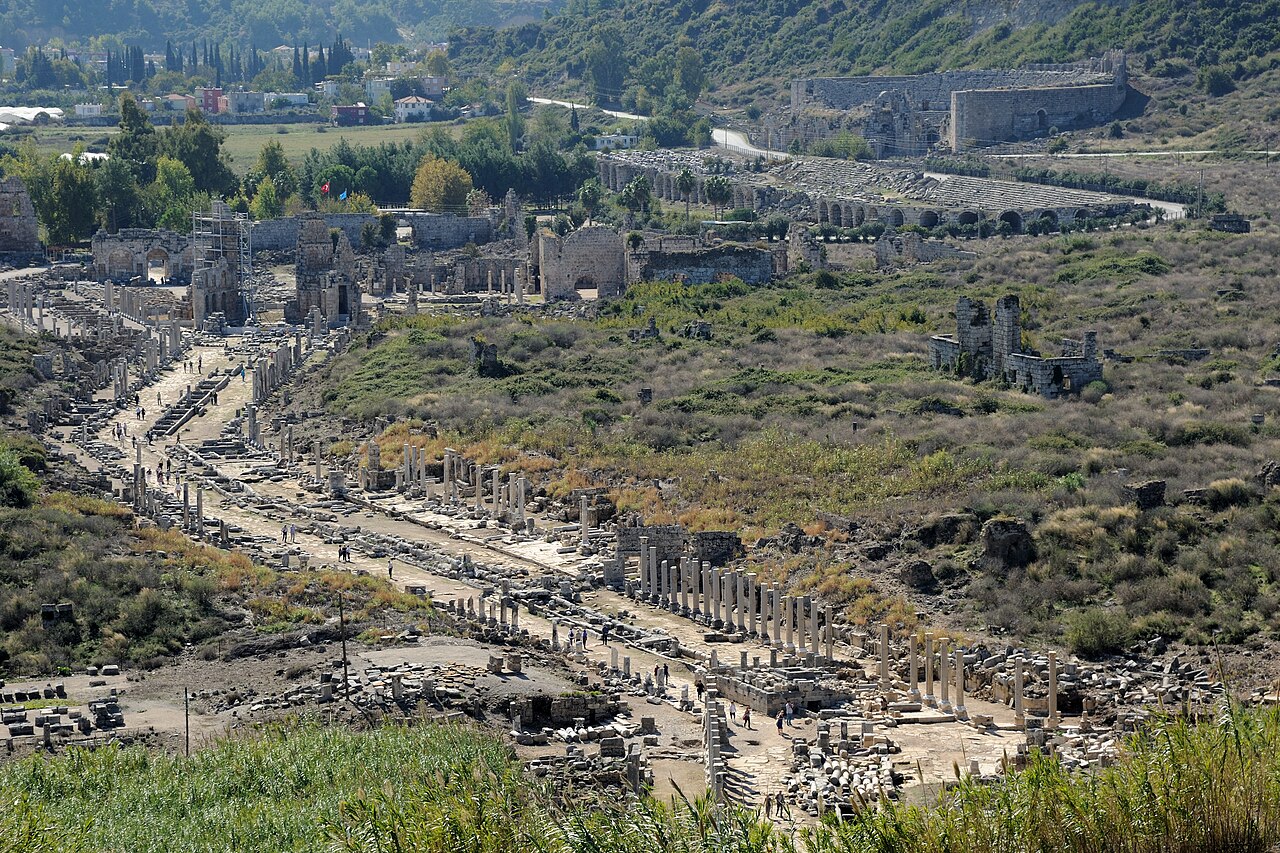
Perge is an archaeological site in Antalya, Türkiye. Plancia Magna rebuilt the gate courtyard in the second century. A water channel ran down the middle of the colonnaded street. Most visitors spend 2-3 hours here. The free Lokali audio guide runs 6 minutes.
✓ Verified October 2026 · how we write these guides
Visitor facts
| Time needed | 2-3 hours |
|---|---|
| Lokali audio guide | 6 min · free |
| Type | Archaeological Site |
| Best for | History |
| Location | Antalya, Türkiye |
| Coordinates | 36.9614, 30.8539 |
| Languages | 45, in the Lokali app |
The story
The heat comes off the stone in waves. There is almost no shade here, and the light bounces off pale limestone until you squint. Dry grass grows between the paving blocks, and grasshoppers jump away from your feet with a dry clicking sound. Somewhere behind you a gate creaks. The dust on the path is fine and pale, and it settles on your shoes within minutes. Bring water. Then look up at the two round towers ahead.
Those towers belong to the old Hellenistic gate, and they are the image most people carry away from Perge. Built of squared blocks, they have lost their upper storeys but still stand well above head height. Between and behind them lies an oval courtyard. Anyone entering the city passed through this narrow, controlled space. It was defensive first. Later, under Roman rule, it was turned into something closer to a display room.
That transformation had a sponsor with a name. Plancia Magna came from a leading family here in the second century, held public office and priesthoods, and paid for the courtyard to be rebuilt in marble with niches for statues. The statues showed gods, emperors and members of her own family, with inscriptions recording who gave what. Many of them are now in the Antalya Museum. Empty niches in the walls are where they stood.
Beyond the courtyard the main colonnaded street runs north in a straight line. It is long, wide and unmistakable. Down the centre of it there is a shallow stone channel that carried water through the city. On a hot day that channel would have cooled the air and supplied the shops on either side. Columns line both edges, some standing, many lying where they fell. Look at the paving for grooves worn by cart wheels.
At the far end of the street, at the foot of a flat-topped hill, stand the remains of a monumental fountain. Water arrived here and fell into a basin before feeding the channel you have just walked beside. A reclining river god was carved as part of it. The hill behind is the acropolis, the oldest settled part of the site, which people occupied long before the Roman city spread across the plain below.
Walk back and out to the stadium. It is one of the best-preserved in Anatolia, a long oval of seating raised on rows of vaults. Go underneath. The vaulted chambers on the outer side were used as shops, and some carry inscriptions naming the trades or the shopkeepers who rented them. Stand in the middle of the track and look at the tiers. Tens of thousands of people could watch races and games from these rows.
Next to it is the theatre, built into a slope with a stage building behind. Fragments of its carved decoration survive, including relief panels connected with Dionysos, the god of wine and theatre. Access to the theatre depends on ongoing conservation work, and it is sometimes closed to visitors. If it is open, climb a few rows and look back across the plain toward the sea. If not, the exterior wall is still worth walking around.
Much of the sculpture in the Antalya Museum came from the bath complex just inside the gate. Roman baths were social buildings as much as washing places, and this one had a sequence of hot, warm and cold rooms with pools, marble floors and statues in the corners. You can still trace the layout and see the brick supports that once held raised floors. Warm air circulated below them and up through the walls.
The agora, the city's market square, sits close to the gate. It was a large open court surrounded by shops, with a round building in the middle. Look at the floors around the edges. Patterned mosaic survives in patches, laid in simple geometric designs in black and white. Shop thresholds still show the sockets where doors turned. This was the commercial centre of a city that grew rich from the fertile plain around it.
Perge produced a figure whose work you may have studied without knowing where he came from. Apollonius of Perge was a mathematician of the Hellenistic period who wrote a great study of conic sections — the curves you get by slicing a cone. The words ellipse, parabola and hyperbola come from his work. Centuries later, astronomers describing the orbits of planets were using the vocabulary and the geometry of a man born here.
The city also appears in early Christian history. The Acts of the Apostles records that Paul and his companions came to Perga on their journey through this region. Perge remained important into the Byzantine period, with churches built inside the old street grid. Eventually the harbour access silted up, security on the coast worsened, and people moved away. The plain went back to farming, which is what surrounds the site today.
One question comes up on the drive here. Why build a large city on an open plain, several kilometres from the sea, with no natural defences? The answer is the river. Boats came up it from the coast, which gave the city access to shipping without exposing it directly to raiders from the water. Around you now the plain is farmland — cotton, orchards and rows of greenhouses — with the modern town of Aksu between the ruins and the shore.
End your visit standing in the middle of the colonnaded street, facing the fountain and the hill. Try to hear past the cicadas. Shops on both sides, water running down the centre, carts on the paving, people crossing to the baths — that is what this space was for. Now there is dry grass and a lot of sky. Feel how hot the stone is under your hand. Then walk back out through the round towers.
Key facts
What to look for
Practical tips
Common questions
How long do you need at Perge?
Plan 2-3 hours. That is the time most visitors spend at Perge. The free Lokali audio guide runs 6 minutes and is made to listen to while you walk.
Is there a free audio guide to Perge?
Yes — the Lokali app narrates Perge free of charge in 50+ languages. No ticket, tour group or subscription, and it works offline once downloaded.
Where is Perge?
Perge is in Antalya, Türkiye, at 36.9614, 30.8539. Tap the map link on this page for directions.
What should you know before visiting Perge?
Carry water and a hat; the site has almost no shade
What is Perge known for?
Plancia Magna rebuilt the gate courtyard in the second century
What is the best time to visit Perge?
Go early or late, since midday heat is severe
On the map
Opens directions to Perge from your location.
More to see in Antalya


Hear Perge in your language
The full story, narrated, in 50+ languages. Download it before you go and it plays offline, at your own pace, with no ticket and no tour group.