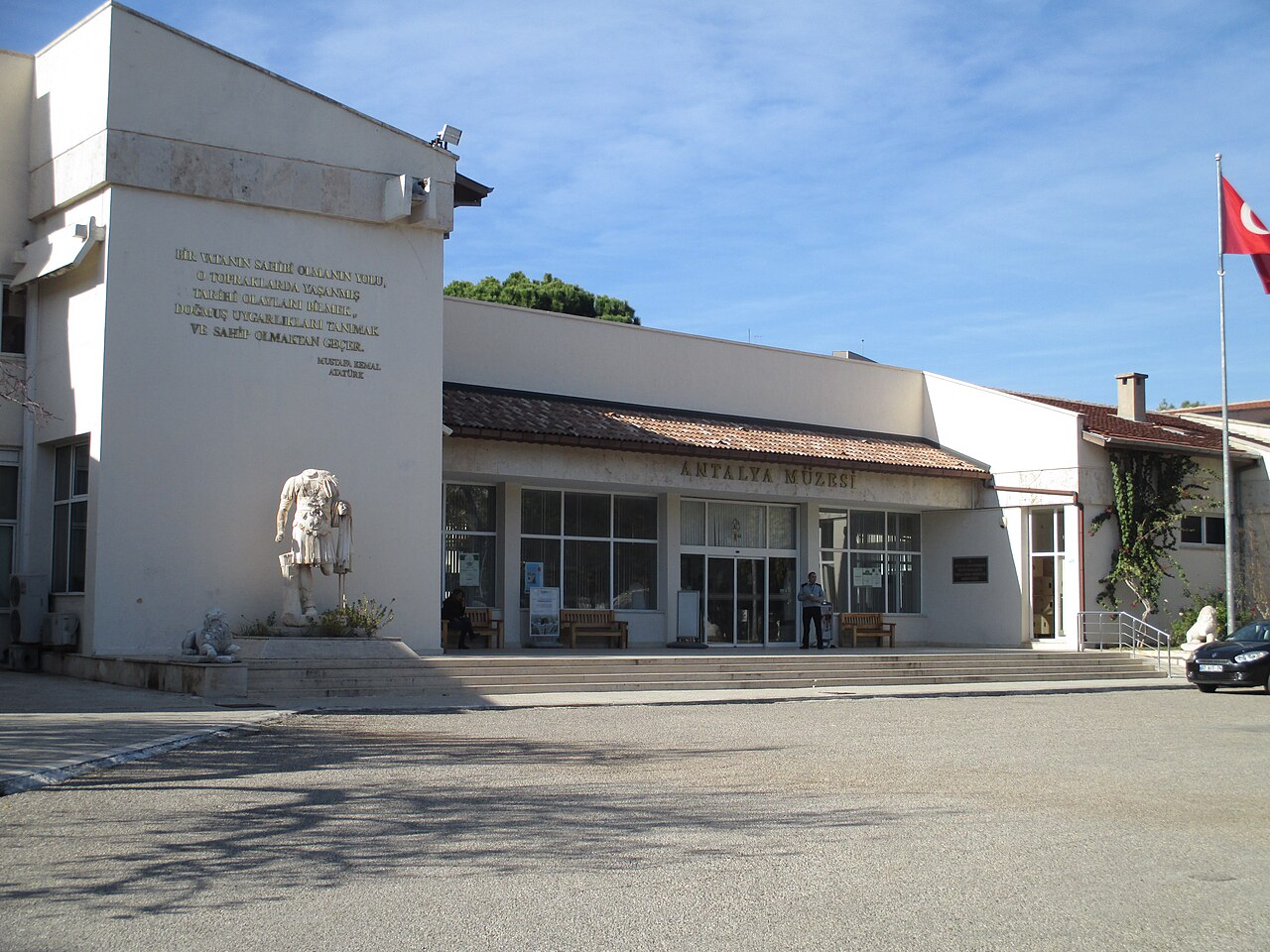
Antalya Museum is a museum in Antalya, Türkiye. Most sculpture here was excavated at nearby Perge. The upper half of the Weary Herakles returned from America in 2011. Most visitors spend 2-3 hours here. The free Lokali audio guide runs 6 minutes.
✓ Verified October 2026 · how we write these guides
Visitor facts
| Time needed | 2-3 hours |
|---|---|
| Lokali audio guide | 6 min · free |
| Type | Museum |
| Best for | History |
| Location | Antalya, Türkiye |
| Coordinates | 36.8853, 30.6803 |
| Languages | 45, in the Lokali app |
The story
The doors close behind you and the noise of the road disappears. Cool, dry air replaces the heat. Your footsteps come back at you off polished floors and high ceilings. The light is low and directed, so the marble stands out and the walls fall away into shadow. There is a faint smell of stone dust and cleaning fluid. Ahead, a row of figures taller than you are waits along both sides of a long hall.
This is the archaeological museum for the whole Antalya region, and it holds what was dug up along this coast rather than objects brought in from elsewhere. That gives it a particular strength. Almost everything here came out of the ground within a few hours of where you are standing. The building sits on the western side of the city, near the Konyaaltı road, with a tram stop directly outside and the sea a short walk downhill.
Start in the hall of gods and emperors. Most of these statues came from Perge, the ancient city on the plain east of Antalya, where a monumental bath complex and a theatre produced an extraordinary quantity of sculpture. They are Roman works, many of them copies or versions of older Greek originals. Walk between them slowly. The drapery is carved so the folds fall differently on each figure, and the marble is polished smooth on the skin.
One statue here has an unusual recent history. A large figure of Herakles, shown leaning on his club and looking exhausted, was found in two parts. The lower half turned up in excavations at Perge. The upper half had left the country and ended up in a museum collection in the United States. After a long legal and diplomatic argument, the top was returned to Türkiye in 2011 and joined to the bottom. The join is visible.
The sarcophagus rooms are the other highlight. Roman stone coffins were carved with scenes in high relief, and several here show the labours of Herakles running around the sides like panels in a comic strip. Look for the lion, the bull and the boar. Other sarcophagi use heavy carved garlands with small heads and figures between them. Lids were shaped like roofs or like couches with the dead reclining on top.
Look for the statues of a woman named Plancia Magna. She was a wealthy citizen of Perge in the second century who paid for a major rebuilding of the city gate, and inscriptions record her public offices there. Her family put up statues of her, and she put up statues of her relatives and of the imperial family. It is rare to be able to attach a name, a face and a construction project to the same person.
Another figure is easy to miss and worth finding — a dancing woman carved from two colours of marble. The body is one stone and the clothing another, cut and fitted so the garment appears to be a different fabric from the skin. Sculptors used this technique to imitate coloured cloth. Her arms and head are restored or missing, but the twist of the body still reads clearly. She also came from Perge.
The earlier galleries cover a much longer stretch of time. Stone tools, bones and simple objects come from caves in the mountains behind Antalya, including Karain, which people occupied over an enormous period. These rooms are quieter and less photographed than the statue halls. They are the reminder that this coast was inhabited for tens of thousands of years before anyone built a temple or carved a god.
Coins and small finds fill several cases. The region produced its own coinage for centuries, and the museum has been involved in some well-known recovery cases, including a major hoard of ancient silver coins found near Elmalı that was smuggled abroad and later returned to Türkiye in the 1990s. If you like small objects, slow down in these rooms — the jewellery, glass and bronze reward close attention more than the big marble does.
Further on there are Byzantine and Christian rooms with icons and church objects. Among them the museum displays material connected with Saint Nicholas, the fourth-century bishop of Myra along this same coast, whose church at Demre is one of the region's main pilgrimage sites. Bone fragments associated with him are kept here in a reliquary. The connection between the busy museum hall and that quiet church down the coast is worth holding in mind.
An ethnographic section covers more recent centuries — carpets and kilims, embroidered clothing, household tools, weapons, and objects from Ottoman-period life in the region. Allow around two hours for the whole museum if you want to see it properly. There is a shop and a café, and a garden with more stone pieces outside. Photography rules are posted at the entrance. The tram makes it easy to combine this with a walk in the old town.
One idea is worth carrying through these galleries. It is easy to picture the ancient world as plain white marble. It was not. Statues were painted in strong colours, walls were plastered and decorated, and floors carried scenes made from thousands of small cut stones. Conservators across the Mediterranean now find traces of pigment on sculpture that looks bare today. Keep that in mind as you pass the figures in the long hall, and look carefully at the mosaic floors on display.
Before you leave, go back to the hall of gods and stand at one end. Look along the row. Every one of these figures stood outdoors in a city on this plain, in strong sun, in front of people going about their day. Now they are indoors, lit and labelled, a few kilometres from where they were made. When you step outside into the heat, you will be walking in the same landscape they came from.
Key facts
What to look for
Practical tips
Common questions
How long do you need at Antalya Museum?
Plan 2-3 hours. That is the time most visitors spend at Antalya Museum. The free Lokali audio guide runs 6 minutes and is made to listen to while you walk.
Is there a free audio guide to Antalya Museum?
Yes — the Lokali app narrates Antalya Museum free of charge in 50+ languages. No ticket, tour group or subscription, and it works offline once downloaded.
Where is Antalya Museum?
Antalya Museum is in Antalya, Türkiye, at 36.8853, 30.6803. Tap the map link on this page for directions.
What should you know before visiting Antalya Museum?
Allow about two hours to see the galleries properly
What is Antalya Museum known for?
Most sculpture here was excavated at nearby Perge
On the map
Opens directions to Antalya Museum from your location.
More to see in Antalya


Hear Antalya Museum in your language
The full story, narrated, in 50+ languages. Download it before you go and it plays offline, at your own pace, with no ticket and no tour group.