
Banteay Samré
13.4421° N · 103.9590° E · Archaeological Site
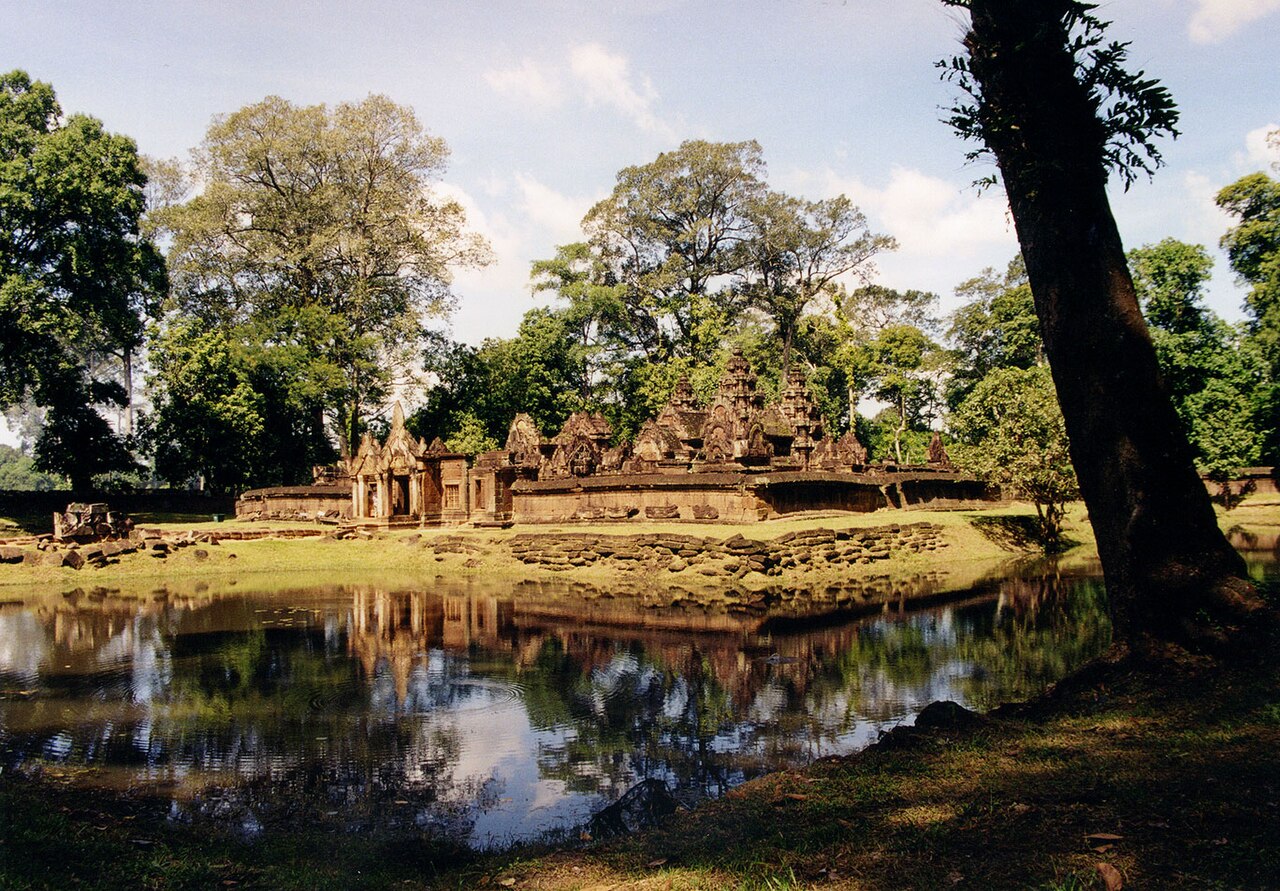
Photo: The original uploader was RichardSocher at English Wikipedia. · CC BY 2.5 · Wikimedia Commons
Banteay Samré is a temple. It is in Siem Reap, Cambodia. Built in the twelfth century during the Angkor Wat era. The free Lokali audio guide runs 7 minutes.
✓ Published October 2026 · how we write these guides
Visitor facts
| Lokali audio guide | 7 min · free |
|---|---|
| Type | Archaeological Site |
| Location | Siem Reap, Cambodia |
| Coordinates | 13.4421, 103.9590 |
| Languages | 50+, in the Lokali app |
The story
Run a hand along the outer wall here and you feel it first: laterite, the rusty red stone of the Angkor plain, full of tiny holes like a dry sponge. It is warm even in the morning. Beyond it, pale grey sandstone rises in towers and carved doorways. The air smells of dry leaves and dust, and somewhere a cicada starts its long electric buzz. You are standing at Banteay Samré, a temple that many visitors pass on the road and never stop to see.
Banteay Samré sits a short drive east of the great reservoir known as the East Baray, out in quieter country beyond the busiest temple circuits. Because it lies a little off the usual loop, the crowds here are often thin. That changes the feeling of the place completely. You can hear your own footsteps on the stone. You can stand in a doorway for a full minute without anyone moving past you. For a temple of this quality, that calm is rare.
The temple dates to the twelfth century, the same broad period that produced Angkor Wat. Scholars usually link it to the reign of Suryavarman the Second, or to the years soon after. You do not need a textbook to see the connection. Look at the central tower, shaped like a lotus bud about to open. It carries the same rounded, stacked profile that crowns Angkor Wat. In a way, this temple is a smaller sibling of that much larger monument, built in the same artistic language.
Like Angkor Wat, Banteay Samré was dedicated to Vishnu, one of the great gods of Hinduism, the preserver who keeps the universe in balance. That matters when you start reading the carvings. Many of the stories cut into the stone come from the life of Vishnu and his earthly forms, especially Krishna and Rama. The Khmer kings of this era did not only worship these gods. They tied their own power to them, and temples like this one helped to make that link visible in stone.
Now look at the plan of the place as you walk in. The temple is built as a set of nested enclosures, one wall inside another, with the sanctuary at the centre. The word banteay in Khmer means a citadel or a fortress, and you can feel why. The high walls close the world off. Once you pass inside, the outside landscape almost disappears, and your eye is pulled inward, towards the central tower.
Here is a detail many visitors miss. Inside the outer wall, the inner enclosure is surrounded by a sunken, stone-paved area. Some writers describe it as an inner moat, a ring that may once have held water. Stand at its edge and picture it filled, with the towers reflected on the surface. The galleries around it would have looked like they were floating. Today it is dry, and you can walk the paving and look up at the walls from below.
The second surprise is how complete the temple looks. That is not luck. In the twentieth century, French archaeologists rebuilt much of Banteay Samré using a method called anastylosis. In simple terms, it means taking a fallen structure apart stone by stone, recording each piece, strengthening the ground, and then putting the original blocks back in their places. New material is used only where it is truly needed. Banteay Samré was one of the early Angkor temples to receive this careful treatment.
As you move closer to the sanctuary, slow down at the pediments, the triangular panels above the doorways. The sandstone here is fine-grained, and the carvers used it well. You will find gods, warriors, and animals, set inside frames of curling leaves and flames. Some panels show battle scenes with figures crowded together. Others show a single god at the centre. Take your time. In the side light of morning or late afternoon, shadows deepen in the cuts and the figures stand out clearly.
The temple also has two small buildings that experts call libraries. They stand inside the enclosure, near the approach to the sanctuary. No one is fully sure how they were used. The name is a modern label, and some scholars think they may have held sacred objects or served ritual purposes rather than storing texts. Look at their proportions and their carved doorways. Even these secondary buildings received serious attention from the builders.
Then there is the name itself. Samré refers to a people of the region, often described as an early mountain group of Cambodia. The temple's name is usually explained through a popular legend, and it is only that, a legend. Locals tell of a humble farmer who grew cucumbers so sweet that the king claimed them. The farmer was given a spear to guard his field, and one night he struck an intruder in the dark.
The intruder, the story says, was the king himself, who had come to taste the cucumbers. In the tale, the farmer then became king. It is a story about chance, power, and a quiet man rising to the throne. No historian treats it as a record of real events. But it has been told around Angkor for generations, and it gives this calm temple a slightly mischievous character. Many visitors leave remembering the cucumbers more than the carvings.
Before you go, find a shaded spot and simply look. Notice how the red laterite of the walls and the grey sandstone of the towers sit side by side. The builders used laterite for bulk and structure, and sandstone where they wanted fine carving. Notice the moss in the joints, the lichen on the lintels, and the smooth hollows worn into thresholds by many feet. Each surface shows a different stage of the temple's long life.
As you walk back out through the gates, listen for a moment. Birds call from the trees beyond the walls. A motorbike hums somewhere along the road. The stone under your feet is warmer now than when you arrived. Turn once more towards the central tower, that rounded lotus shape against the sky, and keep the image with you. It is the same shape you will see again at Angkor Wat, in a much quieter setting.
Key facts
What to look for
Practical tips
Common questions
Is there a free audio guide to Banteay Samré?
Yes — the Lokali app narrates Banteay Samré free of charge in 50+ languages. The guide runs about 7 minutes, covers the history, what to look for on site and practical tips, and works offline once downloaded.
Where is Banteay Samré?
Banteay Samré is in Siem Reap, Cambodia, at 13.4421, 103.9590. Tap the map link on this page for directions from where you are.
What is Banteay Samré known for?
Built in the twelfth century during the Angkor Wat era. Dedicated to the Hindu god Vishnu.
What should you look for at Banteay Samré?
Lotus-bud central tower echoing Angkor Wat's profile. Red laterite walls beside grey carved sandstone. Sunken stone-paved ring around the inner enclosure.
What should you know before visiting Banteay Samré?
Visit early morning for soft light and few visitors. Combine with Banteay Srei along the same road.
When is the best time to visit Banteay Samré?
Visit early morning for soft light and few visitors.
On the map
Opens directions to Banteay Samré from your location.
More to see in Siem Reap


Hear Banteay Samré in your language
The full story, narrated, in 50+ languages. Download it before you go and it plays offline, at your own pace, with no ticket and no tour group.