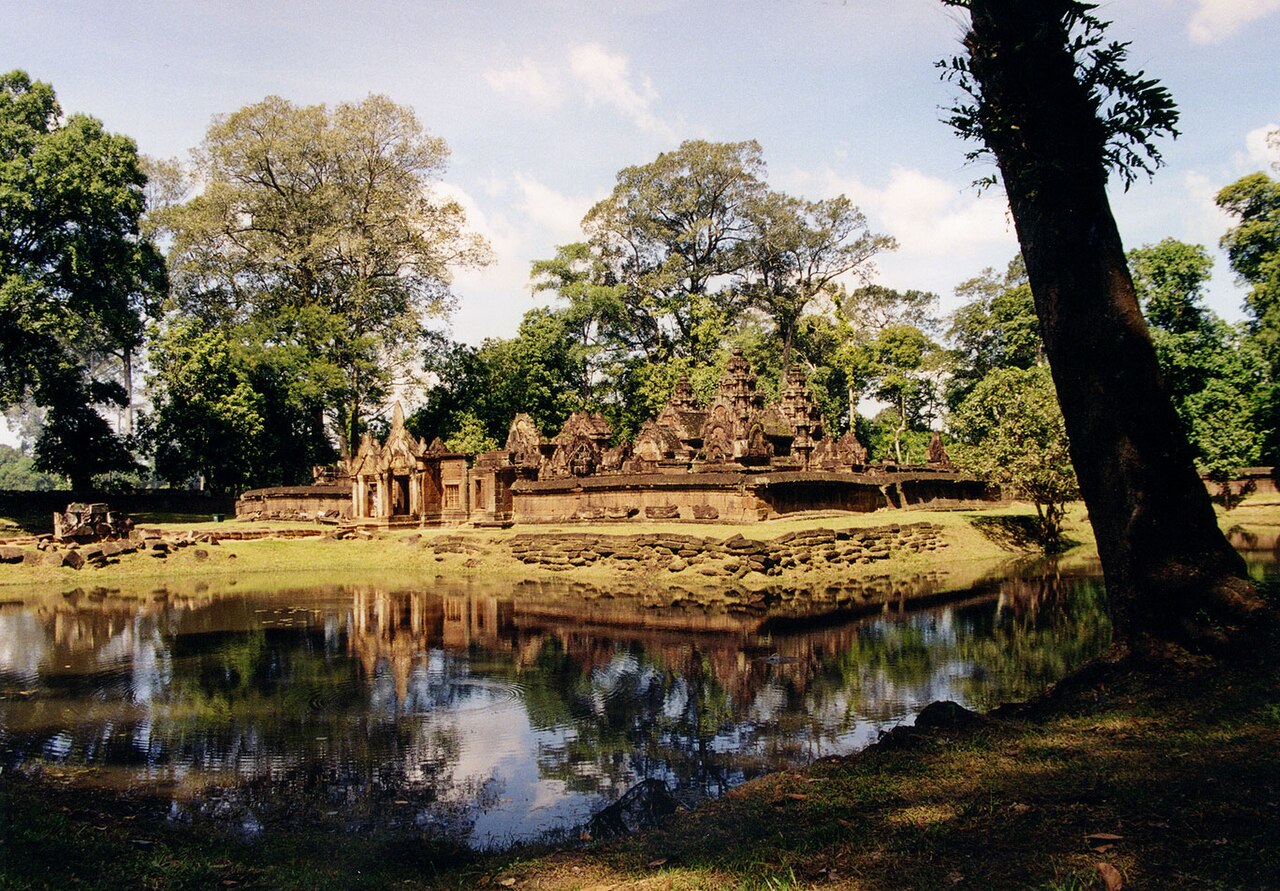
Banteay Srei Temple is a 10th-century Hindu temple renowned for its intricate pink sandstone carvings and miniature scale. It is in Siem Reap, Cambodia. Most visitors spend 2–3 hours here. The free Lokali audio guide runs 5 minutes.
✓ Verified August 2026 · how we write these guides
Visitor facts
| Time needed | 2–3 hours |
|---|---|
| Lokali audio guide | 5 min · free |
| Type | Temple |
| Best for | History |
| Location | Siem Reap, Cambodia |
| Coordinates | 13.4394, 103.9939 |
| Languages | 45, in the Lokali app |
The story
The first thing you notice is the color. While the great temples of Angkor stand in cool gray stone, this one glows. It is built of sandstone the shade of warm rose, almost pink in the low morning sun. The walls seem to hold the light. And every surface, from the door frames to the smallest corner, is covered in carving so fine it looks like lace.
This is Banteay Srei. The name in the Khmer tongue means the citadel of the women, or the citadel of beauty. It is small, far smaller than its famous neighbors. You could cross it in a few minutes. But people come from across the world to see it, drawn by the carving, which many call the finest in all of Angkor.
Banteay Srei is old, older than Angkor Wat itself. It was consecrated in the year 967, in the tenth century. That makes it more than a thousand years of age. While the giant temples nearby would not rise for generations yet, the carvers here were already at work, cutting the rose stone with a care that has rarely been matched since.
Here is something rare. Most great temples were ordered by kings. This one was not. It was built by a courtier, a learned man and royal teacher named Yajnavaraha, who served the king of his day. He dedicated the temple to Shiva, one of the high gods of the Hindu faith. A servant of the court, not a ruler, gave this place to the world.
The rose sandstone is the key to the carving. It is harder than the stone of other temples, and finer in its grain. This let the carvers cut deep and sharp, with detail that softer stone could never hold. A thousand years of wind and rain have passed, and still the lines stay crisp, as if the tools had left them only last week.
Look at the panels above the doors. These are the carved scenes the temple is known for. They show old tales of the Hindu gods. In one, a demon king shakes a sacred mountain, and the gods upon it tremble. In another, a god of love aims his arrow at the great Shiva. Each scene is packed with figures, alive with motion, held still in the stone.
Step closer to any wall. The detail does not stop. Flowers open in tight rows. Vines twist and curl across the surface. Guardian figures stand in their niches, part human and part beast, set there to turn away all harm. There is almost no bare stone to be found. Every hand's width has been worked by someone, long ago, with great patience.
Notice the small size of the doors and rooms. A tall person must stoop to pass through. Some say the scale was matched to the gods who were thought to dwell here, not to the people who came to serve them. Others simply see the care of builders who wished every part to feel close, and rich, and full.
For long years this temple stood lost in the forest, far from the main group of Angkor. Outsiders did not record it again until 1914. Soon after, a young French writer tried to steal several carvings from its walls. He was caught and brought to court. The case drew wide notice, and helped wake the world to the worth of these stones.
Banteay Srei sits some distance from the central temples, a fair drive to the northeast. For a long time this kept the crowds away. The journey was part of its quiet. Today the road is easy, and more people come, yet the place still feels apart, a small jewel set off on its own among the trees and fields.
Stand back and take in the whole. The rose walls. The three small towers. The carved guardians at their feet. The fine work runs without pause from the ground to the very tops of the towers. It is the labor of many hands, given to a god, more than a thousand years ago, and somehow it has lasted to meet your eyes today.
Before you go, look once more at a single carved flower. So small. So sharp. So far from the hand that shaped it in time. The carver is long forgotten, the name lost with the years. But the work remains, exact and patient in the rose stone, holding the morning light as it has held a thousand mornings before this one.
Key facts
What to look for
Practical tips
Common questions
How long do you need at Banteay Srei Temple?
Plan 2–3 hours. That is the time most visitors spend at Banteay Srei Temple. The free Lokali audio guide adds about 5 minutes of narration you can listen to as you walk, so it fits inside your visit rather than adding to it.
Is there a free audio guide to Banteay Srei Temple?
Yes — the Lokali app narrates Banteay Srei Temple free of charge in 50+ languages. It covers the history, what to look for on site and practical tips, and it works offline once downloaded.
Where is Banteay Srei Temple?
Banteay Srei Temple is in Siem Reap, Cambodia, at 13.4394, 103.9939. Tap the map link on this page for directions from where you are.
What should you know before visiting Banteay Srei Temple?
Visit in early light to see the rose color.
What is Banteay Srei Temple known for?
Consecrated in the year 967, in the tenth century.
What is the best time to visit Banteay Srei Temple?
The carvings depict scenes from Hindu epics with extraordinary precision — you can see individual hair strands and fabric folds.
On the map
Opens directions to Banteay Srei Temple from your location.
More to see in Siem Reap


Hear Banteay Srei Temple in your language
The full story, narrated, in 50+ languages. Download it before you go and it plays offline, at your own pace, with no ticket and no tour group.