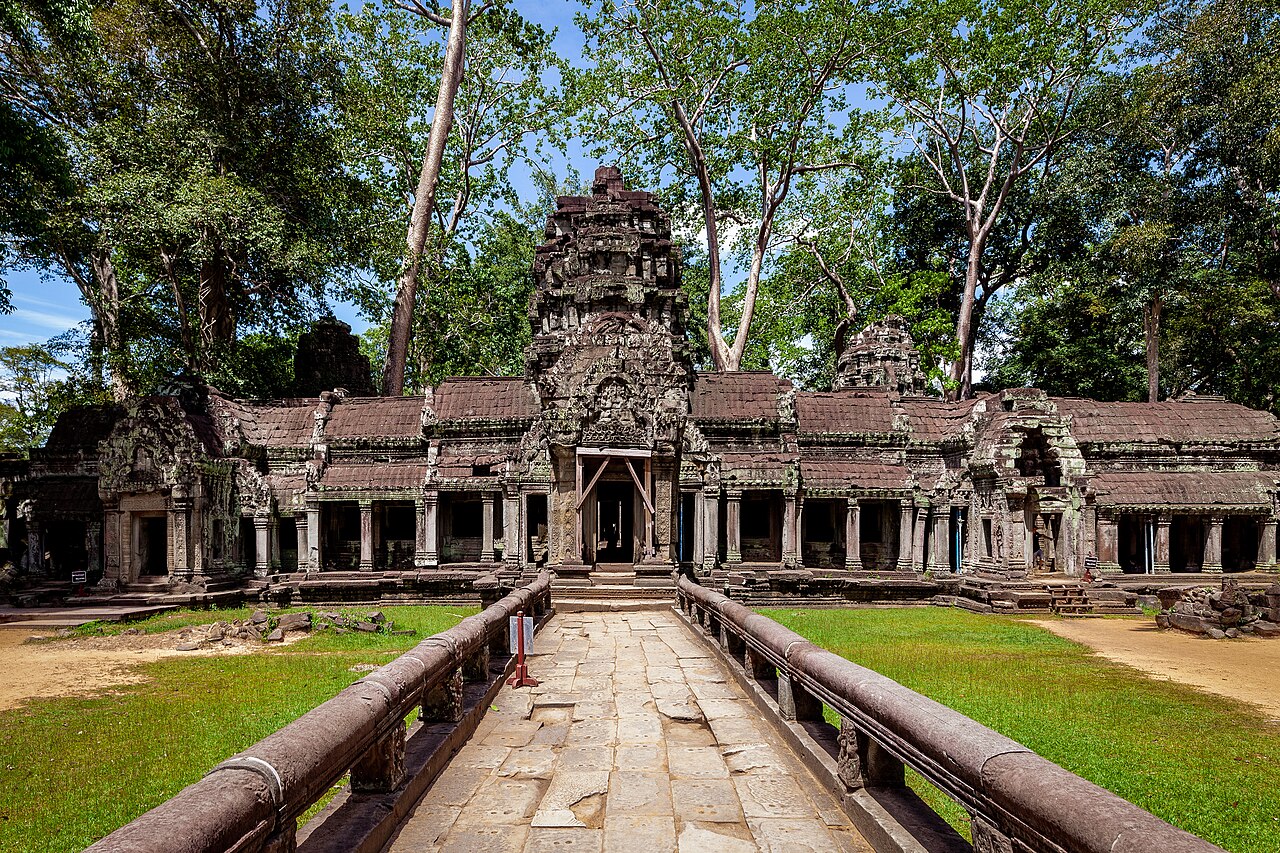
Ta Prohm Temple is a 12th-century temple overgrown with massive tree roots and vines, creating an otherworldly fusion of stone and jungle. It is in Siem Reap, Cambodia. Most visitors spend 1–2 hours here. The free Lokali audio guide runs 5 minutes.
✓ Verified August 2026 · how we write these guides
Visitor facts
| Time needed | 1–2 hours |
|---|---|
| Lokali audio guide | 5 min · free |
| Type | Temple |
| Best for | Photography |
| Location | Siem Reap, Cambodia |
| Coordinates | 13.3431, 103.8643 |
| Languages | 45, in the Lokali app |
The story
You hear it before you see it. A low creak of wood. The hush of leaves far above. Then the path turns, and there it stands. A great tree grows straight out of the temple roof. Its pale roots pour down over the stone like melted wax, gripping the walls, holding the ruin and tearing it apart at the very same time.
This is Ta Prohm. A king named Jayavarman the Seventh founded it in 1186, in the late twelfth century. Its first name was different. It meant the royal monastery. The king built it in honor of his mother. A carved stone here once recorded that thousands of people served the temple, among them many dancers and priests who kept its daily life.
Ta Prohm was more than a place of prayer. It was a monastery and a school. Monks lived and studied within these walls. The stone record speaks of great wealth held here, of gold and pearls and fine cloth, gathered in the temple's name. For a time, this was one of the richest houses of faith in the whole kingdom. The same record counts the many villages whose work went to feed and clothe all who lived inside.
Then the kingdom fell away. The court moved. The forest, held back for so long, began to return. Over the centuries, seeds fell into the cracks of the roofs and walls. They took root. They grew into the great trees you see now. Slowly, without haste, the jungle took the temple back into itself.
When scholars came to clear the ruins of Angkor, they made a choice about Ta Prohm. Most temples were cut free of the forest and braced upright. This one they chose to leave much as they found it. They wanted to show how these places looked when people first came upon them again, half swallowed by the living wood. A few props and walkways were added for safety, but the great trees were left to stand where they grew.
Look at the trees themselves. Two kinds grow here. One is the tall silk cotton tree, with smooth pale bark and roots that spread wide. The other is the strangler fig, which climbs and winds and slowly chokes its host. Their roots run along the tops of the walls and plunge to the ground like frozen falls of water.
Walk on through the broken halls. In places the roofs have come down, and blocks lie scattered where they fell. You climb over stone and duck under leaning frames. Doorways open into other doorways, deep into the shade. It is cool here, out of the sun. The light is green and soft, filtered through the leaves above.
Stop and listen for a while. Birds move in the high branches. Insects drone in the heat beyond the walls. Now and then a dry leaf lets go and drifts down to the stone. This temple feels less like a building now and more like a slow meeting of two great powers, the work of hands and the work of the forest. Neither one has won. Each year the balance shifts a little, root by root, stone by stone.
Look closely at the walls between the roots. Carvings still remain. Slim dancers stand in their niches. Flowers and patterns frame the doors. Strange beasts peer out from the corners. The fine work of the old carvers survives in many places, sheltered, oddly, by the same trees that press so hard upon the stone.
This temple drew wide notice when it appeared in a film about a treasure hunter, more than twenty years ago. Many now come hoping to see that scene with their own eyes. But try to look past the camera. What stands before you is older and deeper than any film. It asks a quiet question about time, and growth, and ruin.
There is a lesson in these stones and roots, if you care to find it. People built with great skill, and meant their work to last. The forest made no plans at all, and yet, in the end, the forest had the longer reach. Here the two are bound together now, and neither one can be removed without the fall of the other.
Before you turn back, find a place to stand alone. Rest your hand on a root, warm and smooth from the air. Above you, the tree still grows, a little each year, patient and slow. The stone holds. The wood climbs. And the two go on together, as they have for many lifetimes, here in the green and quiet shade.
Key facts
What to look for
Practical tips
Common questions
How long do you need at Ta Prohm Temple?
Plan 1–2 hours. That is the time most visitors spend at Ta Prohm Temple. The free Lokali audio guide adds about 5 minutes of narration you can listen to as you walk, so it fits inside your visit rather than adding to it.
Is there a free audio guide to Ta Prohm Temple?
Yes — the Lokali app narrates Ta Prohm Temple free of charge in 50+ languages. It covers the history, what to look for on site and practical tips, and it works offline once downloaded.
Where is Ta Prohm Temple?
Ta Prohm Temple is in Siem Reap, Cambodia, at 13.3431, 103.8643. Tap the map link on this page for directions from where you are.
What should you know before visiting Ta Prohm Temple?
Arrive early to see the trees without crowds.
What is Ta Prohm Temple known for?
Founded in 1186 by Jayavarman the Seventh.
What is the best time to visit Ta Prohm Temple?
Early morning visits reveal the temple before tour groups arrive.
On the map
Opens directions to Ta Prohm Temple from your location.
More to see in Siem Reap


Hear Ta Prohm Temple in your language
The full story, narrated, in 50+ languages. Download it before you go and it plays offline, at your own pace, with no ticket and no tour group.