
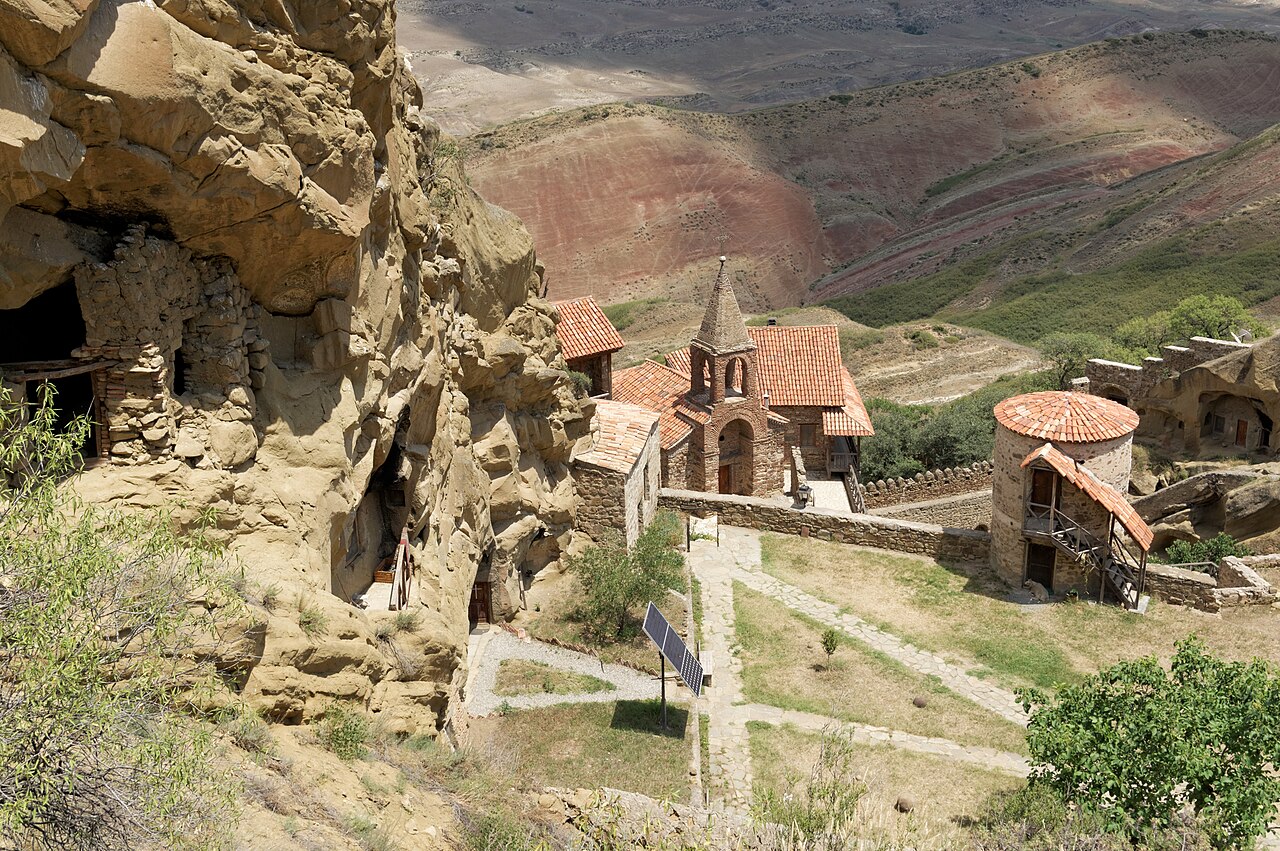
Photo: Kober · Public domain · Wikimedia Commons
Bodbe Monastery is a monastery. It is near Signagi, Georgia. Saint Nino, who converted Georgia, is buried here. The free Lokali audio guide runs 7 minutes.
✓ Published October 2026 · how we write these guides
Visitor facts
| Lokali audio guide | 7 min · free |
|---|---|
| Type | Monastery |
| Location | Signagi, Georgia |
| Coordinates | 41.6068, 45.9331 |
| Official website | sighnaghitravel.com |
| Languages | 50+, in the Lokali app |
The story
Listen first. Somewhere close, a bell rings once and fades into the valley. Cypress trees stand in dark rows on either side of the path, and the air smells of resin and warm stone. Below you, the land falls away into a wide, flat plain that runs all the way to a wall of mountains. This is Bodbe, a short drive from the hilltop town of Sighnaghi, in Georgia's eastern wine region of Kakheti. It is one of the most important places of pilgrimage in the whole country.
The reason for that importance is one woman. Her name was Nino, and Georgians call her the Enlightener. According to Georgian tradition, she came from Cappadocia, a region in what is now central Turkey, in the early fourth century. She arrived in the kingdom of Kartli, the heart of ancient Georgia, carrying a cross made from vine branches. Legend says she tied the branches together with strands of her own hair. That simple cross of vine is still the symbol of the Georgian Orthodox Church today.
Nino's preaching is linked to the conversion of King Mirian and Queen Nana. Their conversion made Christianity the official religion of the kingdom, around the 330s. That places Georgia among the very first Christian states in the world. It is easy to forget how early this was. Rome itself was only just turning toward the new faith at the same moment. So the story you are standing inside is very old... older than most of the cathedrals of Western Europe by many centuries.
After years of travel and preaching, Nino came to this hillside. She died here, and she was buried here. Tradition says King Mirian then built a small church over her grave. Another popular tale says the king wanted to move her body to his capital at Mtskheta, near modern Tbilisi. But, so the story goes, the coffin could not be lifted. Nino stayed where she had chosen to rest. Whatever you believe about that tale, the result is clear. For Georgians, this ground has been sacred for well over a thousand years.
Now look at the main church in front of you. It is a modest building, not a soaring cathedral. Its core is generally dated to around the ninth century, but it has been rebuilt and repaired many times since. Stone, brick and plaster sit side by side in the walls, and each layer comes from a different age of repair. Next to it rises the bell tower, a later addition from the nineteenth century. Notice how its style looks lighter and more decorative than the old church beside it.
Inside, the light is low, and the air is heavy with candle smoke and incense. Pilgrims move quietly. Many of them head straight for one place — the small chapel that holds Saint Nino's tomb. You will see people kneel, touch the stone, and cross themselves three times. Some leave candles. Some simply stand in silence for a long time. Take a moment to watch, without rushing. For many visitors, this is the emotional centre of the whole journey to Kakheti.
Here is something many visitors miss. Bodbe was not only a place of prayer. For centuries it was also the seat of a bishop, and it held real weight in the life of the Kakhetian kingdom. Kakheti was an independent Georgian kingdom for a long stretch of the late Middle Ages. Historians often note that its kings were crowned here, at Nino's resting place. Think of it this way: royal power in this valley was blessed beside the grave of the woman who brought the faith.
The nineteenth century brought big changes. Georgia had been absorbed into the Russian Empire, and the monastery was restored and rebuilt during that period. In the late nineteenth century, Bodbe became a convent for nuns. That is still its role today. Then came the Soviet era. Like many religious sites across the Soviet Union, the monastery was closed, and for decades the buildings served other purposes. Religious life only returned openly as the Soviet system came to an end.
In 1991, the year Georgia regained its independence, nuns came back to Bodbe. Since then, the convent has been restored step by step. The gardens you walk through are the work of that revival. Look at the neat flower beds, the trimmed hedges, the clean stone paths. The nuns care for all of it. You may see them working in the grounds, or crossing quietly between buildings. Please keep your camera low when they pass. This is their home, not only a place to visit.
Now walk to the edge of the terrace, and look out. That wide plain below you is the Alazani Valley, one of the oldest wine landscapes in the world. Georgia has made wine for around eight thousand years, often in large clay jars called qvevri, buried in the ground. On a clear day, the line on the far horizon is the Greater Caucasus range. In late spring and autumn, snow often caps its peaks. In summer, heat haze can soften the whole view into layers of blue.
There is one more surprise, and it lies below you. A long stone stairway leads down the hillside through the trees. At the bottom is a holy spring linked to Saint Nino. Tradition says it began to flow after her prayers. Many pilgrims walk down to bathe in a small font of cold spring water there. Long white shirts are usually available for bathers. The walk down is pleasant and shaded. The climb back up is steep, so take your time and carry water.
A few words on dress, because this is a working convent. Women are expected to cover their heads and wear a skirt. Men should wear long trousers, and shoulders should be covered for everyone. If you arrived unprepared, don't worry. Scarves and wrap skirts are usually offered near the entrance. Inside the church, speak softly and avoid photography during services. These small gestures matter here, and the nuns and pilgrims will notice the respect.
Before you leave, stand still for one more minute. Look at the cypress trees, the rough stone of the old church, the bell tower against the sky. Behind you is a grave that has drawn people up this hill for well over a thousand years. In front of you, the vineyards of the valley run toward the mountains. As you walk back down the path, listen again for the bell... and notice how quiet the hillside becomes after it fades.
Key facts
What to look for
Practical tips
Common questions
Is there a free audio guide to Bodbe Monastery?
Yes — the Lokali app narrates Bodbe Monastery free of charge in 50+ languages. The guide runs about 7 minutes, covers the history, what to look for on site and practical tips, and works offline once downloaded.
Where is Bodbe Monastery?
Bodbe Monastery is near Signagi, Georgia, at 41.6068, 45.9331. Tap the map link on this page for directions from where you are.
What is Bodbe Monastery known for?
Saint Nino, who converted Georgia, is buried here. Georgia adopted Christianity around the 330s.
What should you look for at Bodbe Monastery?
Saint Nino's tomb in a small chapel inside. The nineteenth-century bell tower beside the old church. Mixed stone and brick layers in the church walls.
What should you know before visiting Bodbe Monastery?
Bring a headscarf or borrow one at the entrance. Wear comfortable shoes for the steep spring stairway.
When is the best time to visit Bodbe Monastery?
Carry water for the climb back from the spring.
On the map
Opens directions to Bodbe Monastery from your location.
More to see near Bodbe Monastery
Hear Bodbe Monastery in your language
The full story, narrated, in 50+ languages. Download it before you go and it plays offline, at your own pace, with no ticket and no tour group.