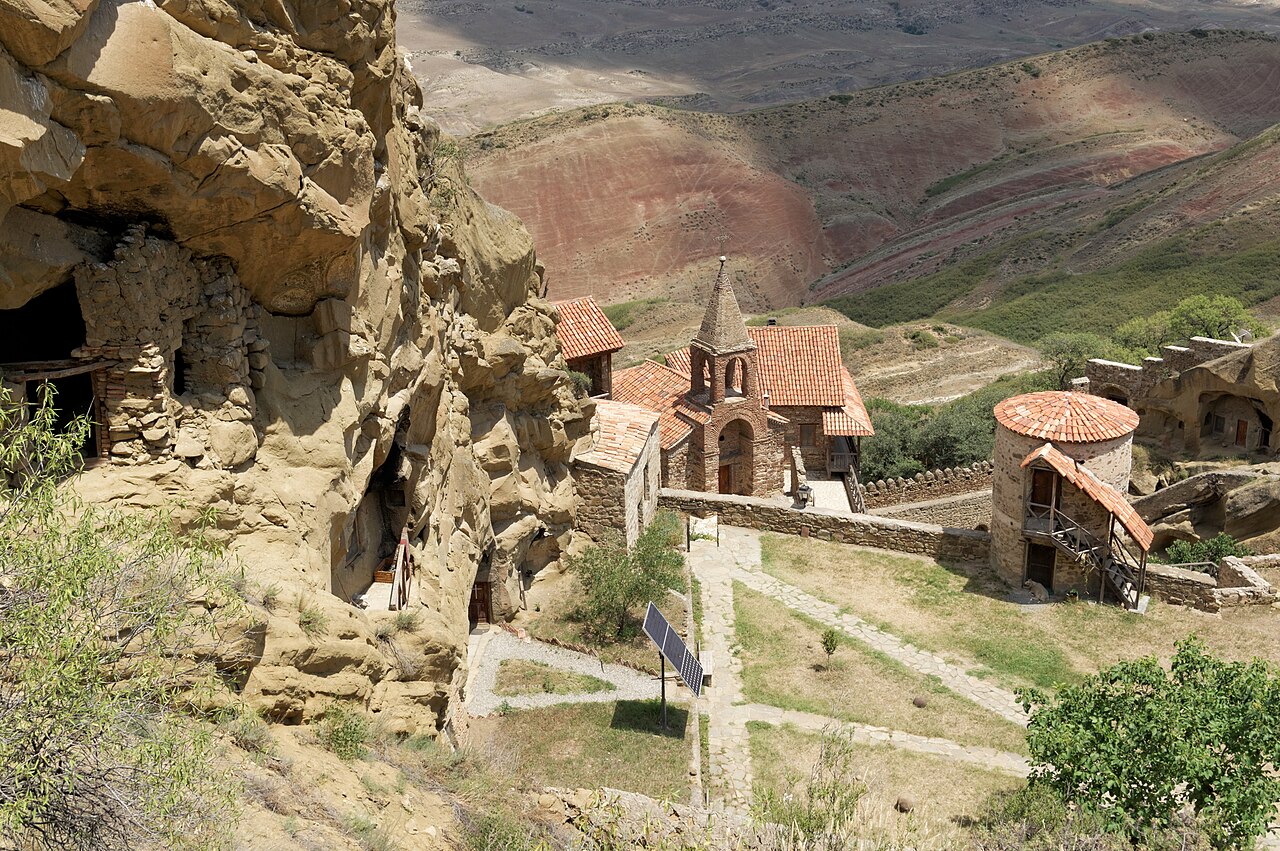
David Gareja Monastery Complex
41.5667° N · 45.3333° E · Monastery
David Gareja Monastery Complex is a sprawling monastic complex carved into red sandstone cliffs 70 km southeast of Tbilisi, dating to the 6th century. It is in Tbilisi, Georgia. Most visitors spend 4–6 hours here. The free Lokali audio guide runs 5 minutes.
✓ Verified August 2026 · how we write these guides
Visitor facts
| Time needed | 4–6 hours |
|---|---|
| Lokali audio guide | 5 min · free |
| Type | Monastery |
| Best for | History |
| Location | Tbilisi, Georgia |
| Coordinates | 41.5667, 45.3333 |
| Languages | 45, in the Lokali app |
The story
The land flattens and empties as you drive southeast from Tbilisi, green hills giving way to bare, folded ridges the colour of sand and rust. After more than an hour the road gives out and cave mouths and a low cluster of buildings appear in the rock. This is David Gareja, a monastery carved into a semi-desert ridge on the very edge of the country.
Its founding reaches back to the sixth century. The complex was begun by David, one of the group of monks remembered as the Assyrian Fathers, who came to spread Christianity across the region and chose this harsh, waterless place precisely because it was hard and far from everything. What started as a few hand-dug cells grew, over centuries, into a scattered chain of monasteries strung along the ridge.
The monks did not build so much as carve. Cells, chapels, refectories, and storerooms were cut straight into the soft sandstone, so the architecture is the cliff itself. The main, lower monastery, called the Lavra, is partly active again, built against the rock in terraces around a precious spring of water.
From the Lavra a footpath climbs over the ridge to Udabno, a line of caves higher up, and this climb is where the real reward waits. The Udabno caves hold medieval wall paintings on their curved rock ceilings — saints, donors, and biblical scenes in worn earth colours. They are among the older surviving fresco cycles of their kind in the region, and reaching them takes a genuine walk and a steep scramble.
The setting is the other half of the experience, and for many visitors it is the larger half. From the upper path the land falls away into a vast, almost empty expanse of striped semi-desert, green and starred with flowers in spring, scorched gold by late summer. There is little shade, few buildings, and almost no sound beyond wind and insects.
That emptiness is exactly what drew the monks. They came here to be far from the world, to live simply against the rock, and to pray in silence. Standing on the ridge, with the caves behind you and the steppe stretching to the horizon, the choice stops seeming strange and starts to make a kind of sense.
There is a complication worth knowing before you go. Part of the complex lies along a contested stretch of border, and access to the upper Udabno caves has at times been restricted, watched, or closed outright. The situation shifts, so it is wise to check the current state of things before you count on doing the full hike, and to respect any signs or instructions on site.
This is not a quick stop. Plan a half day at least, and often a full one, counting the drive each way from Tbilisi. Many visitors come with a tour or a hired driver, since public transport is sparse and the last stretch of road is rough.
Come prepared for the conditions. Bring plenty of water, sturdy shoes for the loose, steep path, and real sun protection — a hat and cover, because there is almost no shade on the ridge. Spring is the kindest season, when the hills turn green and the heat stays bearable; high summer can be punishing in the open.
Give the place the slow attention it asks for. Look closely at the faded frescoes, run your hand along the cut sandstone of a cell, and sit for a while with the view. The point of David Gareja is not a single monument but the whole experience of distance, silence, and human marks left on an empty land.
The journey itself is part of the visit, for better and worse. The road crosses long stretches of open country with few villages and little traffic, and the final approach is rough, so most people come with a tour or a hired driver rather than by public transport. Set the whole day aside and treat the drive as part of the experience.
What survives here is fragile. The frescoes have suffered from weather, time, and long stretches of neglect, and some have been damaged or lost outright. Looking at the worn paint, it is worth remembering how much has already gone, and treading and touching carefully so that what remains lasts longer.
When you finally turn back toward Tbilisi, the noise and crowding of the city will feel very far away, which is precisely the effect the monks were after. Carry a little of the ridge's silence back with you; it makes the return to the capital feel like stepping back into a different, louder century.
Key facts
What to look for
Practical tips
Common questions
How long do you need at David Gareja Monastery Complex?
Plan 4–6 hours. That is the time most visitors spend at David Gareja Monastery Complex. The free Lokali audio guide adds about 5 minutes of narration you can listen to as you walk, so it fits inside your visit rather than adding to it.
Is there a free audio guide to David Gareja Monastery Complex?
Yes — the Lokali app narrates David Gareja Monastery Complex free of charge in 50+ languages. It covers the history, what to look for on site and practical tips, and it works offline once downloaded.
Where is David Gareja Monastery Complex?
David Gareja Monastery Complex is in Tbilisi, Georgia, at 41.5667, 45.3333. Tap the map link on this page for directions from where you are.
What should you know before visiting David Gareja Monastery Complex?
Plan a half to full day from Tbilisi.
What is David Gareja Monastery Complex known for?
Founded in the sixth century by David Garejeli.
What is the best time to visit David Gareja Monastery Complex?
The drive takes about 1.5 hours each way.
On the map
Opens directions to David Gareja Monastery Complex from your location.
More to see in Tbilisi


Hear David Gareja Monastery Complex in your language
The full story, narrated, in 50+ languages. Download it before you go and it plays offline, at your own pace, with no ticket and no tour group.