Narikala Fortress
📍 About this place
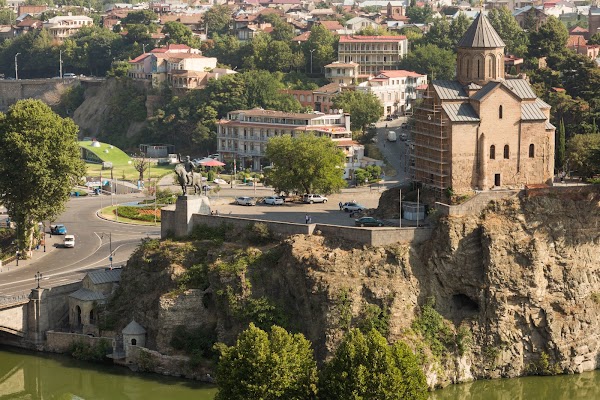
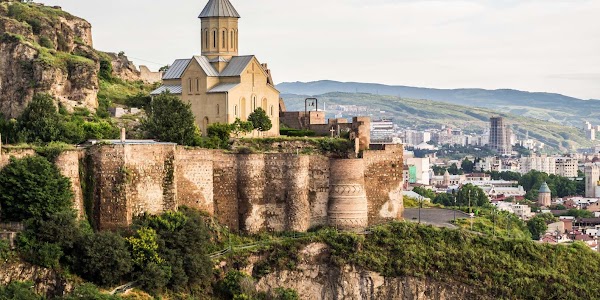
Ancient fortress overlooking Tbilisi from a rocky hill above the old town, with origins in the 4th century. The current stone walls date mostly to the 17th century and offer commanding views of the Mtkvari River and the city skyline.
📖 The story
The stone underfoot is warm from the sun, polished smooth by centuries of footsteps. You are standing inside Narikala Fortress, a sprawling citadel that has watched over Tbilisi since the fourth century. The air smells faintly of dust and wild herbs, and the wind carries distant voices from the old town below.
Narikala began as a Persian fortification, built when Tbilisi was a strategic prize on the Silk Road. The name itself is disputed — some say it comes from a Mongol phrase meaning impregnable fortress, others trace it to older Persian roots. What is certain is that every empire that swept through the Caucasus left its mark here. Persians raised the first walls, Arabs expanded them in the seventh and eighth centuries, Mongols reinforced the towers, and Georgians rebuilt sections after earthquakes and sieges.
The fortress sprawls across two hills, connected by a long defensive wall that snakes down toward the Mtkvari River. Walk along the ramparts and you will see how the builders used the natural topography — steep drops on three sides, narrow approaches that forced attackers into killing zones. The stone is a patchwork of repairs, darker blocks from medieval rebuilds sitting beside pale modern restoration. Each layer tells a different chapter of the city's survival.
In the lower courtyard stands the Church of Saint Nicholas, a small octagonal building with a silver dome. It was reconstructed in the late nineteen-nineties on the foundations of a thirteenth-century church that was destroyed by fire. Step inside and the interior is simple, almost austere — whitewashed walls, a handful of frescoes, the smell of beeswax candles. The acoustics are remarkable; even a whisper carries.
The upper fortress, perched on the higher hill, offers the best views in Tbilisi. From here you can see the entire bowl of the old town — the tiled roofs of the sulphur baths, the brick towers of Sioni Cathedral, the modern glass span of the Peace Bridge cutting across the river. On clear days the Caucasus Mountains rise in the distance, their peaks still white with snow in early summer. This is where the city makes sense as a geography, a crossroads pressed between mountains and river.
Narikala never fell by direct assault. Armies bypassed it, negotiated around it, waited for earthquakes to do the work. A massive quake in 1827 brought down much of the upper fortress, and the Russian imperial authorities chose not to rebuild — they had already moved the city's administrative centre elsewhere. What you see today is a ruin stabilized, a monument preserved but not fully restored.
The climb up from the old town is steep, about twenty minutes on foot through winding lanes and staircases. Many visitors take the cable car from Rike Park, which glides over the rooftops and deposits you near the fortress gate. Either way, bring water — there is no shade on the upper ramparts, and the stone reflects heat in summer. The fortress is open all hours, and locals often come at dusk when the city lights begin to flicker on below.
Look for the original Persian masonry in the lower walls — darker, tighter-fitted blocks that have survived fifteen centuries. Notice the arrow slits angled to cover the approach from the river, and the cisterns carved into bedrock to hold rainwater during sieges. In the upper courtyard, a section of wall has been left deliberately unrestored, the crumbled stone a reminder of the 1827 earthquake.
As you walk back toward the gate, pause and listen. The fortress is quiet now, but the city hums below — car horns, market vendors, the hiss of a bus pulling away. Narikala has outlasted empires, but the life it once defended continues, louder and messier and more stubborn than any wall.
💡 Key facts
👀 What to look for
🎒 Practical tips
❓ Common questions
- How long do you need at Narikala Fortress?
- Plan around 1-2 hours on site. The free Lokali audio guide (~8 min) tells the story as you explore.
- Is there a free audio guide to Narikala Fortress?
- Yes. The Lokali app narrates Narikala Fortress for free in your own language — history, what to look for and practical tips, right at the site.
- What should you know before visiting Narikala Fortress?
- Cable car from Rike Park avoids the steep climb Bring water — no shade on the upper ramparts Visit at dusk for city lights and cooler temperatures.
🗺️ On the map
Opens directions to Narikala Fortress from your location.