Lokali
EN
Tbilisi › Metekhi Church
Metekhi Church, Tbilisi
Tbilisi, Georgia

Metekhi Church

~9 minCathedral★ 4.7

📍 About this place

Medieval church on the right bank of the Mtkvari River, rebuilt in the 5th century on the site where Saint Nino brought Christianity to Georgia. The equestrian statue of King David the Builder stands in front, a symbol of Georgian national identity.

📖 The story

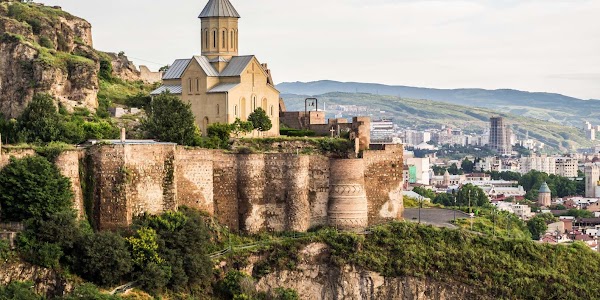
The stone beneath your feet is warm from the sun, and the air smells faintly of river water and wild herbs growing between the rocks. You are standing on a cliff edge above the Mtkvari River, and the church behind you — honey-coloured brick, compact and solid — has watched over this bend in the water for more than seven hundred years.

Metekhi Church was built in the thirteenth century, during the reign of the Georgian monarchs who made Tbilisi their capital. The name itself means "around the palace" — this cliff was once the site of a royal residence, and the church served as the private chapel for the kings and queens who ruled from here. The palace is gone now, erased by centuries of invasion and reconstruction, but the church remains.

The brick you see today is not the original. Metekhi has been destroyed and rebuilt multiple times — by Mongol raids, Persian sieges, Ottoman armies. Each reconstruction left its mark. The current structure dates largely from the late seventeenth century, but fragments of the older walls survive inside, and if you walk around the exterior you will notice patches where the masonry shifts in colour and texture, showing where one era ends and another begins.

Inside, the church is small and dim, lit only by narrow windows set high in the walls. The interior follows the Georgian cross-in-square plan — four pillars support a central dome, and the arms of the cross extend outward to form the nave and transepts. The frescoes that once covered the walls have mostly flaked away, leaving only ghostly traces of pigment in the plaster. What remains is the stone itself, cool and smooth, shaped by hands that worked without power tools or scaffolding.

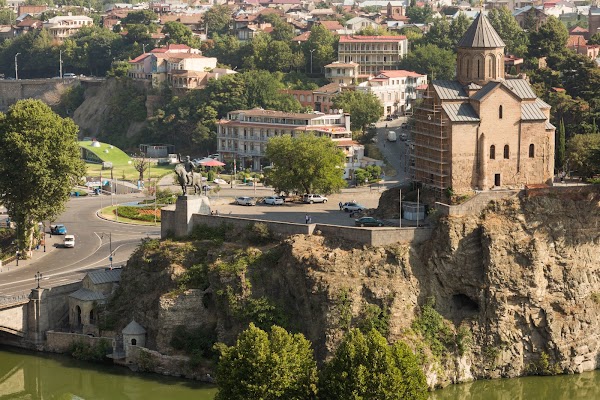
Just outside the church stands a bronze equestrian statue of King Vakhtang Gorgasali, the legendary founder of Tbilisi. The statue was erected in 1967, during the Soviet period, and it faces east toward the old town. Vakhtang sits upright in the saddle, his horse poised as if about to step forward off the cliff. The statue is a favourite with photographers — the silhouette against the sky, the river far below, the jumble of balconies and rooftops spreading across the opposite bank.

For much of the nineteenth and early twentieth centuries, Metekhi was not a church at all. The Russian Empire converted it into a prison, and political dissidents were held in cells built into the cliff below the sanctuary. The writer Maxim Gorky spent time here, as did other revolutionaries and intellectuals. The church was returned to religious use only in the nineteen-nineties, after Georgian independence.

The view from the terrace is one of the finest in Tbilisi. To your left, the domes of the Narikala Fortress rise above the ridge. Straight ahead, the Old Town cascades down the hillside in layers of wooden balconies, terracotta roofs, and narrow streets that twist like threads. Below, the Mtkvari River curves wide and slow, its surface catching the light. In the evening, when the sun drops behind the western hills, the whole valley turns gold.

Walk around the perimeter of the terrace and you will find small details that most visitors miss — a carved cross in the stone parapet, a fragment of medieval masonry embedded in the modern retaining wall, wildflowers growing in the cracks where the cliff meets the church foundation. These are the textures that make the place real, the evidence of time passing not in centuries but in seasons, in rain and wind and the slow work of roots.

The church is still active. On Sunday mornings, the doors open and the interior fills with candlelight and the sound of Georgian polyphonic chanting — low male voices layered in harmonies that seem to come from the stone itself. If you happen to be here during a service, step quietly inside and stand near the back. The acoustics are extraordinary.

As you leave, notice the cobblestones underfoot, worn smooth by centuries of footsteps. The path that leads down from the church connects to the old town below, winding through narrow lanes where laundry hangs between balconies and cats sleep in doorways. The city spreads out around you, alive and ordinary, and the church on the cliff becomes just one more layer in the long story of this place.

💡 Key facts

Built in the thirteenth century as a royal chapel
Destroyed and rebuilt multiple times across seven centuries
Served as a tsarist prison in the nineteenth century
Returned to religious use after Georgian independence in 1991
Name means around the palace in Georgian

👀 What to look for

Patches of older masonry in different colours on exterior walls
Traces of faded frescoes inside the dim sanctuary
Carved cross in the stone parapet on the terrace
Wildflowers growing between the cliff and church foundation
Four pillars supporting the central dome inside

🎒 Practical tips

Visit on Sunday morning to hear Georgian polyphonic chanting
Best light for photography in late afternoon
Wear sturdy shoes for the cobblestone terrace
Combine with a walk down to the old town below

❓ Common questions

How long do you need at Metekhi Church?
Plan around 30-45 min on site. The free Lokali audio guide (~9 min) tells the story as you explore.
Is there a free audio guide to Metekhi Church?
Yes. The Lokali app narrates Metekhi Church for free in your own language — history, what to look for and practical tips, right at the site.
What should you know before visiting Metekhi Church?
Visit on Sunday morning to hear Georgian polyphonic chanting Best light for photography in late afternoon Wear sturdy shoes for the cobblestone terrace.

🗺️ On the map

Opens directions to Metekhi Church from your location.

Google PlayGet the app
Listen to this guide — free, in your language.Get the app