
Tbilisi Botanical Garden is a park in Tbilisi, Georgia. Sprawling across a steep ravine on the city's eastern edge, this garden showcases Georgian flora and exotic plants arranged by region and climate zone. Most visitors spend 1–2 hours here. The free Lokali audio guide runs 5 minutes.
✓ Verified August 2026 · how we write these guides
Visitor facts
| Time needed | 1–2 hours |
|---|---|
| Lokali audio guide | 5 min · free |
| Type | Park |
| Best for | Family |
| Location | Tbilisi, Georgia |
| Coordinates | 41.7068, 44.8180 |
| Languages | 45, in the Lokali app |
The story
Step through the gate behind the fortress and the city simply drops away. The traffic noise fades, the air cools under the trees, and a path leads down into a green gorge with a stream running along its floor. This is the Tbilisi Botanical Garden, a long ribbon of cultivated and wild planting folded into a valley right beside the old town, yet almost hidden from it.
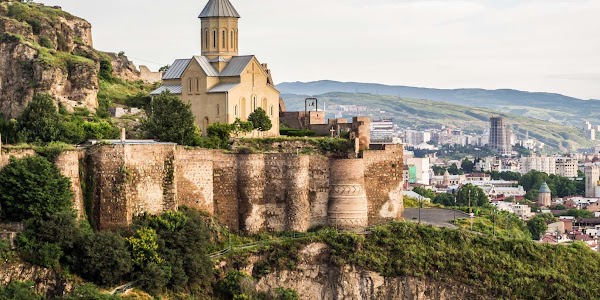
Its position is the first surprise. The garden fills the gorge on the far side of the Narikala ridge, so although it sits within a short walk of the fortress and the bathhouse quarter, it feels entirely removed from the streets. Paths run along the stream on the valley floor and climb the wooded slopes on either side.
Planting here has deep roots. The valley held gardens long before it became a formal botanical garden in the middle of the nineteenth century, and since then it has grown into one of the larger gardens of its kind in the region. Over generations it has gathered plants from across Georgia and from far beyond its borders.
The collections are laid out to be walked through rather than simply viewed. They are arranged along the valley by region and habitat, moving through trees, flowering shrubs, and seasonal beds, so that a walk becomes a slow tour of different landscapes. Labels and signs help, but much of the pleasure is simply in the variety underfoot and overhead.
Water gives the garden its centre. A waterfall drops over rock partway up the gorge, fed by the same stream that runs the length of the valley, and both an old stone bridge and a higher footbridge cross the water. From the bridges you get long views down the green gorge, with the fortress walls sometimes visible on the ridge above.
The garden changes completely with the seasons, so the time of year shapes what you see. Spring brings blossom and fresh growth; early summer is lush and deeply shaded; autumn turns the slopes gold and red. High summer can be hot and dry on the open paths, which is the one time a morning visit clearly beats an afternoon one.
This is a place for walking, not for quick looking. The paths climb and dip, some of them steep and uneven, and you can easily spend a couple of hours wandering without covering the whole garden. Comfortable shoes and a bottle of water make a real difference, because the upper sections involve genuine climbing.
There is more life here than the plants alone. The gorge draws birds and insects, and the mix of cultivated and half-wild ground makes it feel more like a living valley than a manicured park. On a quiet weekday morning the loudest sounds are often the stream and the birdsong rather than the city.
Getting in is easy from either end. You can enter from a gate near the bathhouse district at the mouth of the valley, or come in from above, near the fortress, and walk down. Entering from the top and leaving from the bottom, or the reverse, lets you see the whole length without retracing your steps.
A few practical points help. There is a small entrance fee, and the garden keeps daytime hours that shorten in winter, so it is worth checking before a late-afternoon visit. Weekday mornings are the quietest; weekends bring local families out along the lower paths.
The garden has long been a place of escape for city people, not only a scientific collection. Families picnic on the lawns, couples walk the quieter upper paths, and on hot days the shade and the sound of the stream draw locals up from the streets below. It works as a public garden as much as a botanical one.
From certain points the two worlds meet in a single view: the cultivated valley in the foreground and the fortress walls or the old-town roofs on the ridge above. Those overlaps are the best reminder of how close this green gorge sits to the heart of the city.
Find a bench by the stream, or a spot on the upper path with a long view down the gorge, and let the quiet do its work for a while. It is striking how completely a green valley can hide a few steps from a busy old town. When you climb back out to the fortress, the city returns all at once, and it feels louder than before for the contrast.
Key facts
What to look for
Practical tips
Common questions
How long do you need at Tbilisi Botanical Garden?
Plan 1–2 hours. That is the time most visitors spend at Tbilisi Botanical Garden. The free Lokali audio guide adds about 5 minutes of narration you can listen to as you walk, so it fits inside your visit rather than adding to it.
Is there a free audio guide to Tbilisi Botanical Garden?
Yes — the Lokali app narrates Tbilisi Botanical Garden free of charge in 50+ languages. It covers the history, what to look for on site and practical tips, and it works offline once downloaded.
Where is Tbilisi Botanical Garden?
Tbilisi Botanical Garden is in Tbilisi, Georgia, at 41.7068, 44.8180. Tap the map link on this page for directions from where you are.
What should you know before visiting Tbilisi Botanical Garden?
Wear good shoes for the steep, uneven paths.
What is Tbilisi Botanical Garden known for?
Set in a gorge behind the Narikala ridge.
What is the best time to visit Tbilisi Botanical Garden?
The garden is quietest on weekday mornings.
On the map
Opens directions to Tbilisi Botanical Garden from your location.
More to see in Tbilisi


Hear Tbilisi Botanical Garden in your language
The full story, narrated, in 50+ languages. Download it before you go and it plays offline, at your own pace, with no ticket and no tour group.