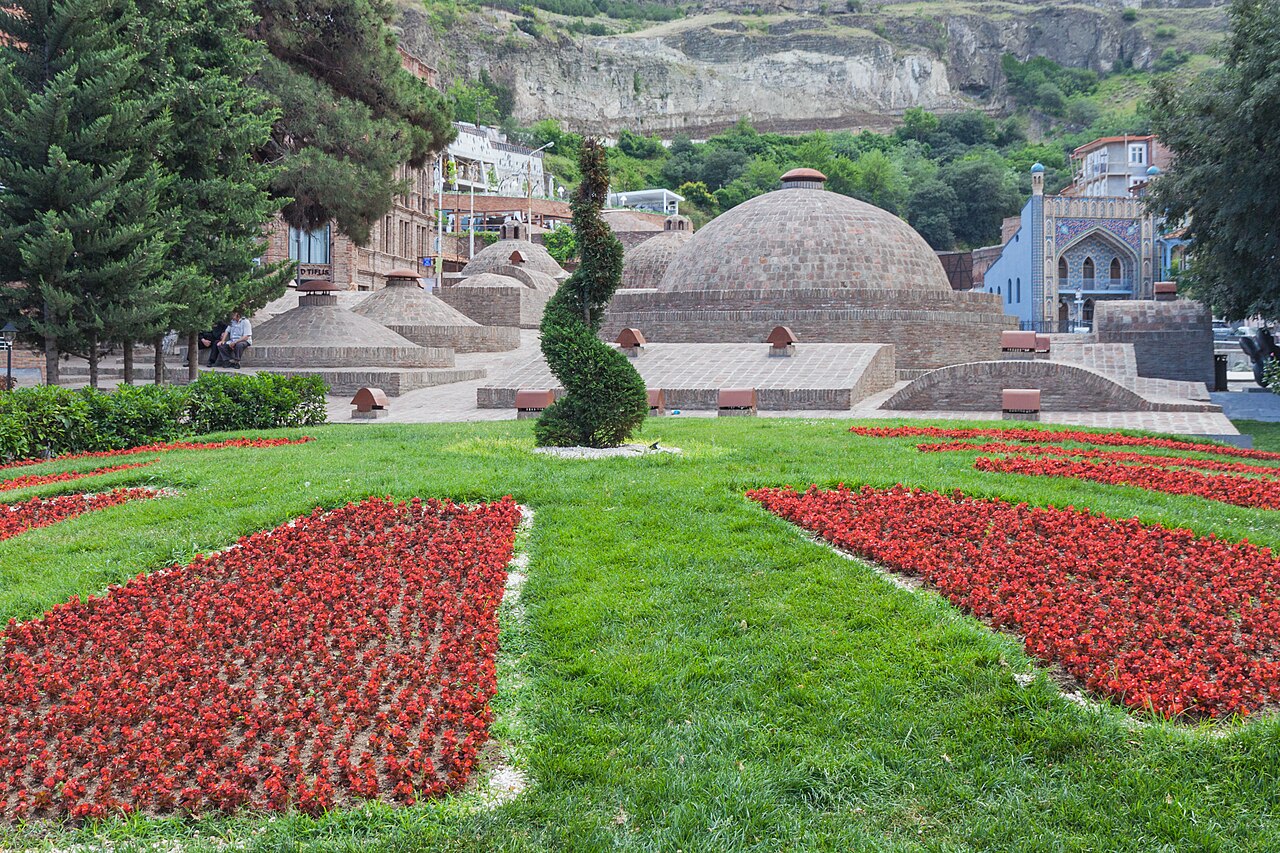
Abanotubani is a neighborhood in Tbilisi, Georgia. Historic bathing quarter below Narikala Fortress, known since medieval times for its natural sulphur springs. Most visitors spend 1–2 hours here. The free Lokali audio guide runs 5 minutes.
✓ Verified August 2026 · how we write these guides
Visitor facts
| Time needed | 1–2 hours |
|---|---|
| Lokali audio guide | 5 min · free |
| Type | Neighborhood |
| Best for | Local life |
| Location | Tbilisi, Georgia |
| Coordinates | 41.7165, 44.8040 |
| Languages | 45, in the Lokali app |
The story
The air carries a faint smell of sulphur and warm stone. Thin steam rises from rows of low brick domes set into the ground. Somewhere beneath your feet, water is moving. This is Abanotubani, the bath district, and it is the oldest corner of Tbilisi. People have come here to bathe for longer than the city has had a name.
The domes around you are not buildings. They are roofs. The baths themselves lie below ground, dug down toward the source of the heat. Each dome covers a private chamber filled with naturally hot water. Small glass openings at the top let in a little daylight. The warmth stays trapped inside, close to the spring that feeds it.
These springs are the reason the whole city exists. An old legend explains how. In about the fifth century, King Vakhtang Gorgasali was hunting in this wooded valley. In one telling, his falcon chased a pheasant, and both birds dropped into a steaming spring. In another, a wounded deer fell into the hot water and walked out healed. When the king saw it, he understood what lay under the ground.
The king ordered a city raised on this very spot. He gave it the name Tbilisi. The word comes from the old Georgian word for warm. So the city carries these springs inside its own name. Every time someone says Tbilisi, they are naming the warm water under their feet, whether they know it or not.
People bathed here long before any king arrived. Archaeologists have found traces of bathing from the Bronze Age, thousands of years ago. The written record begins in the fifth century. For more than a thousand years, this small district has done one steady thing. It has offered hot water to tired travellers, traders, and citizens.
The water has a strong mineral smell. That sharp scent of sulphur is part of the place, not a fault in it. The water leaves the rock already hot, between 38 and 45 degrees Celsius. Many people believe the minerals soothe the skin and ease aching muscles. Whether the cures are real or not, the deep, settling heat certainly is.
Look closely at the brick domes again. Their rounded shape is not purely Georgian. It carries Persian influence from the Safavid period, roughly the sixteenth to eighteenth centuries. Tbilisi sat on the trade roads between large empires. The city took in styles, foods, and words from every direction. These quiet domes are one record of that long exchange.
At its height, this district was far busier than it looks today. By the end of the thirteenth century, the city counted around 65 baths. In the medieval centuries, more than 60 bathhouses worked here at once. Today fewer than a dozen still open their doors. The ones that remain carry the memory of all the others that have closed.
One bathhouse stands out from the plain brick domes. It has a tall front covered in blue and patterned tiles. This is the Orbeliani Bath, which many people simply call the colourful bath. Its facade looks closer to a mosque than to a bathhouse. Visitors often stop here to take a photograph before stepping inside for their own soak.
Walk past the last domes and the city seems to fall away. A narrow gorge opens behind the baths, with a small waterfall at its end. The path follows a stream between tall rock walls. In a few steps you move from stone lanes to a pocket of green. Many visitors are surprised to find it so close to the centre.
Writers have praised these baths for a very long time. The Russian poet Alexander Pushkin came here in 1829. Afterward he wrote that he had never seen anything more luxurious than the baths of Tbilisi. His line still follows the district around. Many visitors arrive partly to test the poet's bold claim against their own skin.
Inside, an attendant may offer you a scrub. The treatment is firm, brisk, and thorough. You lie on warm stone while the dust of the road is worked away. People leave the chambers pink, loose, and unusually calm. This simple ritual has barely changed across the many generations who have passed through these same rooms.
Stand quietly for a moment above the domes. Below you, the same water that once stopped a king is still rising through the rock. The heat that gave the city its name is warming someone, somewhere under your feet, right now. Few places let you stand so close to their own beginning. Here, the start of Tbilisi is still gently flowing.
Key facts
What to look for
Practical tips
Common questions
How long do you need at Abanotubani?
Plan 1–2 hours. That is the time most visitors spend at Abanotubani. The free Lokali audio guide adds about 5 minutes of narration you can listen to as you walk, so it fits inside your visit rather than adding to it.
Is there a free audio guide to Abanotubani?
Yes — the Lokali app narrates Abanotubani free of charge in 50+ languages. It covers the history, what to look for on site and practical tips, and it works offline once downloaded.
Where is Abanotubani?
Abanotubani is in Tbilisi, Georgia, at 41.7165, 44.8040. Tap the map link on this page for directions from where you are.
What should you know before visiting Abanotubani?
Bring flip-flops and a towel, or rent them on site.
What is Abanotubani known for?
Legend dates the spring discovery to the fifth century.
What is the best time to visit Abanotubani?
The air smells of sulphur and steam.
On the map
Opens directions to Abanotubani from your location.
More to see in Tbilisi

Hear Abanotubani in your language
The full story, narrated, in 50+ languages. Download it before you go and it plays offline, at your own pace, with no ticket and no tour group.