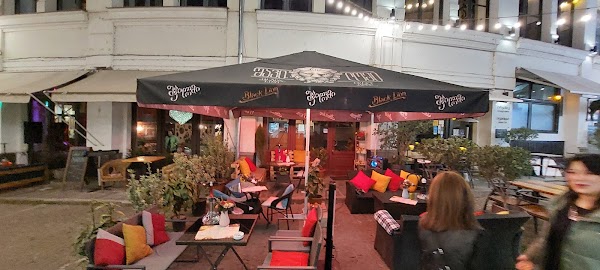
Shardeni Street Market is a lively open-air market in central Tbilisi selling fresh produce, spices, dried fruits, and Georgian specialities. It is in Tbilisi, Georgia. Most visitors spend 30–45 min here. The free Lokali audio guide runs 5 minutes.
✓ Verified August 2026 · how we write these guides
Visitor facts
| Time needed | 30–45 min |
|---|---|
| Lokali audio guide | 5 min · free |
| Type | Market |
| Best for | Local life |
| Location | Tbilisi, Georgia |
| Coordinates | 41.7165, 44.8010 |
| Languages | 45, in the Lokali app |
The story
A short, paved lane in the heart of the old town fills, by late afternoon, with the clink of cups and the smell of coffee from a dozen open terraces. This is Shardeni Street, the social spine of the historic quarter. It is worth saying plainly: this is a lane of cafes, bars, galleries, and craft stalls rather than a traditional covered market, so come for the atmosphere rather than the shopping.
The street takes its name from a visitor of long ago. It honours Jean Chardin, a seventeenth-century French traveller and jeweller whose name Georgians render as Shardeni, and who left some of the most detailed early European accounts of the region. The lane that carries his name has become one of the most sociable corners of the old town.
What you actually find here is browsing rather than a bazaar. Along the street and in the lanes branching off it, small shops and stalls sell crafts, jewellery, ceramics, enamel work, and souvenirs, mixed in among the cafes and wine bars. It is the kind of place to wander slowly with a coffee in hand, picking things up, rather than to shop from a list.
The street keeps a clear daily rhythm. Mornings are quiet, with staff setting out chairs and hosing down the stone. Through the afternoon the terraces fill, and by evening Shardeni becomes one of the liveliest spots in the old town, busy with diners and drinkers well into the night. Each part of the day shows you a different version of the lane.
Its setting is part of the appeal. Shardeni sits close to the Sioni cathedral, the bathhouse district, and the river, so it falls naturally into a walk through the old town. Restored merchant houses rise on either side, their carved balconies overhanging the narrow paving and throwing shade across the terraces below.
The architecture rewards a look upward, as so often in this city. Many of the buildings are old houses given new life as restaurants and galleries, and the balconies, brackets, and painted details above the cafe awnings are older and finer than the modern signage at street level suggests.
It is, frankly, a place that knows it is for visitors, and prices reflect that. Eating and drinking on Shardeni itself runs higher than in less central spots, so it is worth a short walk into the quieter side streets for cheaper and often more local food and drink, then returning to the main lane for the atmosphere.
The galleries are an easy thing to overlook between the cafes. Several small art and craft spaces open onto the street, showing Georgian painting, enamel, and design, and they make a pleasant, free detour from eating and drinking. Stepping into one is a good way to escape the crowd for a few minutes.
Timing shapes the experience. Come in the late afternoon to catch the shift from quiet to lively, when the light softens and the terraces fill. Warm evenings and weekends are the busiest, with the lane at its most sociable; if you prefer calm, an earlier visit lets you see the street and its buildings without the crowd.
Treat it as a pause rather than a sight to tick off. Shardeni is somewhere to sit, watch, and rest your feet between the churches, the baths, and the river, all of which are only a few steps away. Used that way, it earns its place in a day in the old town.
The lane is a relatively recent success story. Once a quieter corner of the old town, it was restored and given over to cafes and galleries, and it has become a model for how the historic centre has been polished up for visitors. That history explains both its charm and its slightly staged feel.
It also makes a useful base after dark. When many of the churches and museums have closed, Shardeni and the lanes around it stay open and lively, so it is a natural place to end a day in the old town with a meal or a glass of Georgian wine.
Find a terrace, order something, and watch the flow of people between the squares for a while; that, more than any single shop or building, is the real point of Shardeni. When you have had your fill of the crowd, the quiet old-town lanes are only a few steps away in any direction, ready to pull you back into the older, slower city.
Key facts
What to look for
Practical tips
Common questions
How long do you need at Shardeni Street Market?
Plan 30–45 min. That is the time most visitors spend at Shardeni Street Market. The free Lokali audio guide adds about 5 minutes of narration you can listen to as you walk, so it fits inside your visit rather than adding to it.
Is there a free audio guide to Shardeni Street Market?
Yes — the Lokali app narrates Shardeni Street Market free of charge in 50+ languages. It covers the history, what to look for on site and practical tips, and it works offline once downloaded.
Where is Shardeni Street Market?
Shardeni Street Market is in Tbilisi, Georgia, at 41.7165, 44.8010. Tap the map link on this page for directions from where you are.
What should you know before visiting Shardeni Street Market?
Browse the craft and souvenir stalls with a coffee.
What is Shardeni Street Market known for?
A pedestrian lane of cafes, bars, and craft stalls.
What is the best time to visit Shardeni Street Market?
Go mid-morning when stalls are fully stocked.
On the map
Opens directions to Shardeni Street Market from your location.
More to see in Tbilisi


Hear Shardeni Street Market in your language
The full story, narrated, in 50+ languages. Download it before you go and it plays offline, at your own pace, with no ticket and no tour group.